

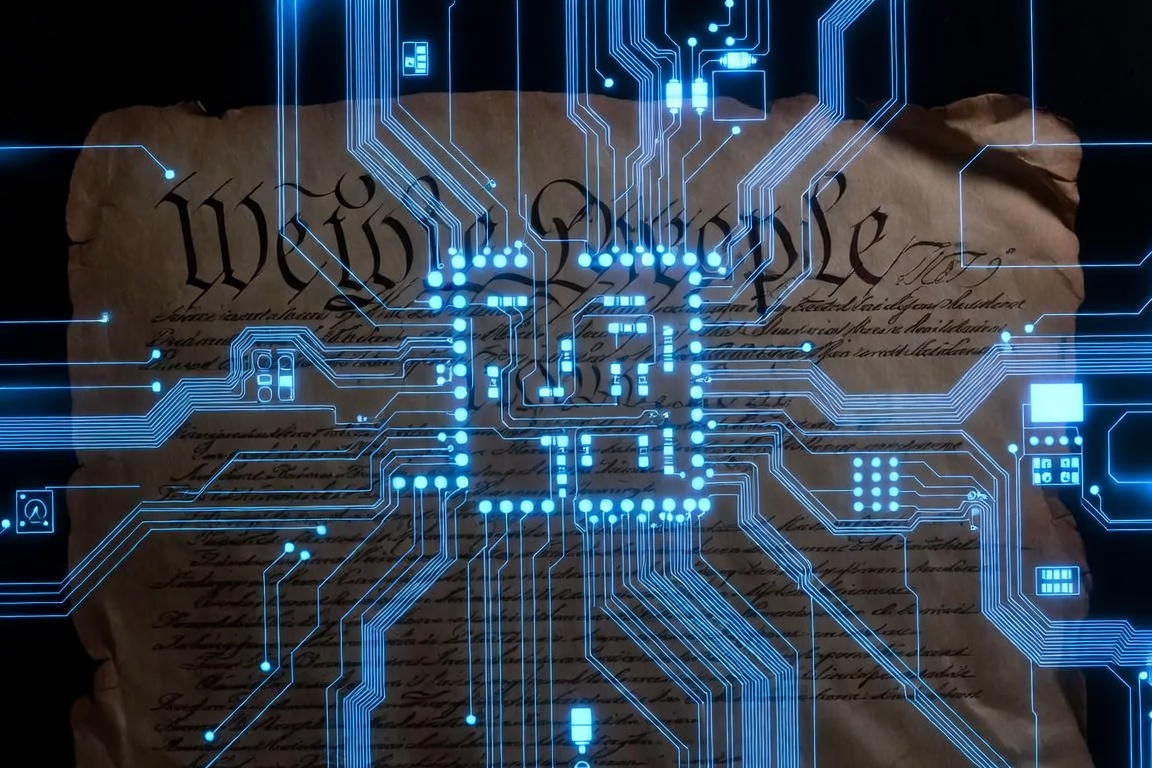
Artificial intelligence is advancing at a pace that America’s legal system has never before experienced. Every major technological revolution—from the telegraph and telephone to radio, television, and the internet—eventually forced the United States Supreme Court to define constitutional boundaries. AI promises to be different not merely because it is another communications technology, but because it increasingly functions as a creator, advisor, decision-maker, and, in some cases, a substitute for human judgment.
The Supreme Court now appears headed toward an unavoidable collision with artificial intelligence. The only remaining question is whether the Court will establish principled constitutional guardrails that preserve liberty or allow fragmented lower-court decisions to create uncertainty that chills innovation while expanding government authority.
Several recent legal disputes illustrate just how quickly these issues are arriving. Courts are already confronting questions involving AI-generated copyright claims, attorney use of generative AI in litigation, privilege protections for AI conversations, and the legal responsibilities of companies that develop foundation models. The Supreme Court has thus far declined to resolve some of these issues directly, leaving lower courts to build a patchwork of precedents that may eventually demand nationwide clarification.
The constitutional questions extend far beyond intellectual property.
The First Amendment may become the first battlefield.
Is AI-generated speech entitled to constitutional protection? Does the government possess authority to regulate machine-generated political commentary? If Congress attempts to require licensing, watermarking, or mandatory disclosure for every AI-generated statement, where does government regulation end and censorship begin?
The Founders deliberately established broad protections for speech because they understood that governments inevitably seek greater authority over public discourse. While artificial intelligence introduces new challenges—including misinformation, deepfakes, and synthetic propaganda—the constitutional solution cannot simply be government bureaucrats deciding which computer-generated ideas Americans are permitted to read.
The answer should not depend upon whether speech originated from a keyboard typed by a human or one assisted by an algorithm. What ultimately matters is whether a human exercises responsibility for publishing it. The Constitution protects citizens, not software. Yet citizens should remain free to use increasingly sophisticated tools to express ideas.
Then comes the Fourth Amendment.
Modern AI systems consume staggering quantities of personal information. Smartphones, online purchases, search histories, location records, financial transactions, emails, medical information, and social media interactions increasingly become training material or inputs for AI-driven decision making.
Law enforcement agencies are understandably attracted to AI’s ability to identify suspects, predict criminal activity, analyze surveillance footage, and connect massive quantities of data in seconds rather than months.
Those capabilities also create unprecedented opportunities for government overreach.
The Framers drafted the Fourth Amendment precisely because they rejected generalized searches. AI makes generalized searches technologically effortless. The Supreme Court will eventually need to determine whether constitutional protections designed to prevent unreasonable searches can survive an era in which algorithms continuously analyze virtually every digital footprint Americans leave behind.
The Fifth and Fourteenth Amendments present equally difficult questions.
Increasingly, AI assists judges, parole boards, insurers, employers, lenders, and government agencies in making decisions affecting individual rights. Although these systems promise greater efficiency, they also introduce opacity. Many advanced models cannot fully explain how they reached particular conclusions.
Due process requires that citizens understand governmental decisions affecting their liberty or property.
If neither the government nor the software developer can explain why an AI denied benefits, recommended incarceration, or influenced sentencing, meaningful due process becomes increasingly difficult to guarantee.
Conservatives have traditionally viewed concentrated governmental power with skepticism. Artificial intelligence should not alter that instinct.
An opaque algorithm exercising governmental authority deserves at least as much scrutiny as any unelected bureaucrat.
Perhaps the most immediate legal battlefield involves liability.
Should AI developers bear responsibility whenever users misuse their products?
History suggests caution.
Automobile manufacturers are generally not liable because someone commits a robbery using a car. Telephone companies are not responsible because criminals coordinate illegal activity over phone lines. Internet providers generally are not liable simply because users violate copyright or publish unlawful content.
Recent Supreme Court reasoning emphasizing that general-purpose technologies are not automatically responsible for every downstream misuse may significantly influence future AI litigation. That principle recognizes an important distinction between intentionally facilitating unlawful conduct and merely providing a broadly useful technology capable of both beneficial and harmful applications.
Expanding liability too aggressively would produce unintended consequences.
Every startup developing innovative AI applications would face enormous litigation risk before releasing a single product. Investors would become increasingly reluctant to fund innovation. Compliance costs would favor only the largest technology companies capable of maintaining armies of attorneys.
Ironically, regulations promoted as restraints on Big Tech often strengthen Big Tech by making competition prohibitively expensive.
Conservatives generally recognize this dynamic because similar patterns have emerged throughout financial regulation, healthcare regulation, and environmental compliance.
Artificial intelligence is unlikely to prove different.
Copyright law provides another illustration.
The Supreme Court recently declined to hear Stephen Thaler’s effort to recognize an AI system as the legal author of copyrighted artwork, leaving intact lower-court rulings that human authorship remains a fundamental requirement of copyright law. That outcome preserves an important principle: technology remains a tool, while legal accountability rests with human beings.
That distinction matters.
If machines become legal creators, inventors, or speakers independent of human responsibility, long-established legal doctrines become increasingly unstable.
America’s constitutional framework presumes human accountability.
Artificial intelligence should enhance human capability, not replace human responsibility.
The Supreme Court’s coming AI cases will therefore concern far more than software.
They will determine whether constitutional liberties remain durable when technology advances faster than legislation. They will define the limits of administrative authority over emerging technologies. Most importantly, they will reveal whether America’s constitutional framework continues to restrain government power even during periods of rapid technological disruption.
The Constitution has successfully adapted to railroads, telephones, aviation, radio, television, nuclear power, and the internet without abandoning its foundational principles.
Artificial intelligence deserves the same approach.
Innovation should remain free.
Rights should remain human.
Government should remain constitutionally limited.
If the Court remembers those principles, America’s legal system can navigate the AI revolution without sacrificing either technological leadership or constitutional liberty.