

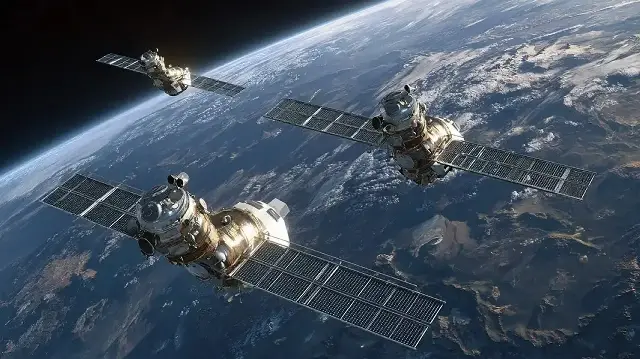
Russia’s effort to build its own battlefield-capable alternative to Starlink has suffered another significant setback, with none of the 16 Rassvet satellites launched July 19 reaching their intended operational altitude by August 31. Many remain hundreds of kilometers below their planned orbit, while some are already experiencing orbital decay and at least two appear headed toward atmospheric reentry. The difficulties come as Moscow races to establish an independent satellite communications network after Russian forces lost access to Starlink terminals being used in Ukraine. Although the struggling constellation can still provide limited communications windows useful for drones and precision strikes, Russia faces major technical, manufacturing, and launch-capacity obstacles to deploying the hundreds of satellites required for continuous coverage.
Key Takeaways
- Russia’s second 16-satellite Rassvet launch has fallen well short of expectations, with the spacecraft failing to reach intended operational altitudes and some already suffering orbital decay, raising questions about the reliability and longevity of the fledgling constellation.
- Moscow has a strong military incentive to accelerate Rassvet because satellite communications can support drones, targeting, command-and-control operations, and precision strikes, particularly after Russian forces lost access to Starlink connectivity previously obtained through unofficial channels.
- Russia’s greatest obstacle may be scale: achieving continuous coverage over Ukraine could require roughly 200 to 300 operational satellites, while limited Soyuz-2.1b launch capacity, satellite failures, production constraints, and Ukrainian attacks on supporting infrastructure could substantially delay that objective.
In-Depth
Russia’s attempt to field a homegrown satellite communications network capable of replacing Starlink on the battlefield has encountered a serious technical setback. The second group of 16 Rassvet satellites, launched July 19, had not reached its expected operational altitude by August 31. Many remained between roughly 300 and 400 kilometers, where atmospheric drag can shorten satellite life and increase fuel demands. At least two were reportedly approaching reentry.
The failure matters because reliable low-Earth-orbit communications have become an increasingly important component of modern warfare. Russian forces previously exploited Starlink terminals acquired through unofficial channels, but access was curtailed earlier this year. Moscow has consequently faced added pressure to accelerate Rassvet, despite the engineering and launch-capacity challenges involved in building a large constellation.
Russia’s ambitions remain substantial. Plans call for hundreds of satellites, while Ukrainian officials have estimated that roughly 200 to 300 functioning spacecraft could be necessary for continuous coverage over Ukraine. Yet Russia’s dependence on the Soyuz-2.1b launch vehicle constrains how quickly those numbers can be achieved. The first March deployment also produced mixed results, with only 12 of 16 satellites reaching sustainable operational altitudes by late July.
That does not make Rassvet irrelevant. Even limited connectivity could support drones, targeting, command links, and precision strikes during available coverage windows. The larger lesson is that Russia retains the resources and strategic incentive to pursue independent military communications, but translating that ambition into a resilient, Starlink-scale network remains a formidable industrial and technological challenge under wartime conditions and mounting sanctions.
Sources
- https://understandingwar.org/research/russia-ukraine/russian-offensive-campaign-assessment-august-31-2026/
- https://www.reuters.com/business/media-telecom/russia-rolling-out-starlink-style-network-faster-than-expected-kyiv-says-2026-08-10/
- https://www.wired.com/story/meet-rassvet-russias-answer-to-starlink/
- https://www.euronews.com/next/2026/09/01/russias-starlink-copycat-has-failed-so-far-but-still-threatens-ukraine/