

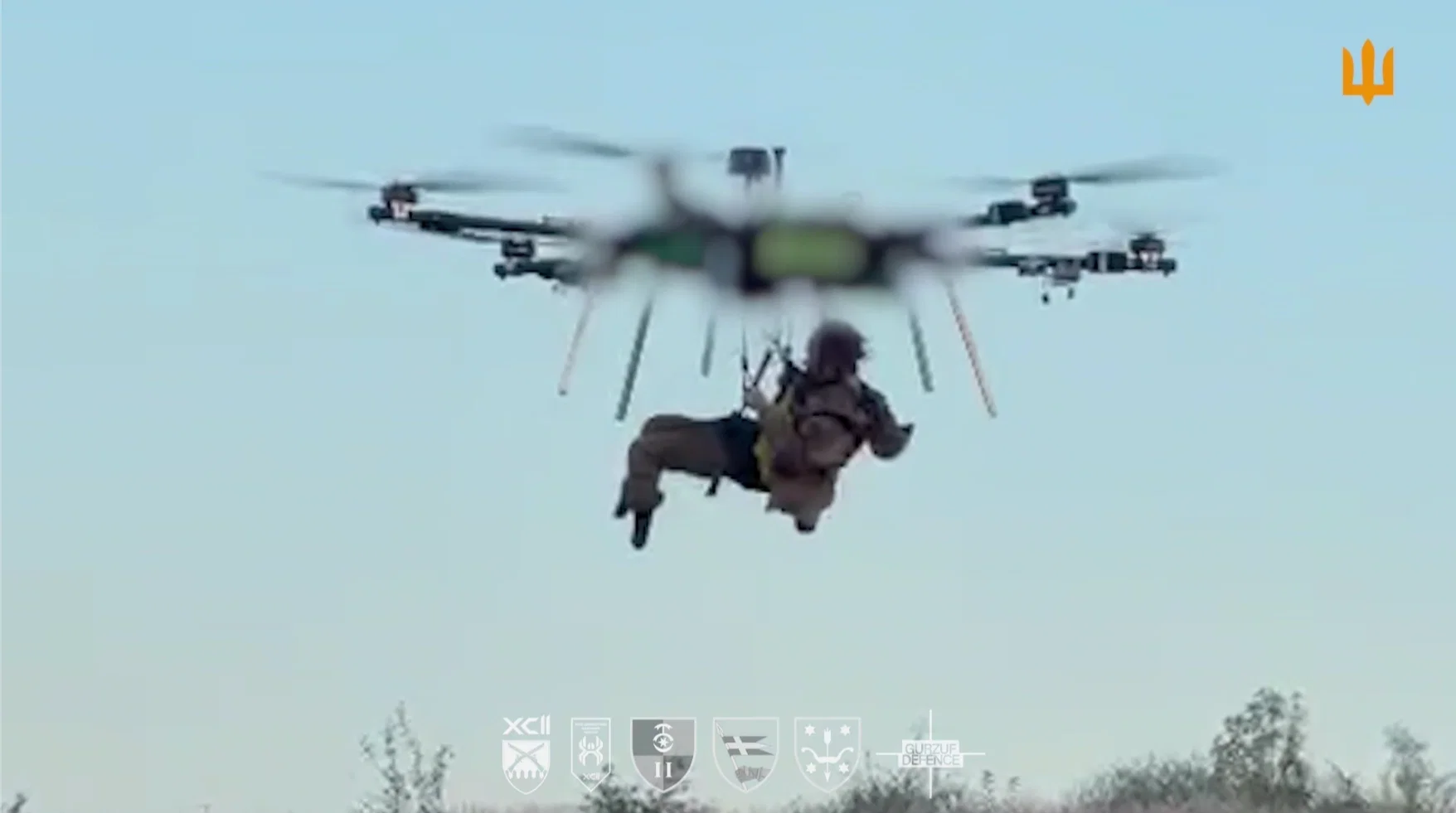
Ukrainian forces have reportedly conducted the world’s first aerial drone evacuation of a wounded soldier directly from an active battlefield, demonstrating a potentially transformative advancement in military rescue operations. The mission involved a heavily modified, six-rotor Ayudag-6 drone that transported an injured infantryman to safety after Russian surveillance drones and extensive minefields made conventional evacuation impossible. The soldier, who had reportedly spent nearly 500 days at a frontline position, was rescued through a coordinated operation involving multiple Ukrainian military units and a domestic drone manufacturer. The successful mission highlights how unmanned technology is expanding beyond reconnaissance and combat into lifesaving operations, potentially reshaping battlefield medicine while reducing the exposure of military personnel to enemy fire.
Key Takeaways
• Historic Battlefield Rescue: Ukrainian forces successfully evacuated a wounded infantryman using a heavy-lift aerial drone, in what they describe as the first operation of its kind.
• Innovative Military Technology: A modified Ayudag-6 hexacopter transported the soldier approximately 38 miles during a mission lasting roughly 75 minutes, overcoming terrain and enemy threats that prevented ground evacuation.
• Future of Military Medicine: The operation demonstrates how unmanned aircraft could reduce casualties among rescue personnel, although payload limitations, enemy interference, and operational risks remain significant obstacles.
In-Depth
Ukraine’s military has demonstrated a potentially groundbreaking application of unmanned aircraft, successfully evacuating a wounded soldier from the front lines using a heavy-lift drone. The operation represents a significant development in battlefield medicine, where increasingly sophisticated surveillance and attack systems have made conventional casualty retrieval extraordinarily dangerous.
The wounded infantryman belonged to Ukraine’s 30th Separate Mechanized Brigade and had reportedly occupied a frontline position for nearly 500 days. Following a serious injury, Russian drone activity and surrounding minefields prevented evacuation by vehicle, ground robot, or rescue personnel.
Specialists from the 92nd Separate Assault Brigade collaborated with Ukrainian manufacturer Gurzuf Defence to modify an Ayudag-6 hexacopter, originally designed for military payload operations. Engineers developed stabilization modifications and a lifting arrangement capable of transporting a human casualty without excessive swinging or destabilizing the aircraft.
After preliminary testing, Ukrainian personnel delivered attachment equipment to the injured soldier and deployed the modified aircraft. The rescue reportedly covered approximately 38 miles over roughly 75 minutes, successfully delivering the serviceman to safety. Ukrainian military officials subsequently confirmed that he was receiving treatment and rehabilitation.
The implications extend beyond one extraordinary rescue. Modern battlefields increasingly expose medical evacuation teams to precision-guided weapons, mines, and persistent aerial surveillance. Unmanned evacuation platforms could eventually reduce the need to risk additional personnel when recovering casualties.
Nevertheless, significant challenges remain. Heavy-lift drones require substantial power, reliable communications, and protection against electronic warfare and interception. Their successful deployment also depends on weather, payload capacity, and battlefield conditions.
For military planners, Ukraine’s achievement illustrates how technological innovation can preserve lives while fundamentally changing the logistics of modern warfare.
Sources
• https://www.pravda.com.ua/eng/news/2026/10/19/8058730/
• https://www.twz.com/air/aerial-drones-appear-to-be-picking-up-wounded-off-the-battlefield-in-ukraine
• https://www.aerotime.aero/articles/ukraine-drone-rescue-wounded-soldier-airlift