

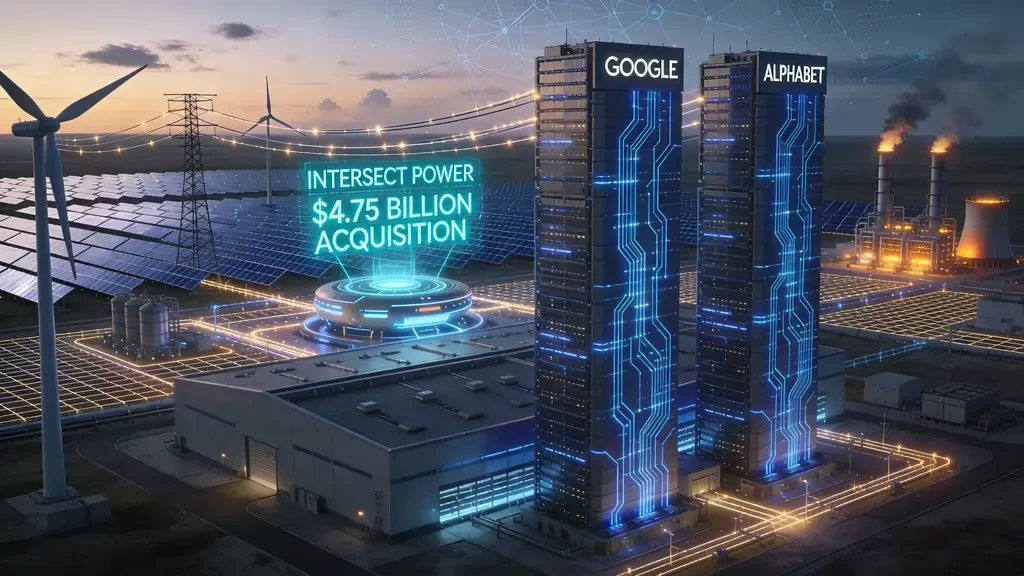
Alphabet, the parent company of Google, has agreed to acquire clean-energy and data-center infrastructure developer Intersect Power for approximately $4.75 billion in cash plus assumed debt. The move is designed to secure reliable power sources for Alphabet’s rapidly expanding artificial-intelligence-driven data centers amid growing grid constraints that have slowed new capacity build-outs across the United States. Alphabet already held a minority stake in Intersect and plans to integrate Intersect’s team and gigawatts of energy and data-center projects currently under development into its infrastructure strategy, while certain existing assets in Texas and California will remain independent under other investors. The deal, expected to close in the first half of 2026, reflects a broader trend of major tech companies investing directly in energy development to bypass bottlenecks in power availability that could hinder AI growth and data-center expansion.
Sources: WebPro News, AP News
Key Takeaways
• Alphabet is acquiring Intersect Power for $4.75 billion in cash plus debt to secure energy infrastructure needed for AI-focused data center expansion.
• The deal allows Alphabet to develop power generation capacity in tandem with data center build-outs, addressing U.S. grid limitations.
• Intersect’s team and many projects in development will join Alphabet, while some operational assets remain outside the acquisition.
In-Depth
Alphabet’s acquisition of Intersect Power marks a significant strategic pivot for one of the world’s largest tech companies as it navigates the escalating energy demands of artificial intelligence and cloud computing infrastructure. With AI workloads consuming ever more electricity, traditional reliance on strained regional power grids has increasingly become a barrier to data center deployment and scalability. The roughly $4.75 billion purchase—paid in cash and including the assumption of Intersect’s existing debt—offers Alphabet direct access to clean energy assets and expertise that can be aligned with its data center footprint without the typical delays associated with utility interconnection and grid capacity limitations.
News outlets report that Intersect Power, which develops both energy generation and data center infrastructure solutions, will bring its team and multiple gigawatts of projects currently under development or construction into Alphabet’s fold. A core part of the strategy is enabling data centers and energy generation to be co-located and built in lockstep. This “power-first” approach is a response to what many in the industry see as a bottleneck affecting not just Google’s infrastructure plans but the broader technology sector’s ability to scale AI operations. Securing control over energy resources positions Alphabet to avoid grid congestion, permit delays, and transmission constraints that have hindered faster build-outs of compute capacity in power-hungry regions.
Importantly, the deal does not encompass all of Intersect’s assets; existing operational and in-progress assets in places like Texas and California will remain under independent ownership supported by other investors, with Intersect continuing to operate under its brand. That arrangement allows Alphabet to integrate key future projects while leaving some legacy infrastructure outside its balance sheet.
The acquisition follows a trend in which major tech firms are increasingly investing in energy infrastructure to support digital infrastructure growth, from renewable projects to storage and microgrid technologies. This reflects a shift in how power is viewed within the context of digital competitiveness: not merely a purchased input, but a strategic asset essential for maintaining growth in AI services, cloud computing, and next-generation technologies. For Alphabet, the move underscores a broader commitment to innovation in energy and technology, ensuring that its data centers—critical hubs for AI development and cloud services—have the reliable and scalable power they need to stay competitive in an increasingly energy-intensive landscape. The closing of this acquisition, anticipated in the first half of 2026, could set a precedent for further energy-centric strategies across the tech industry as AI continues to drive demand for power and data processing capacity.