

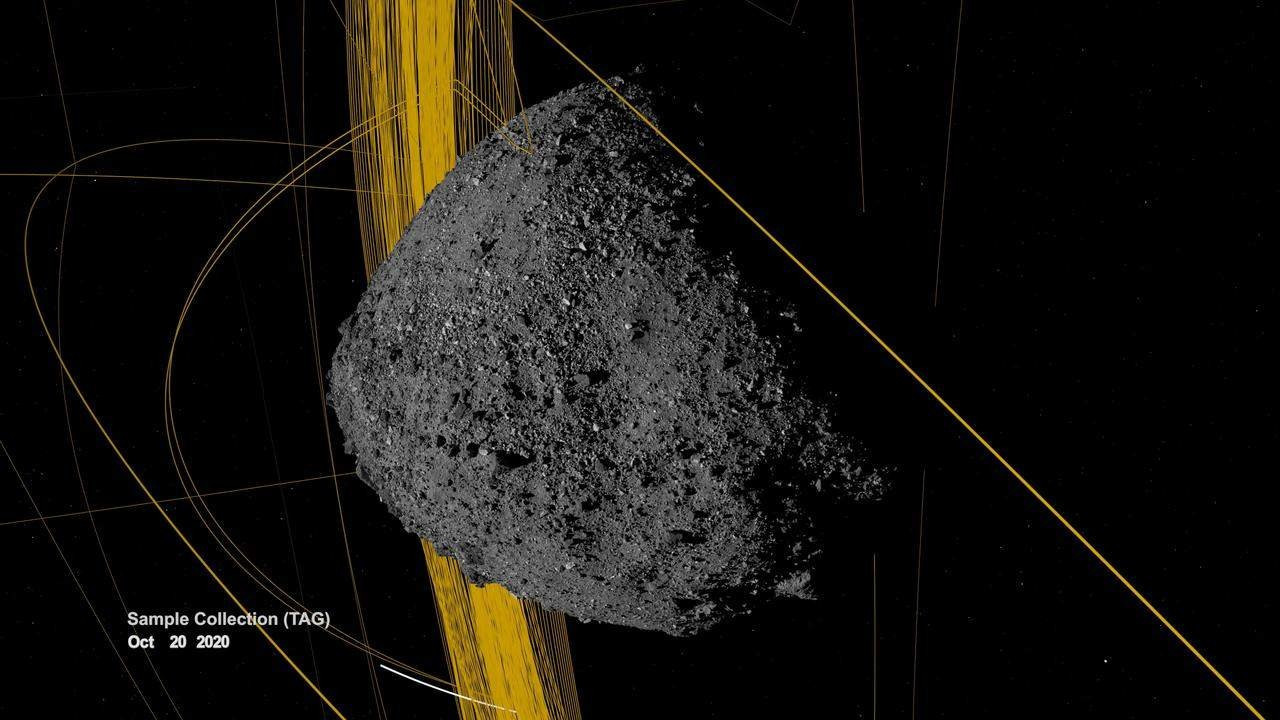
Recent studies of material from the near-Earth asteroid OSIRIS-REx’s sample return from Bennu indicate that the building blocks of life — including amino acids and even sugars — might already be present in space. Scientists report that the rock and dust collected from Bennu contain carbon-rich organic compounds and signs of ancient saltwater environments, suggesting that asteroids may have delivered not just water but also complex chemistry to early Earth.
Sources: NASA, Live Science
Key Takeaways
– The Bennu asteroid sample includes amino acids and other organic molecules that align with life’s precursors on Earth, suggesting space rocks could have seeded early Earth with materials vital for life.
– Evidence of evaporated salt-water minerals in the asteroid sample points to a history of ancient watery environments — potentially where chemistry toward life could have occurred.
– The discovery of sugars and diverse organic compounds in meteorites and asteroids bolsters the theory that prebiotic chemistry is common across the solar system, not unique to Earth.
In-Depth
When the OSIRIS-REx mission returned samples from asteroid Bennu in late 2023, scientists expected retrieving primitive space material — but what they found went way beyond dry rock and dust. Inside the tiny vial of asteroid regolith, researchers uncovered a surprisingly complex mix of organic compounds: not only a host of amino acids — the same building blocks that living organisms on Earth use to build proteins — but also evidence of nucleobases and other prebiotic chemicals. In effect, these spaceborne fragments resemble the raw molecular ingredients that helped spark life on Earth.
Even more compelling was the revelation that Bennu’s ancient environment likely included salt-water: the sample contained minerals that form when salty water evaporates and leaves behind crystalline residues. This suggests Bennu, and perhaps many asteroids like it, once held watery brines where chemical reactions among organic compounds could unfold. Such chemistry in a liquid environment vastly increases the odds that foundational biological molecules could form — not on a planet, but in space — and later be delivered to young Earth through impacts.
Previous studies on meteorites had already found sugars like ribose — a key component of RNA — and other organic substances, providing a missing piece of the “origin of life” puzzle. The Bennu findings build on that foundation by confirming these processes in a pristine, uncontaminated sample collected directly from space rather than meteorites that have landed and possibly picked up Earth contaminants.
Together, these discoveries suggest strongly that Earth was not a lone chemical workshop for life. Rather, our planet may have received a steady supply of life’s precursor ingredients from space — via asteroids like Bennu — acting as a kind of cosmic delivery service. That shifts the narrative: the early solar system may have been far more biologically generous than we imagined, with the seeds for life distributed broadly among small bodies, waiting for the right conditions on a planet like ours to flourish.