

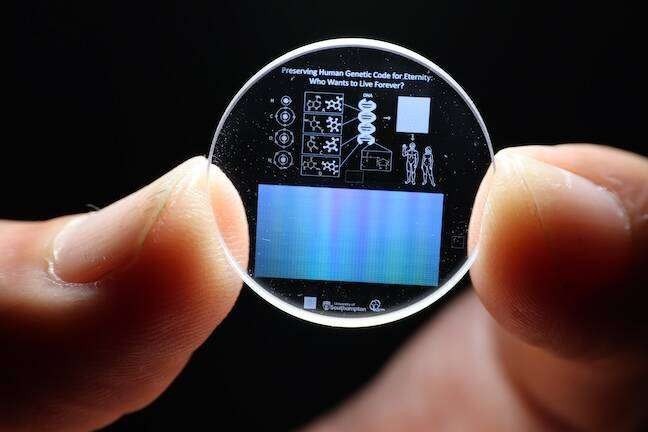
SPhotonix has taken a major step toward commercializing its 5D Memory Crystal technology, a glass-based archival storage medium capable of encoding up to 360 terabytes on a five-inch fused silica disc with potential data lifespan measured in billions of years. Unlike conventional magnetic or electronic storage, this approach uses femtosecond lasers to etch nanostructures in five dimensions—three spatial plus orientation and intensity—creating an ultra-durable, energy-free cold storage solution geared for data centers and long-term archives. The Delaware-based startup, spun out of University of Southampton research and co-founded in 2024, recently raised $4.5 million to advance prototypes from technical validation to demonstration, with plans to pilot the technology in data centers over the next few years while improving read/write speeds. Early demonstrations include storing the human genome and archived time capsule projects, though retrieval currently requires laboratory equipment.
Sources: The Register, Data Central Magazine
Key Takeaways
• SPhotonix’s 5D Memory Crystal is targeting cold data storage with ultra-long durability and high capacity compared to existing media.
• The company has secured early funding and is transitioning from lab validation toward real-world data center pilots.
• Technology promises sustainable, energy-efficient archival storage but current read/write speeds and accessibility remain limited.
In-Depth
In the midst of an ever-expanding digital world, companies and institutions face a growing crisis over how to store data safely, sustainably, and for the long haul. Traditional storage systems—hard disk drives, solid-state drives, tapes—are built around physical mechanics and electronics that wear out, consume power, and often require regular maintenance and replacement. For “cold” data—information that doesn’t need to be accessed instantly but must be preserved intact for years, decades, or even millennia—these legacy formats are increasingly inadequate both in terms of longevity and cost efficiency. Enter SPhotonix and its 5D Memory Crystal: a bold, physics-driven alternative that could alter how we think about archival storage forever.
At its core, the 5D Memory Crystal is grounded in decades of optical storage research. It employs femtosecond lasers to inscribe data throughout the volume of a fused silica glass disc. This isn’t your typical two-dimensional approach where bits sit on a surface; instead, SPhotonix leverages three spatial dimensions along with two optical ones—orientation and intensity of the nanostructures—to encode information in what’s effectively a five-dimensional space. The result is an astonishing packing density: up to 360 terabytes on a single five-inch disc, with the very structure of the glass promising virtually indefinite stability. The company asserts that this data could survive for up to 13.8 billion years—even at elevated temperatures—far surpassing any conventional medium.
This theoretical longevity isn’t just marketing. Fused silica glass is chemically stable and, when free of internal stresses, resists degradation from environmental factors that plague metal and electronic media. That durability, coupled with the fact that the medium requires no power to maintain data once written, makes it inherently sustainable. In a climate-aware business environment where data center power use is under scrutiny, this energy-free archival approach could be a compelling pitch.
But the path from lab prototype to widespread deployment is not without challenges. SPhotonix itself acknowledges that the current generation of its technology sits at Technology Readiness Level 5, meaning it’s technically validated in a controlled environment but not yet proven in operational conditions. The recent $4.5 million funding round—led by institutional deep-tech investors—aims to move the technology to TRL 6, which entails demonstration in relevant environments outside the lab. That’s an important milestone, but still a couple of steps from full commercialization. The company has begun discussions with hyperscale data centers about pilot projects that could take place over the next few years, but it will take continued investment and engineering advancements to make the technology economically competitive with existing archival options.
One limitation today is performance. Current write and read speeds under real-world conditions are measured in the low megabytes per second range—adequate for cold storage where access times are less critical, but far from the performance expected in more active systems. SPhotonix envisions a roadmap where these speeds improve significantly, potentially reaching hundreds of megabytes per second and making the technology more attractive to enterprise users.
Another practical hurdle lies in accessibility. Right now, retrieving data from a 5D Memory Crystal requires specialized laboratory equipment. Commercial viability will depend on developing rugged, field-ready readers that data centers and enterprises can deploy without high overhead or specialized skills. Early estimates place initial reader devices in the several thousand dollar range, which could be reasonable for niche archival use cases but will need to fall further to achieve mainstream appeal.
Despite these challenges, the startup’s commitment and momentum are noteworthy. The co-founders combine deep academic expertise with entrepreneurial experience, and the technology has already been demonstrated on real datasets such as the human genome and curated time capsules. That lends credibility to the claim that this is more than a lab curiosity; it’s a nascent platform with genuine potential in the archival storage market.
Moreover, the broader industry context underscores the need for innovation in this space. Global data production is exploding—IDC predicts that zettabytes of data will be generated annually in the coming years. Most of that data may never be accessed again after initial use, but it still needs to be preserved for regulatory, historical, scientific, or cultural reasons. Traditional media are simply not up to the task for storage horizons stretching decades or centuries. Optical storage alternatives, including technologies pursued by other startups and research groups, reflect a growing recognition that digital preservation at scale will require fundamentally different approaches.
SPhotonix’s 5D Memory Crystal is among the most ambitious of these, promising unprecedented longevity and density through a clever combination of photonics and material science. If the company successfully navigates the remaining engineering and commercialization hurdles, this technology could offer a stable, low-maintenance repository for humanity’s digital heritage. In a world where data outlives the hardware that holds it, solutions like 5D optical storage may be one of the few viable paths forward for truly future-proof archives.