

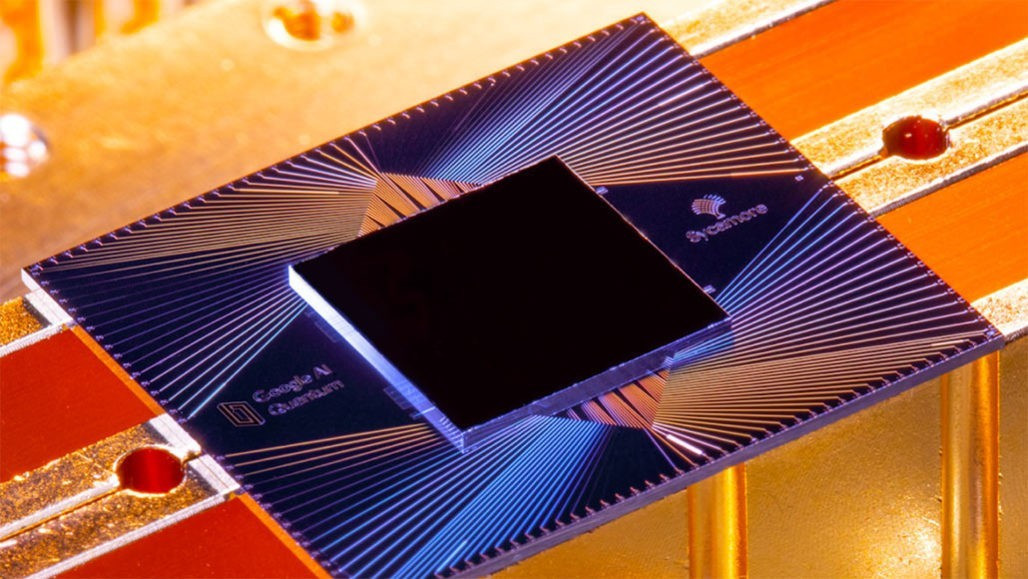
A major milestone has emerged in quantum computing as Google Quantum AI (GQAI) revealed its new algorithm dubbed “Quantum Echoes,” which runs on its 105-qubit “Willow” chip and delivers a speed up of roughly 13,000 times compared to the world’s fastest classical supercomputers in specific tasks. The algorithm functions by performing an out-of-time-order correlator (OTOC) calculation—essentially sending a signal forward in the quantum system, then reversing it to measure an “echo” of how quantum perturbations spread. According to Google’s blog and independent reporting, this is the first time a quantum computer has demonstrated a verifiable quantum advantage—meaning the result can be reproduced on comparable quantum hardware or compared to nature itself—rather than just raw speed claims. Applications highlighted include molecular structure measurement, such as a “molecular ruler” experiment that matched traditional NMR spectroscopy results for a 15-atom and 28-atom molecule, opening a path toward drug discovery, materials science and advanced AI training. As of October 2025, the breakthrough places Google squarely in the lead of the race to practical quantum computing, though researchers—and Google themselves—emphasize that this remains largely a proof of concept rather than a broad-scale commercial tool.
Key Takeaways
– Google’s Quantum Echoes algorithm demonstrates a quantum computing milestone: 13,000× speed-up over classical supercomputers in specific benchmarked tasks and verifiable results on hardware that can be cross-verified.
– The verifiability aspect—i.e., obtaining repeatable results on quantum hardware or comparing to real-world physical experiments—is a critical shift, moving quantum computing from theoretical demonstrations toward real-world applicability.
– While the achievement is significant, the breakthrough remains a narrow proof-of-concept for specific molecular and physics simulation tasks; scaling to broad, commercial quantum applications (e.g., large-scale drug discovery or general-purpose quantum computing) remains future work.
In-Depth
Quantum computing has long promised to revolutionize how we solve the world’s most difficult computational problems—from decoding complex molecular structures to accelerating artificial-intelligence models and simulating materials with atomic precision. Yet for decades, the promise has outpaced the practical results. With the latest announcement by Google Quantum AI, however, we may be witnessing a genuine leap forward. At the heart of the breakthrough is the algorithm called Quantum Echoes, developed by Google researchers and running on their Willow quantum processor. What distinguishes this achievement is twofold: the magnitude of the speed-up and, equally importantly, the verifiability of the quantum computation.
In conventional quantum-supremacy announcements, the goal has often been “just beat the fastest classical computer at some contrived task.” What Google is now claiming is different: its algorithm produces an out-of-time-order correlator (OTOC) measurement—a genuine quantum-physics experiment of how information propagates and scrambles across a quantum system—and it is designed such that the results can be verified on comparable quantum hardware or validated with physical experiments, such as those from nuclear-magnetic-resonance (NMR) spectroscopy. According to Google’s blog post, “This is the first time in history that any quantum computer has successfully run a verifiable algorithm that surpasses the ability of supercomputers.”
And the numbers are dramatic. The company reports that the Quantum Echoes algorithm running on the Willow chip achieved results 13,000 times faster than the best classical algorithm on current supercomputers—tasks that might take years classically were completed in hours or less on the quantum hardware. The experiment included probing molecular geometry by measuring spin interactions in molecules of 15 and 28 atoms, and those results mirrored what NMR spectroscopy could produce, plus additional information previously inaccessible. That dual capability—speed and verifiable physical relevance—is exactly the type of milestone the industry has long sought.
For supporters of a more conservative, practical approach to technology, this breakthrough represents a validation of the incremental hardware-software co-design roadmap: Google did not simply claim quantum supremacy and stop; instead it iterated its hardware (Willow chip with extremely high gate fidelities across 105 qubits), refined the algorithm, ensured measurement precision, and focused on verifiability. For industries watching this space—pharma, materials, energy, aerospace—the implications are clear: quantum computing is inching closer to real-world zero-sum applications rather than remaining an academic curiosity.
Nevertheless, this is not a headline of “quantum computers replace supercomputers today.” Several caveats remain. The task demonstrated is still highly specialized and does not yet translate to all types of computation or commercial workloads. The 13,000× speed-up applies to a narrow benchmark, not necessarily all classical workloads. Quantum error correction, scaling to thousands or millions of qubits, and making quantum machines robust and easy to use still lie ahead as major technical hurdles. And although Google emphasizes verifiability—a welcome corrective to past quantum claims—independent external verification and wider replication across the quantum-computing ecosystem are still forthcoming.
From the vantage of strategic investors, technology watchers and industry stakeholders, this milestone signals that quantum computing is transitioning from “lab exotic” to “real-world aspirational.” Governments and corporations that have invested in quantum frameworks may find their research bets are starting to pay off. For conservative technologists and business strategists alike, the message is: now is the time to assess quantum readiness—not just for theoretical risk (e.g., cryptography) but for potential pragmatic advantage in R&D, simulation, optimization and novel product development.
In short, Google’s Quantum Echoes milestone is a tangible turning point. It will not immediately overhaul classical computing, but it marks the moment when quantum computing moves firmly into the realm of practical, verifiable science. For businesses, investors and technologists who have tracked this trend patiently, the horizon for meaningful quantum deployments is clearer than ever—even if still a few years away.