

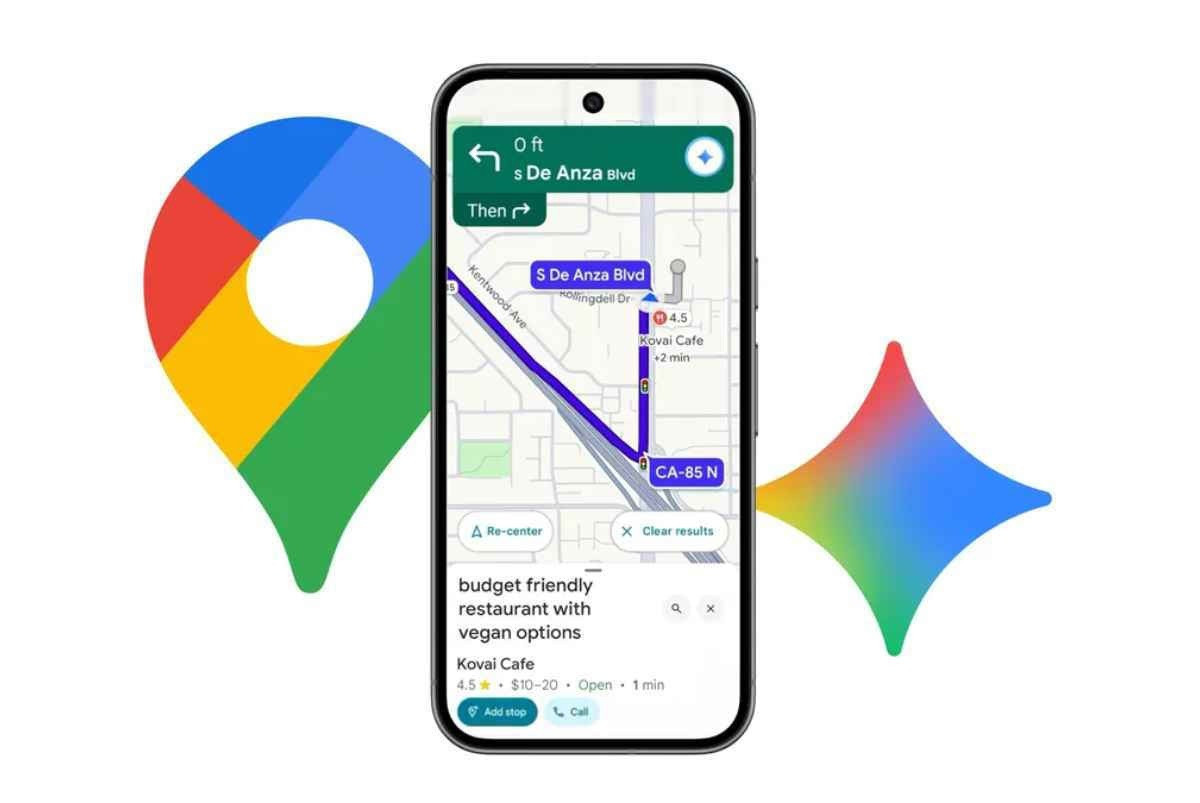
Google Maps is now powered by Gemini, Google LLC’s latest AI assistant, to deliver a more conversational and hands-free navigation experience. The update allows drivers and walkers alike to ask natural-language questions—such as pointing their camera at a landmark or inquiring about nearby restaurants and parking—and receive immediate responses built on real-world data. According to Google, the system cross-references over 250 million places with Street View imagery to provide landmark-based turn instructions (for example, “turn right after the gas station”) rather than the classic “in 500 feet” cues. The rollout starts in the U.S. for iOS and Android users, with Android Auto support coming soon.
Sources: AP News, TechCrunch
Key Takeaways
– Users of Google Maps will gain a voice- and camera-driven navigation assistant, enabling seamless queries such as “find a vegan-friendly restaurant along my route” without manually typing or tapping during travel.
– The landmark-based navigation upgrade uses rich data from Street View and millions of mapped point-of-interests to provide more intuitive directions (e.g., real-world landmarks) and proactive traffic alerts.
– This push signals Google’s strategy to deepen the integration of its AI model (Gemini) into core services, reinforcing its competitive position against alternative voice-assistants and generative-AI platforms.
In-Depth
Google’s introduction of Gemini into Google Maps marks a significant step forward in how navigation apps respond to user needs, particularly from a practical and conservative consumer-lens. Instead of simply plotting a route on a map and relying on generic “turn in 500 feet” instructions, the app now serves as a smarter co-pilot—guiding you not only where to go but providing context, real-world landmarks, and relevant options along your journey. As detailed in Google’s own blog, “Google Maps navigation gets a powerful boost with Gemini” explains that the new system enables hands-free driving, reporting of traffic incidents by voice, and checking for nearby services such as EV chargers or parking with simple queries.
From a conservative viewpoint, this update underscores the value of innovation while still being grounded in verifiable data. Google emphasises that Gemini’s responses in Maps are anchored to actual business listings, verified reviews, Street View imagery, and geospatial mapping—all designed to prevent the AI “hallucinations” that often plague generative systems. For example, users can now ask “Is there a budget-friendly restaurant with vegan options within two miles of my route and what’s the parking like?” and then request the app to add the place to their calendar—all without diverting attention from the road.
The landmark navigation is especially practical. Instead of hearing “turn left in 0.3 miles,” drivers will hear something like “turn left after the Thai Siam Restaurant,” making the instruction more intuitive and less reliant on measuring distance—which can be especially helpful for non-technical drivers or those unfamiliar with an area. Google reports that this feature uses data from 250 million mapped places and their Street View imagery.
Safety is an important facet in this rollout, which will resonate well with conservative audiences who prioritise practical tools and reliable systems. Google is phasing in these features in the U.S., starting with Android and iOS devices; Android Auto compatibility is “coming soon.” According to TechCrunch, traffic alerts are initially rolling out only for Android users in the U.S., while landmark navigation begins on both iOS and Android in the U.S.
In terms of broader implications, this move by Google strengthens its AI ecosystem by embedding Gemini across a critical service used by billions. For users, the benefits are clear: less fiddling with screens, safer navigation, more personalised options along the route, and integration into other apps—such as calendar and Lens—for a more holistic travel experience. From a brand-strategy standpoint, Google is positioning itself to compete more aggressively in voice assistants and navigation intelligence, leveraging real-world data to out-flank competitors who rely more heavily on generic AI responses.
Of course, there are considerations. Users should ensure they have updated versions of Maps and that their devices support the new features. Privacy-conscious users may want to review how location and voice data are handled, since the system continuously processes route details and potentially user preferences. Also, while Google emphasises grounding in real-world data to reduce errors, any AI system carries risk of mis-interpretation—so conservative users should remain attentive and treat the system as a smart assistant rather than full autonomy.
In summary, Google Maps’ integration of Gemini marks a meaningful leap toward conversational, context-aware navigation. The app is evolving from simply telling you where to go to actively guiding how you get there—with voice, landmarks, proactive routing and real-world knowledge. For users who travel frequently or rely on navigation in varying contexts, the upgrade promises to make the process more intuitive, responsive and useful—while preserving the conservative virtues of reliability, real-world grounding and measurable results.