

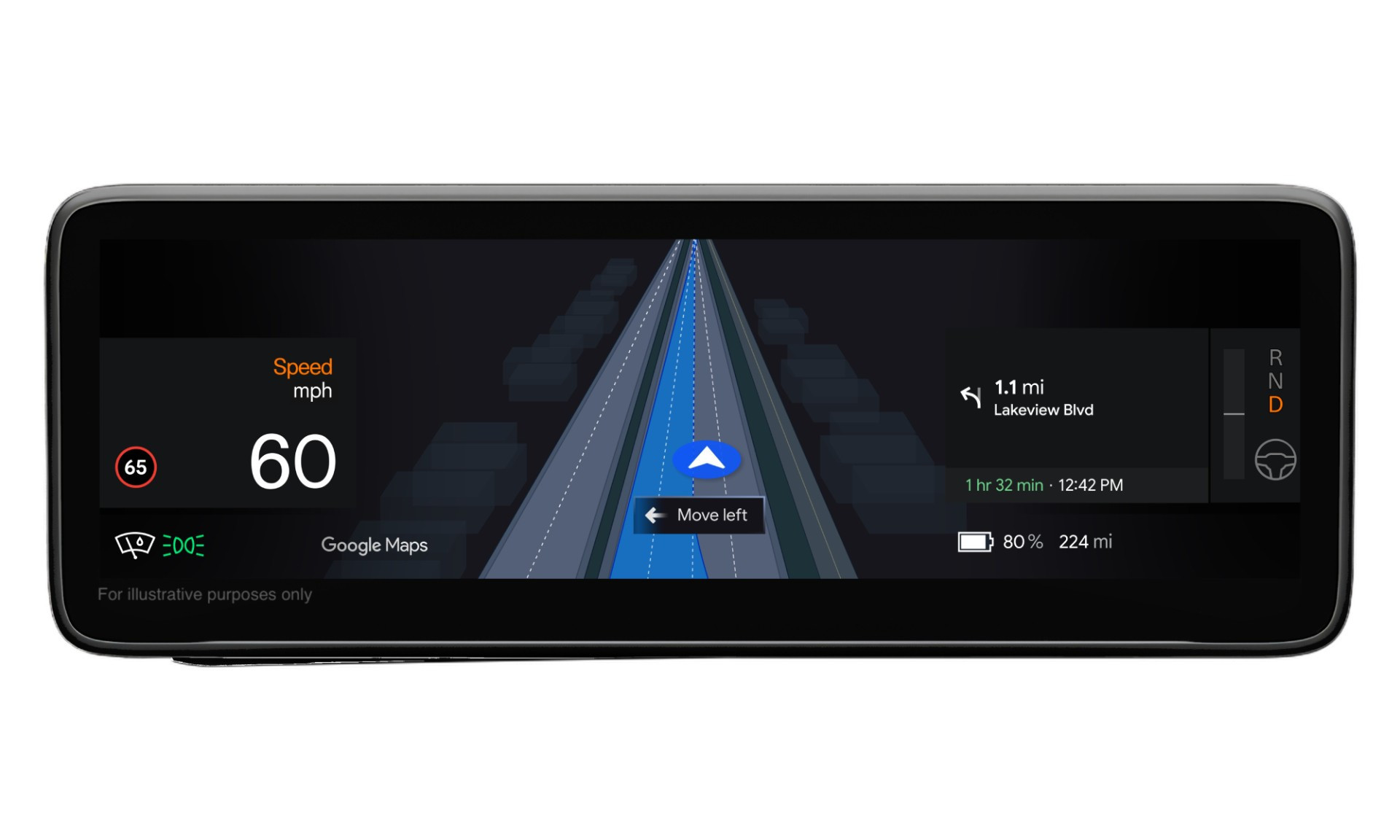
Google Maps is introducing a new “live lane guidance” feature for vehicles with the Google Built-In (Android Automotive) platform, starting with the Polestar 4 electric SUV in the United States and Sweden. The system taps the car’s forward-facing camera to detect lane markings and highway signage, feeds that data into onboard AI, and then delivers visual and audible cues on which lane the driver should occupy and when to merge — for example when a journey’s exit is on the right but the vehicle is in a left-lane. According to Google, this marks “for the first time” that Maps can “see the road and its lanes like a driver” and integrate that with navigation. The partnership between Google LLC and Polestar builds on five years of collaboration (since Polestar 2) and is positioned both as a safety enhancement and a convenience improvement for drivers on complex highway interchanges. While initially limited to one model and two markets, the companies plan to expand both to more road types and to other automakers.
Key Takeaways
– The feature uses the vehicle’s forward-facing camera plus AI to identify lane markings/road signs in real time and integrate that with Google Maps navigation, thus enabling “which lane should I be in” intelligence rather than just turn-by-turn directions.
– It debuts exclusively on the Polestar 4 in the U.S. and Sweden, but represents a broader strategic move by Google (and by extension automakers) toward deeper software-infused driving experiences via Android Automotive/Google Built-In.
– While promising improved convenience and potentially safety (fewer last-second merges/missed exits), this also raises questions about reliance on camera/AI systems, scope of rollout, hardware dependencies and the competitive implications for navigation/infotainment systems in cars.
In-Depth
The newly announced live lane guidance feature in Google Maps signals a meaningful step forward in how navigation systems interact with the driver’s environment. Traditional navigation apps (including many already built into cars) typically show an arrow, tell you your next turn, and perhaps indicate “stay left” or “stay right.” What sets this apart is the integration of a live camera feed and AI analysis that recognizes what lane you are in relative to the upcoming exit or junction, then proactively suggests when and how to merge. According to Google, the software “sees the road and its lanes like a driver” by analyzing lane markings and signage captured by the forward-facing camera. The Verge explains that when you’re in a far left lane and your exit is far to the right, the system will prompt you in time to shift lanes rather than waiting until the last second.
For the U.S. market and Sweden, the rollout begins with the Polestar 4 — the Scandinavian electric vehicle built on Android Automotive software with Google Built-In. Polestar has worked with Google for about five years (starting with the Polestar 2) to embed Chrome, high-definition maps and other Google services into the car’s infotainment system. The live lane guidance initiative thus builds on that foundation, and for Polestar it’s part of “driver-centric UX strategy” aimed at reducing stress and missed exits or quick lane-changes.
From a conservative perspective, this move aligns well with drivers’ desires for dependable, safety-enhancing features rather than gimmicks. Merging across multiple lanes late on a highway is a recurring source of commuter frustration and risk; a system that helps you anticipate and execute lane changes earlier may reduce accidents, insurance claims and stress. At the same time, rollout limitations matter: Google and Polestar emphasise that the feature is initially confined to highways (not yet city roads, local roads or complex intersections) and only in two markets and only in one vehicle model — signalling prudent, incremental deployment rather than sweeping early adoption.
However, the hardware and software dependencies should not be overlooked. To support this feature you need a car with built-in Google/Android Automotive software, a compatible camera system, and over-the-air update capacity. That means older cars, non-Google-built infotainment systems or cheaper vehicles may be excluded. Also, while the system promises fewer surprises, it also means that drivers will become more reliant on software prompts rather than situational awareness and driving skill alone — a point often raised by critics of in-car automation features.
Strategically, Google is staking a claim not just in the map/phone space but increasingly in the cockpit of the vehicle. By offering deeper integration (camera + AI + real-time lane guidance) it may create stronger value propositions for automakers partnering with them, thus reinforcing Google’s platform in the automotive software stack. For automakers, the opportunity lies in differentiating their vehicles by software-rich experiences rather than purely mechanical specs. From a competitive standpoint, rival platforms (Apple CarPlay, bespoke vehicle infotainment systems, Tesla‘s in-house software) may feel pressure to match or exceed this sort of functionality.
In the longer term, once expanded to more models and regions, live lane guidance could become a standard expectation among drivers and may contribute to improved safety outcomes (fewer abrupt lane changes) and perhaps traffic flow benefits. From a consumer viewpoint, this feature will likely appeal to those who regularly drive on multi-lane highways, interchanges or unfamiliar territory. For suburban commuters, travelers in complex metro zones, or those driving unfamiliar rental or leased EVs, having this kind of intelligent guidance may reduce stress and cognitive load.
In sum, this rollout marks a milestone in automotive navigation: moving from “which turn next” to “which lane now.” It reflects the broader shift from mechanical vehicles toward software-driven mobility experiences, where the vehicle’s hardware (camera, sensors), software (AI, maps) and services (over-the-air updates, integration) all converge. For drivers who value safety, clarity and technological advantage, it presents a meaningful upgrade. For the industry, it signals that the cockpit — once dominated by knobs, gauges and steering wheels — is now firmly part of the digital platform era.