

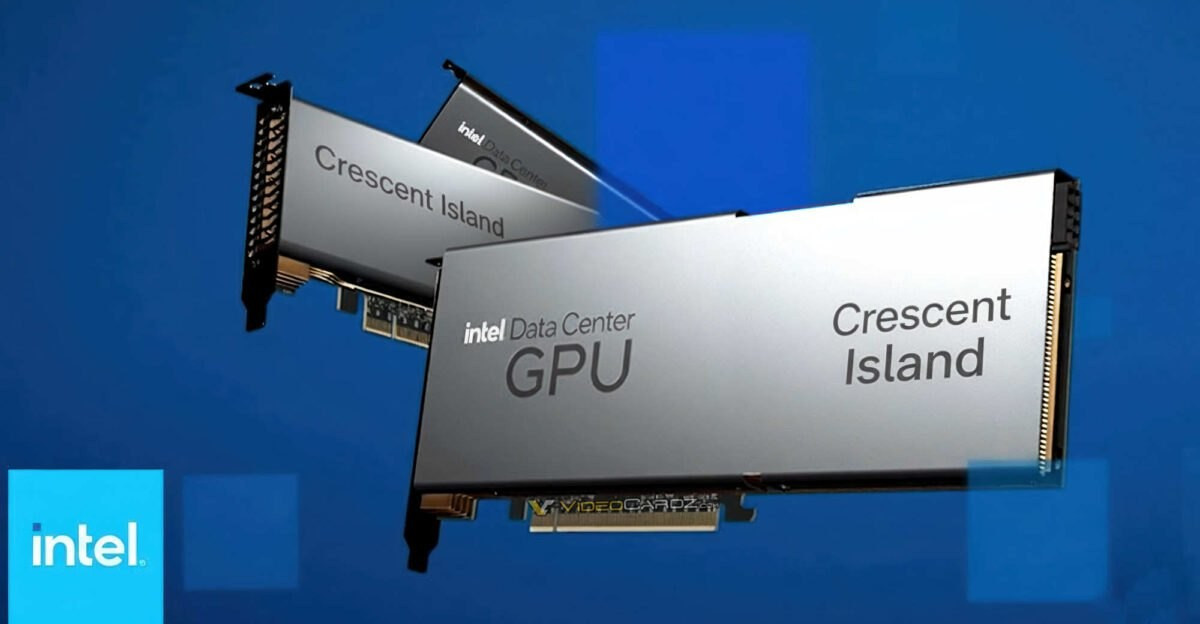
Intel has just dropped its latest data-center GPU, code-named Crescent Island, at the 2025 OCP Global Summit, pitching it as a high-efficiency inference engine with 160 GB of LPDDR5X memory, optimized for air-cooled servers and designed to fit into an annual GPU release cadence that mirrors Nvidia and AMD‘s playbooks. Crescent Island runs on Intel’s new Xe3P microarchitecture and supports a broad range of data types, with sampling slated for the second half of 2026.The GPU is “inference-only” (rather than general compute) and suggests its memory layout is unusually ambitious, possibly signaling a dual-GPU or ultra-wide interface design. The move is part of Intel’s strategy to pivot toward an open, heterogeneous AI stack—leveraging software layers tested via its Arc Pro B-Series GPUs—while trying to carve out share in Nvidia’s and AMD’s entrenched territories.
Key Takeaways
– Intel is aggressively targeting the inference GPU market with Crescent Island, emphasizing 160 GB memory and energy efficiency over general-purpose compute.
– The emphasis on open, heterogeneous software stacks suggests Intel is betting on flexibility and ecosystem appeal to break Nvidia/AMD’s dominance.
– Timing is critical: sampling begins in H2 2026, so Intel must deliver performance and software maturity to stay credible in a fast-evolving field.
In-Depth
Intel’s announcement of Crescent Island marks a turning point—or at least an ambitious bet—in its strategy to compete in AI hardware. For years, Intel lagged behind Nvidia in accelerators, and many in the industry viewed its GPU attempts as halting or iterative at best. But by presenting a 160 GB inference-optimized engine, Intel is signaling that it’s not just dipping its toes into the water—it’s trying to make a splash.
What’s notable is the design focus. Crescent Island isn’t pitched as a do-everything GPU; it’s explicitly tailored for inference workloads in data centers—tasks like running large language models, vision models, or other AI tasks where the model is already trained and you’re doing forward execution. That sidesteps many of the challenges faced in training (which requires extreme memory bandwidth, compute scaling, and interconnects). According to Tom’s Hardware, the memory layout is ambitious and perhaps unconventional—Intel may be placing multiple LPDDR5X devices in a wide bus or dual-GPU configuration to hit 160 GB. That kind of engineering gamble is bold, because memory systems often make or break performance in real use.
Another big piece of the puzzle is the software and architecture story. Intel isn’t going in with just hardware; it’s trying to wrap Crescent Island into an open, heterogeneous AI stack. They’re already testing that stack via existing Arc Pro B-Series GPUs to help developers get early optimizations. The point is to allow multiple vendors to plug into a unified layer, rather than handing users a black box. That’s a contrast to Nvidia’s relatively closed CUDA and tightly integrated ecosystem. Reuters notes Intel is pushing this open flexibility to appeal to customers who don’t want to be locked into a single vendor.
Yet Intel faces big challenges. The sampling window (H2 2026) leaves limited time to prove real-world performance, latency, and power efficiency. Inference workloads are unforgiving: model sizes grow fast, and memory bottlenecks kill scaling. Intel must also prove the ecosystem—framework support, libraries, drivers—can catch up. If the hardware is fantastic but software lags, adoption will stall.
From a competitive lens, this move could shake things up. Nvidia and AMD have dominated inference and general AI accelerators, and their ecosystems are mature. But they also face criticism for vendor lock-in and opaque stacks, which may give Intel a narrative to win over cloud providers, enterprises, or governments that prefer open architectures.
In sum: Crescent Island is Intel’s bid to get back in the game. It’s a focused, inference-only play with a heavy memory commitment and a software vision of openness. If Intel can pull it off, it could transform perceptions. If they can’t, it may just be another ambitious prototype that never fully competes. The race is on—and now Intel is officially in.