

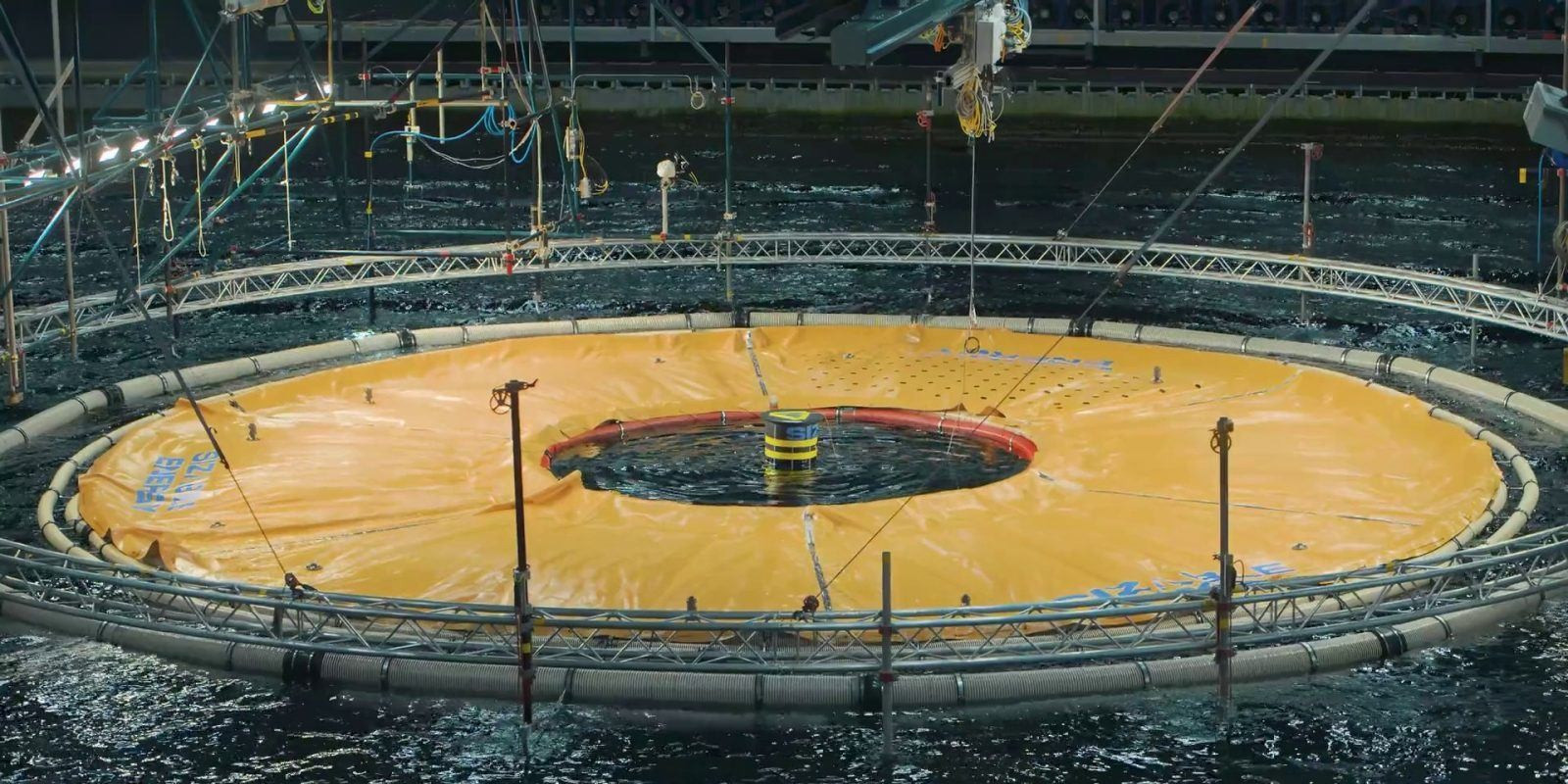
A new startup called Sizable Energy has secured an $8 million funding round to develop a long-duration energy-storage system that uses flexible reservoirs submerged offshore to store excess electricity from renewables by pumping super-salty seawater between depths. One article explains the concept of using the ocean as a giant battery by leveraging pumped hydropower technologies adapted to marine environments. Another source highlights the cost targets for the technology — roughly €20 per kWh, or about one-tenth the cost of many current grid-scale battery systems — and the plan to pair the system with offshore wind and large-scale renewables. A third publication describes the broader industry shift: with wind and solar producing ever more variable output, utility-scale storage is considered the missing link for grid reliability, and ocean-based pumped hydro may finally become commercially viable.
Sources: Yahoo Finance, ElecTrek.co
Key Takeaways
– Sizable Energy is aiming for radically lower cost energy storage by deploying reservoirs offshore that can pump and store water to generate electricity when needed.
– The cost target (~€20 per kWh) is highly ambitious and represents a potential game-changer compared to current storage technologies — if it works at scale.
– The move underscores a broader recognition that long-duration storage must advance far beyond lithium-ion batteries to keep up with large amounts of wind and solar on the grid.
In-Depth
In the world of energy innovation, the challenge is no longer simply generating power from wind or solar — it’s storing that power when the sun isn’t shining or the wind isn’t blowing. A company called Sizable Energy has recently stepped into the spotlight with a bold vision for addressing that exact problem: use the ocean itself as a giant battery. The concept seems futuristic, but it’s grounded in one of the oldest forms of energy storage: pumped hydropower. Instead of relying on large mountain reservoirs, Sizable Energy proposes flexible reservoirs beneath the sea surface — basically large bags or membranes anchored in deep seawater — which are filled (or allowed to empty) to store energy. During periods of excess renewable generation, the system pumps very salty seawater into one reservoir, raising its potential energy; when demand picks up, the water is released through a turbine, generating electricity. The company has raised $8 million to push prototypes forward.
What makes this interesting — and politically resonant for those who favour market-based innovation and infrastructure rather than endless subsidy schemes — is the cost target: about €20 per kWh of storage, or roughly one-tenth the cost of many current grid-scale batteries. If Sizable Energy can deliver even a meaningful fraction of that, it could transform how utilities think about balancing the grid. Reduced storage costs would make renewables far more competitive and reliable without requiring massive government interventions. For investors and policymakers alike, this is an appealing scenario: the energy market moves forward by delivering lower cost, more reliable technology rather than relying on ever-expanding mandates or subsidies.
Of course, there are serious hurdles. Marine environments are harsh, with salt, currents, corrosion, and maintenance challenges that far exceed land-based systems. The viability of anchoring, deploying, maintaining, and connecting large infrastructure far offshore remains unproven at scale. Moreover, permitting and environmental concerns — particularly offshore ecosystems — will likely complicate deployments. Then there’s the question of deployment speed: often, the challenge with innovative storage systems is not simply technical feasibility but the ability to scale quickly and cost-effectively. For conservative investors and infrastructure planners who prefer risk-minimizing approaches, it may take time before this system is considered a safe bet.
Still, the timing is compelling. As utilities ramp up wind and solar investments, the need for long-duration storage is becoming a bottleneck. Traditional pumped hydropower already accounts for the bulk of long-duration storage in many systems, and adapting that concept to offshore settings offers a fresh frontier. Deployment offshore could bypass land-use constraints, tap into deep water head differentials, and co-locate with offshore wind farms — meaning synergies with existing infrastructure. From a conservative policy perspective, the key takeaway is that the energy transition should not rely solely on subsidised battery builds; we need multiple storage pathways, including innovative ones that leverage existing physics and mature engineering concepts rather than speculative chemical breakthroughs.
In sum, Sizable Energy’s plan represents a smart bet on infrastructure-scale innovation rather than throw-away subsidies. If it works, we could see storage costs drop, renewables become more reliable, and the grid get stronger — all while embracing engineering and market discipline. For stakeholders who value fiscal prudence and private-sector innovation, this model offers a welcome alternative to endless subsidy cycles. That said, the execution risk remains high. The next couple of years will be critical in proving whether this ocean-based storage concept can move from prototype to industrial reality.