

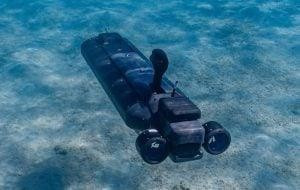
Skana Robotics, a Tel Aviv–based startup, has developed SeaSphere, an AI-driven fleet management system that lets autonomous underwater vehicles (AUVs) and unmanned vessels communicate with each other over long distances without surfacing, overcoming a decades-old challenge in submerged robotics by sharing sensor data and adaptive decision-making in real time deep beneath the ocean’s surface. This new capability not only improves coordination among robotic fleets in defense contexts but also enhances maritime infrastructure security and other underwater missions, with commercial deployment slated for 2026 as the company seeks government and industry contracts amid rising geopolitical tensions affecting sea lanes.
Sources: Interesting Engineering, WebPro News
Key Takeaways
• Skana’s SeaSphere software enables submerged underwater robots to exchange data and coordinate adaptively without surfacing, addressing long-standing communication limits in AUV operations.
• The breakthrough has clear defense and infrastructure security applications, particularly for contested maritime environments where stealth and reliability are priorities.
• Commercial rollout is planned for 2026, with initial focus on government and industry contracts as part of broader maritime technology adoption.
In-Depth
For decades, one of the most persistent and limiting challenges in underwater autonomy has been communication. Conventional radio waves cannot penetrate water beyond shallow depths, forcing autonomous underwater vehicles (AUVs) and unmanned vessels to surface to transmit data, which carries tactical risk and operational inefficiency. Skana Robotics, a relatively new entrant in the maritime robotics sector, is now positioning itself as a game-changer by offering a solution that keeps robotic fleets submerged while still communicating effectively. Their new fleet management platform, SeaSphere, uses established AI algorithms to enable groups of underwater robots to share critical information and make real-time decisions based on inputs from their teammates, significantly enhancing coordination and effectiveness in complex underwater environments.
The implications are broad: in defense applications, synchronized autonomous fleets can more effectively conduct surveillance, reconnaissance, and other missions in contested waters without exposing their position by surfacing; in commercial and infrastructure contexts, coordinated robotic networks can improve the security and maintenance of undersea cables, pipelines, and supply chain assets. Defense analysts watching modern maritime operations have noted that undersea autonomy and secure communication are essential as nations focus on protecting critical infrastructure and securing strategic waterways; Skana’s innovation directly addresses that operational need.
Key to SeaSphere’s performance is not flashy cutting-edge neural networks but a set of mathematically driven AI techniques that emphasize predictability and explainability — attributes valued in mission-critical environments where understanding how decisions are made can be as important as the decisions themselves. These older, well-understood algorithms form the backbone of Skana’s approach, providing a compromise that sacrifices the latest “wow factor” for dependable, explainable performance.
The company has already exited stealth and is actively seeking sizable contracts, particularly in Europe where maritime threat levels have been elevated by ongoing geopolitical tensions such as those stemming from the Russia-Ukraine conflict. Skana’s leadership has indicated they expect to close a major government deal soon and plan to release a commercial version of SeaSphere in 2026, signaling confidence in both the technology and market demand.
If SeaSphere performs as promised in real-world deployments, it could usher in a new era of underwater autonomy where fleets of robotic vessels can work together seamlessly, much like aerial drones do today. The technology’s ability to maintain communication integrity while submerged enhances both strategic capability and operational safety, giving navies and commercial operators tools once only dreamt of in naval research labs. More broadly, this may mark a turning point where underwater robotics becomes an indispensable part of national security and commercial maritime operations, expanding the frontier of autonomous systems beneath the waves.