

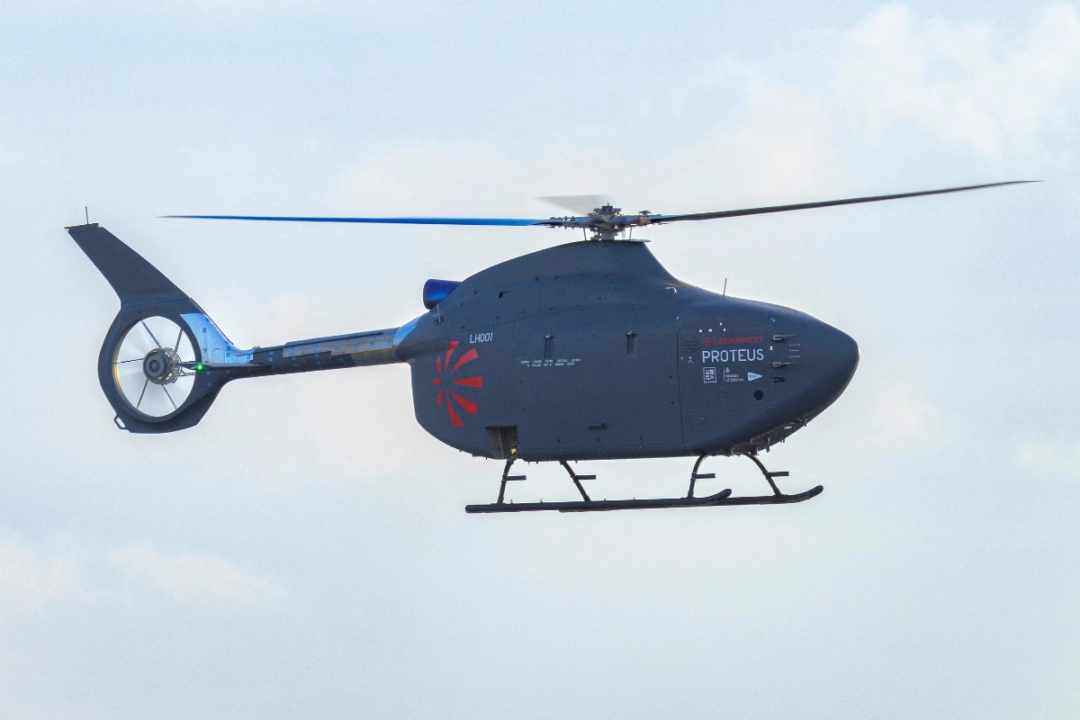
The British Royal Navy has unveiled and flown its first full-size autonomous helicopter, Proteus, marking a significant milestone in autonomous military aviation as it completed its maiden flight at Predannack airfield in Cornwall, England. Designed and built by Leonardo Helicopters as a technology demonstrator under a £60 million UK-funded programme, the Proteus is intended to patrol seas, enhance anti-submarine warfare, and support future maritime missions without onboard crew, operating as part of the Royal Navy’s Strategic Defence Review “New Hybrid Navy” concept. Proteus is capable of independent navigation and complex task execution using advanced sensors and onboard computing, allowing it to take on dull, dirty, and dangerous assignments while freeing crewed aircraft for priority operations. This represents one of the world’s first autonomous full-size helicopters and aligns with efforts to modernize defense capabilities amid rising geopolitical tensions.
Sources:
https://www.theepochtimes.com/world/british-navy-unveils-full-sized-autonomous-helicopter-5973019
https://www.reuters.com/business/aerospace-defense/uk-navy-launches-new-crewless-helicopter-counter-north-atlantic-threats-2026-01-16/
https://www.navalnews.com/naval-news/2026/01/new-royal-navy-helicopter-drone-makes-history-with-first-flight/
Key Takeaways
• The Royal Navy’s Proteus has completed its maiden autonomous flight, a first for full-size helicopters in British military aviation.
• Proteus is designed to operate without onboard pilots, using advanced autonomy for high-risk maritime missions and anti-submarine warfare.
• The program reflects the UK’s Strategic Defence Review goals to integrate autonomous systems into future “hybrid air wing” operations.
In-Depth
The Royal Navy’s successful maiden flight of the Proteus autonomous helicopter marks a notable evolution in military aviation and naval capability, especially in the context of autonomous systems integration and maritime strategy. Built by Leonardo Helicopters in the United Kingdom, this helicopter represents a leap from smaller unmanned aerial systems to a full-size rotorcraft capable of operating independently of onboard pilots while performing essential missions that are often dangerous, repetitive, or resource-intensive. The first publicized flight took place at Predannack airfield in Cornwall, a site already associated with aviation developments and training. This historic test demonstrated Proteus’s ability to take off, follow a predefined test routine, and control its flight systems autonomously under the supervision of ground-based test pilots, showcasing how autonomy and advanced software can manage real-time environmental and operational demands without human piloting directly aboard.
From a strategic standpoint, Proteus aligns with the goals outlined in the UK government’s Strategic Defence Review, which advocates for a “New Hybrid Navy” where autonomous and crewed platforms operate in tandem to broaden capabilities and mitigate risks to personnel. By undertaking roles such as extended maritime patrols, anti-submarine tracking, surveillance, and other missions traditionally fulfilled by human-piloted helicopters, Proteus and subsequent autonomous systems aim to free up crewed aircraft for priority tasks and project power more efficiently across vast ocean regions like the North Atlantic. With a payload capacity reportedly exceeding one tonne, Proteus’s design underscores its versatility: it could carry sensors, mission equipment, or modular payloads tailored for each mission, reflecting a modern approach to distributed sensing and multi-domain operations.
The broader implications speak to how modern navies adapt to emerging threats and budgetary constraints by leveraging autonomy to enhance persistence, reduce risk to personnel, and increase force multiplication. Autonomous rotary-wing aircraft like Proteus could become an integral part of hybrid air wings, complementing crewed helicopters and fixed-wing aircraft. Such platforms can conduct long-duration flights over challenging sea states and weather conditions where human fatigue and risk factors are significant. In an era of rising geopolitical competition and increasing emphasis on protecting undersea infrastructure and maritime lanes, capabilities that extend surveillance and response reach without increasing human exposure are strategically valuable. As the Royal Navy continues testing and refining Proteus’s systems, future deployments and expanded mission sets may serve as a bellwether for broader adoption of full-size autonomous helicopters across allied naval forces.