

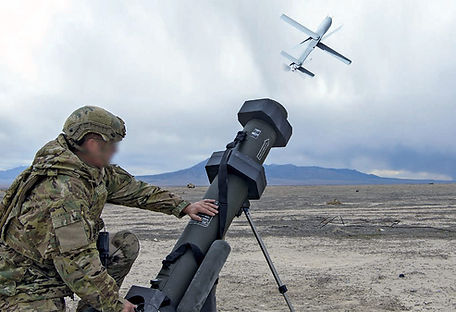
The U.S. Army has selected the Israeli-developed HERO-90 loitering munition to participate in its Low Altitude Stalking and Strike Ordnance (LASSO) program, an initiative aimed at giving Brigade Combat Teams a portable, precision-strike capability against armored threats and hardened targets on the battlefield. Developed by UVision Inc. and integrated by Mistral Inc., the HERO-90 system is designed for rapid deployment by a single operator, offering configurable warheads, mission abort and re-engage functions, and secure communications for extended-range engagements under complex conditions. The LASSO program reflects an Army priority to address gaps in infantry anti-armor lethality and adaptability, and while this selection does not yet constitute a full procurement award, it places the HERO-90 into accelerated evaluation for potential fielding. This move follows broader trends in Army modernization that emphasize portable unmanned systems alongside existing solutions like the Switchblade family to increase tactical overmatch in high-intensity conflict environments.
Sources:
https://www.jpost.com/defense-and-tech/article-883761
https://www.prnewswire.com/news-releases/mistral-and-uvision-team-announces-hero-90-selection-for-us-armys-lasso-program-302663549.html
https://thedefensepost.com/2026/01/19/us-army-hero-90/
Key Takeaways
• The U.S. Army’s LASSO program is prioritizing portable precision-strike systems to improve infantry anti-armor capabilities and battlefield flexibility.
• The HERO-90 loitering munition, developed by UVision and partnered with Mistral, offers man-portable deployment, advanced sensors, configurable warheads, and secure communications for precision engagement.
• Selection for LASSO signals movement toward accelerated evaluation and potential future procurement, aligning with broader U.S. Army modernization priorities for unmanned systems.
In-Depth
In a notable development for U.S. Army modernization efforts, the service has chosen the HERO-90 loitering munition to take part in its Low Altitude Stalking and Strike Ordnance (LASSO) program, a move designed to augment dismounted infantry capabilities against armored threats and other challenging targets. The selection was announced jointly by Mistral Inc. and UVision Inc., two defense technology firms that have been working to provide highly mobile, precision-strike solutions for modern battlefields. According to press releases and reporting from multiple defense news outlets, the HERO-90 will now enter the Army’s accelerated evaluation track under LASSO, which aims to test, refine, and assess candidate systems rapidly for potential future fielding.
The LASSO program itself reflects a shift in priorities within Army acquisition and capability development. Faced with emerging threats from peer and near-peer adversaries, U.S. ground forces are seeking ways to close capability gaps for light and dismounted units that may lack access to heavy artillery, close air support, or other high-end firepower in fast-moving engagements. With armored vehicles and fortified positions still central features of potential future battlefields, the Army wants systems that can provide immediate, tactical standoff effects without waiting on support from higher echelons. The HERO-90 loitering munition fits this requirement by giving a single soldier a system that can be launched quickly, loiters on station while awaiting target confirmation, and then delivers a precision strike with minimal collateral damage potential.
The HERO-90 platform itself combines a backpack-portable launcher with a loitering aerial vehicle equipped with electro-optical and infrared sensors, AI-assisted tracking, and secure beyond-line-of-sight communications. Configurable warheads allow it to be tailored to different mission sets, whether anti-armor or high-explosive effects are needed. Crucially, the weapon also features man-in-the-loop control with the ability to abort or re-engage missions based on real-time situational changes, an important feature for minimizing unintended consequences in dynamic combat environments.
Industry perspectives characterize the HERO-90 as part of a broader trend toward integrating unmanned systems into infantry formations as tactical multipliers rather than niche capabilities. The U.S. Army previously selected systems like AeroVironment’s Switchblade family for related LASSO requirements, demonstrating a willingness to evaluate multiple loitering munition solutions to see which best meets operational needs. As future threats evolve, this participatory evaluation approach could shape eventual procurement decisions and influence doctrine for how infantry units engage armored targets without relying on heavier platforms.
Moreover, the selection of an Israeli-developed system highlights the increasingly international dimension of defense technology cooperation, with allied innovations helping the U.S. military leverage capabilities that might otherwise take longer to mature domestically. While the HERO-90’s selection does not yet guarantee large-scale fielding, its inclusion in the Army’s evaluation pipeline underscores a clear priority: lightweight, lethal, networked systems that expand the tactical toolkit of brigade and below commanders. With continued advances in drone tech and battlefield autonomy, such systems are likely to play a significant role in shaping how ground combat unfolds in the coming decade.