

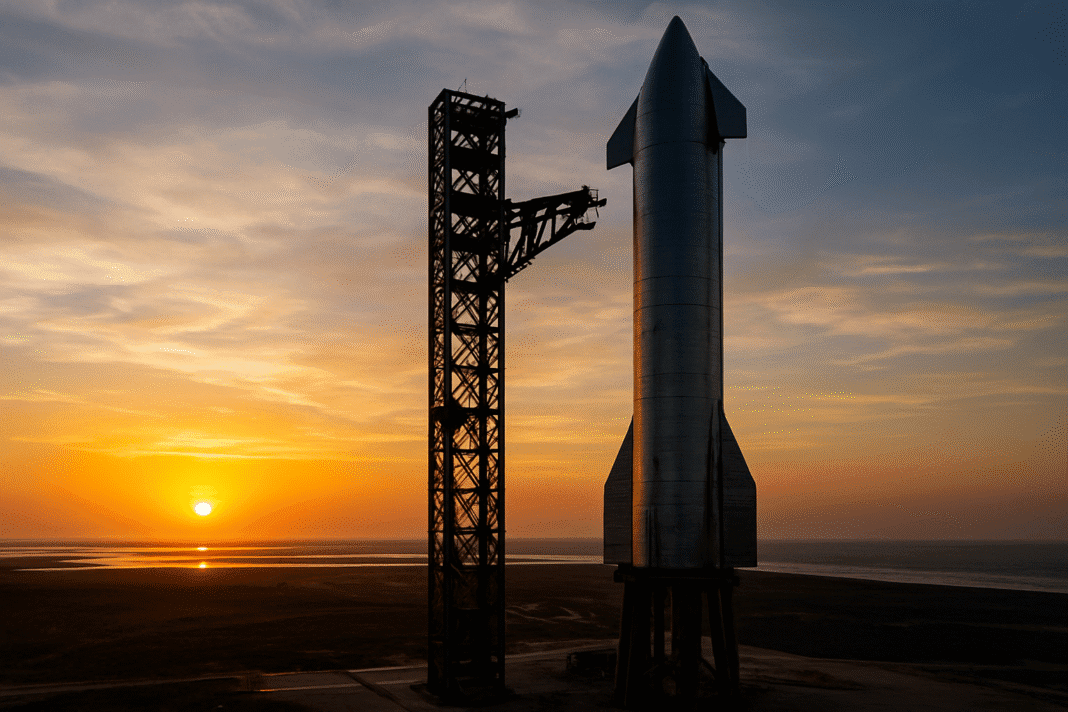
SpaceX has officially pegged mid-March 2026 as the target window for the first test launch of its upgraded Starship V3 rocket, according to CEO Elon Musk‘s announcement on social media, after the program faced delays following a November 2025 booster failure that damaged an earlier prototype. This next-generation Starship is larger and more powerful, designed to carry heavier payloads including the next wave of Starlink satellites and to perform advanced orbital operations, and the upcoming test is viewed as a critical milestone for the company’s broader ambitions in satellite deployment and deep-space exploration. The announcement comes as SpaceX continues to advance its launch infrastructure and prepare for an aggressive development cadence, while competitors like Blue Origin progress their own heavy-lift capabilities. Analysts see the mid-March debut as both a technology test and a strategic statement from SpaceX as it seeks to maintain its leadership position in commercial spaceflight and support future missions beyond low-Earth orbit.
Sources:
https://techcrunch.com/2026/01/26/spacex-eyes-mid-march-for-first-test-of-upgraded-starship-rocket/
https://timesofindia.indiatimes.com/science/elon-musk-confirms-starship-launch-in-6-weeks-as-spacex-prepares-for-march-2026-liftoff/articleshow/127703079.cms
https://www.teslarati.com/spacex-starship-v3-gets-launch-date-update-from-elon-musk/
Key Takeaways
• SpaceX is aiming for a mid-March 2026 first test of the upgraded Starship V3 after delays tied to booster testing failures.
• The upgraded design emphasizes heavier payload capacity and advanced capabilities, including docking for future missions.
• This launch effort occurs in a competitive environment with other launch providers advancing their own heavy-lift vehicles.
In-Depth
In a development that underscores both the promise and persistent challenges of commercial spaceflight, SpaceX has set its sights on a mid-March 2026 test flight for the first launch of its upgraded Starship V3 rocket. CEO Elon Musk signaled this schedule through a social media announcement indicating the test was roughly six weeks away, marking a pivotal moment for a program that has experienced both high ambition and hard knocks over the past couple of years. The Starship program, designed to produce the most powerful and capable launch vehicle ever built, has long been central to SpaceX’s strategy—not just for satellite delivery but for future lunar and interplanetary missions. Yet development has been far from smooth. A significant setback occurred in November 2025 when a booster stage of an earlier prototype suffered a damaging explosion during ground testing, nudging the timeline into 2026 as engineers addressed hardware and design concerns.
The version targeted for this upcoming flight, Starship V3, represents a substantial evolution over previous iterations. In broad strokes, it is larger and more robust, equipped to carry heavier payloads—especially the next generation of Starlink satellites, which are bigger and heavier than their predecessors—and to support complex maneuvers like orbital docking. These enhancements reflect SpaceX’s dual objectives: sustaining its dominant launch business and advancing capabilities that NASA and other partners may lean on for ambitious missions, including lunar surface access and, eventually, crewed flights farther afield. According to recent commentary, the debut of this upgraded platform is a milestone that could influence the company’s next strategic chapters.
Setting an approximate mid-March test date has clear operational significance. In a sector that moves on tight timelines and intense scrutiny, establishing and meeting credible launch milestones builds confidence among commercial customers and government partners alike. It also sends a signal to competitors—such as Blue Origin, which is progressing its own heavy-lift New Glenn rocket with scheduled launches in the coming weeks—that SpaceX remains at the forefront of next-generation space infrastructure. The timing also aligns with broader aerospace industry calendars, in which multiple orbital and deep-space missions are planned through the first quarter of 2026, making SpaceX’s progress a bellwether for the health of the U.S. space launch ecosystem.
Despite the setbacks, publicly available reporting indicates that SpaceX is pushing forward with determination. The company’s iteration-centric development model embraces rapid testing, learning from failures, and incrementally advancing hardware. That approach has delivered both dramatic successes and high-profile failures, which Musk and SpaceX leadership have framed as essential to refining technologies that will ultimately carry humans and freight deeper into space. With the first test of Starship V3 looming, the aerospace community and space enthusiasts around the world will be watching closely—not just for the raw technical performance, but for what it reveals about SpaceX’s ability to sustain an aggressive pace of innovation in the coming years.