

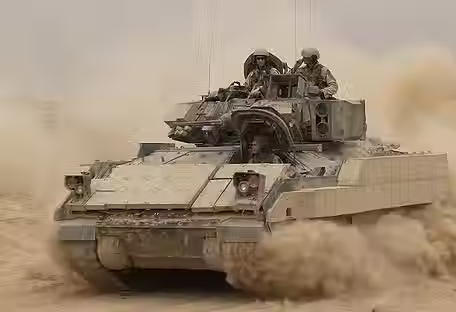
Israeli defense firm Elbit Systems has secured a follow-on contract valued at $228 million to supply its Iron Fist active protection system (APS) for integration on U.S. Army Bradley Infantry Fighting Vehicles, extending an existing partnership under General Dynamics Ordnance and Tactical Systems and continuing efforts to modernize the Bradley fleet’s defensive capabilities, with the hard-kill system designed to detect and intercept a range of battlefield threats including anti-tank missiles, rockets, unmanned aerial systems, and kinetic projectiles while enhancing survivability and reinforcing U.S.–Israeli defense cooperation.
Sources
https://www.jpost.com/defense-and-tech/article-884593
https://www.elbitsystems.com/news/elbit-systems-awarded-228-million-follow-contract-provide-iron-fist-aps-us-army-bradley-ifv
https://thedefensepost.com/2026/01/26/us-bradley-iron-fist/amp/
Key Takeaways
• The U.S. Army awarded Elbit Systems a $228 million follow-on contract to deliver Iron Fist active protection systems for Bradley infantry fighting vehicles as part of a broader modernization initiative.
• Iron Fist APS is a hard-kill defensive technology engineered to detect and neutralize threats such as anti-tank guided missiles, loitering munitions, and unmanned aerial systems to improve battlefield survivability.
• The contract builds on earlier agreements and reflects deepening cooperation between American defense programs and Elbit’s international defense portfolio.
In-Depth
The U.S. Army’s decision to award a substantial follow-on contract to Elbit Systems for its Iron Fist active protection system marks a notable development in armored vehicle defense and international defense partnerships. Iron Fist is a hard-kill active protection system that significantly enhances the ability of armored platforms—specifically the Bradley Infantry Fighting Vehicle—to detect, track, and intercept incoming threats before they can strike. These threats include a spectrum of modern battlefield dangers, from anti-tank guided missiles to rocket-propelled grenades, unmanned aerial systems, and other projectiles that pose a lethal risk to infantry fighting vehicles and their crews. The system’s design, which emphasizes compact form factor and integration efficiency, allows it to be fitted onto Bradley variants in service while preserving mobility and operational effectiveness.
The follow-on contract, worth $228 million and executed over a multi-year period, builds on earlier work under initial APS agreements awarded to Elbit by General Dynamics Ordnance and Tactical Systems, the prime contractor leading the Bradley upgrade program. This continuity underscores sustained confidence by both U.S. Army acquisition authorities and the defense community in Iron Fist’s technological performance and its capacity to address evolving threat environments. In addition to U.S. Army applications, the Iron Fist APS has been selected for use in other NATO and allied armored platforms, signaling broader acceptance of the technology in allied defense modernization efforts.
The integration of advanced protective systems like Iron Fist represents a shift in how mechanized forces approach survivability. Rather than relying solely on passive armor, modern armored warfare emphasizes layered defenses in which active protection systems play a crucial role in neutralizing incoming threats before contact. While active protection systems are not foolproof solutions, their development and deployment reflect military planners’ recognition that adaptable, sensor-driven defensive technologies are increasingly essential on future battlefields where drones, guided weapons, and advanced munitions are prevalent. The Iron Fist contract also highlights enduring cooperation between the United States and international defense partners, with shared interests in enhancing force protection and battlefield effectiveness across allied militaries.