

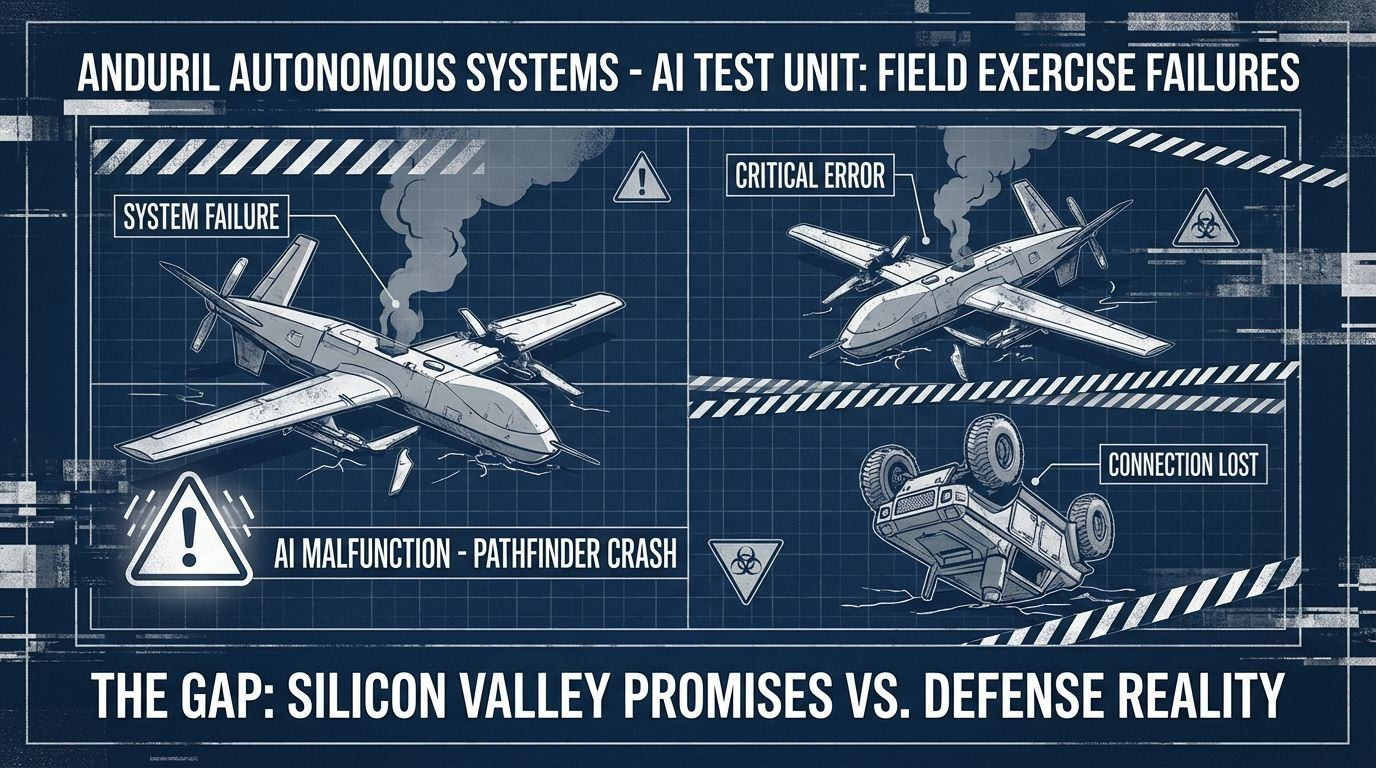
The defense-tech firm Anduril Industries has come under renewed scrutiny after multiple weapons systems suffered critical breakdowns during U.S. Navy exercises, weapons testing, and actual deployment in Ukraine — prompting concerns within military and policy circles about the reliability of autonomous weapon systems.
Sources: TechCrunch, Wall Street Journal
Key Takeaways
– Several of Anduril’s drone boats failed during a May Navy exercise off California, idling and posing safety risks, which sailors flagged as potential hazards.
– The company’s unmanned jet fighter “Fury” experienced engine trouble during ground testing, and its “Anvil” counter-drone system caused a 22-acre fire in Oregon during a separate test, underscoring repeated technical and safety problems.
– In real-world combat, particularly in Ukraine, reports indicate that Anduril’s loitering UAVs (Altius drones) crashed or failed to strike targets, leading Ukrainian forces to abandon their use in 2024.
In-Depth
In a dramatic turn for Silicon Valley’s self-styled defense-tech darling, Anduril Industries is now confronting serious performance failures across multiple weapons systems — failures that have occurred not just in controlled tests, but also during active military operations. According to a recent exposé, more than a dozen of the company’s autonomous drone boats malfunctioned during a naval exercise off California, idling and failing to respond to commands. The incident was so severe that sailors involved raised red flags about safety lapses and the risk of loss of life, citing “safety violations” and “continuous operational security violations.” The Navy reportedly had to scramble overnight to tow disabled vessels back to shore.
The breakdowns did not stop there. During a summer ground test, Anduril’s unmanned jet fighter “Fury” suffered engine damage that delayed critical testing milestones. Even more alarming: a test of the “Anvil” counter-drone system in August triggered a 22-acre fire in Oregon. According to range reports, aerial photos and satellite imagery showed scorched earth and mangled hardware — evidence of how far autonomous weapons still are from maturity.
Perhaps the sharpest blow to Anduril’s reputation came from actual battlefield performance in Ukraine. Ukrainian forces reportedly deployed Anduril’s Altius loitering drones as part of their arsenal. But repeated failures — drones crashing or missing targets — led to a complete pullback in 2024. The technology simply didn’t deliver in the unforgiving chaos of war.
These setbacks call into question the reliability of increasingly hyped autonomous weapons. The failures are not just technical glitches buried in logs — they pose real risks to human lives and mission success. Proponents of Anduril argue that such breakdowns are an expected part of rapid, iterative development: test, fail, learn, improve. That may sound reasonable in software development, but when the software controls lethal weapons, “fail fast” takes on an ominous tone.
Meanwhile, military buyers and policymakers will need to reckon with the reality: these systems are not yet battle-ready. Even if Anduril continues to iterate, the notion that autonomy can safely replace—or even supplement—manned systems seems increasingly questionable until the firm can prove consistent reliability under stress.