

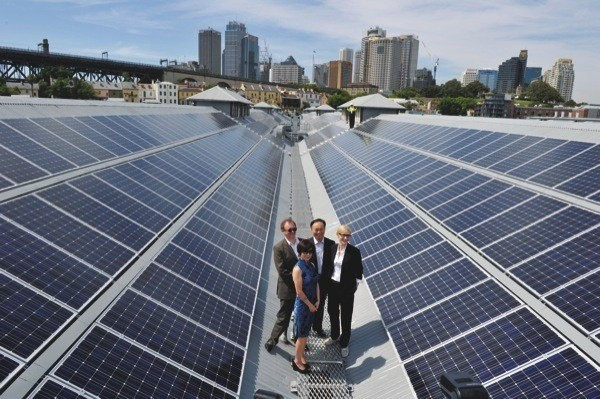
Australia’s federal government is rolling out an ambitious program in July 2026 that will grant households in New South Wales, South Australia and Southeast Queensland three hours of free electricity each day, regardless of whether the household has rooftop solar panels, provided they have a smart meter and shift usage into the midday solar-peak window. The plan, dubbed the “Solar Sharer” scheme, leverages Australia’s booming rooftop solar capacity—where over one in three homes already have solar panels—to flatten demand peaks and ease strain on the grid. Energy retailers will be required to offer these free-power hours to all customers, and the government expects the policy to reduce overall system costs and ultimately benefit all electricity users.
Sources: Reuters, The Guardian
Key Takeaways
– The initiative lets households receive free electricity for three hours daily during midday when solar generation peaks, even if they don’t have rooftop solar panels or batteries.
– The policy is aimed at shifting electricity usage away from expensive and polluting evening peaks (driven by coal and gas) into daylight hours when solar power is abundant and wholesale prices drop, sometimes even turning negative.
– While the move signals consumer relief and grid-efficiency gains, some industry groups warn of insufficient consultation, potential unintended cost impacts for energy retailers, and the need for smart meters and behavioral change from consumers.
In-Depth
The decision by Australia’s federal government to guarantee three hours of free electricity each day to millions of households marks a bold intervention in the energy market—a move that carries both promise and risk. At its heart, the policy recognizes that the country’s rooftop solar build-out has reached a tipping point: with installation costs around US $840 per kilowatt of capacity (roughly a third of U.S. costs) and over one in three homes already outfitted with panels, daytime solar generation has become so abundant that wholesale electricity prices collapse during the sunniest hours. According to TechCrunch, this enables the government to “share more of that power with more Australians.”
By requiring utilities to offer the free-power window—likely sometime between 11 a.m. and 2 p.m.—the program is designed to harness otherwise under-utilised solar production. A key objective is flattening the infamous evening peak when households return from work, fire up air-conditioning, cook dinner and charge electric vehicles, forcing the grid to rely on more expensive and carbon-intensive generation from coal and gas. The government rightly argues that moving load into lower-cost midday hours lowers overall system cost and hence electricity bills in the long run.
What makes the scheme particularly noteworthy is its inclusivity: households without solar panels—renters, apartment dwellers or those whose roofs can’t support panels—will still qualify, so long as they have a smart meter and can opt in to the plan. This is a departure from many incentives that only reward owners of rooftop solar. The broader rollout (after the initial states) is expected by 2027, and the plan is overseen under the Default Market Offer (DMO), which caps how much retailers can charge.
From a conservative viewpoint, the policy ticks several pragmatic boxes: it taps existing market signals (daytime solar oversupply), shifts consumer behaviour to align with supply-side realities, defers costly network upgrades by smoothing demand curves and delivers tangible cost relief for households. However, conservative caution would flag a few issues: first, the burden implicitly shifts onto energy retailers and/or other ratepayers if free hours are not offset by equivalent savings elsewhere. Indeed, industry lobbyists have raised concerns about retailer margins and market confidence. The Guardian reports the Australian Energy Council lamented an announcement “without consultation,” raising fears of unintended consequences.
Second, the plan assumes behavioural change: households must shift laundry, EV charging, pool pumps or other flexible loads into the free-power window to fully benefit. Without this shift, uptake may be weak, and the utility grid benefits smaller. Smart appliances and scheduling tools help, but many households may resist shifting their routines. Third, while free daytime power is attractive, the policy needs to guard against cost shifting: if peak-evening rates rise or network charges increase to compensate, some consumers could end up worse off.
Finally, the broader political context matters. The Australian government has committed to 82 % renewable electricity by 2030 and a 43 % emissions reduction from 2005 levels. This free-power policy fits that trajectory by leveraging solar rather than mandating heavy subsidies. But it will require sustained infrastructure investment—smart-meter roll-out, grid balancing, storage solutions—to succeed reliably.
In summary, Australia’s new free electricity scheme is a clever, market-responsive approach to leveraging solar abundance and benefiting consumers. From a conservative lens, it emphasises cost-savings, infrastructure efficiency and behavioural alignment rather than endless subsidies. But its success hinges on effective rollout, clear consumer participation, regulatory balance and careful monitoring to ensure the benefits are fairly distributed and the risks contained.