

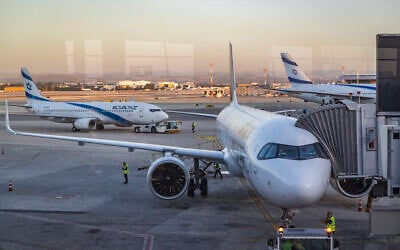
Boeing and Israel’s Technion have launched a significant collaboration through the Boeing–Technion Sustainable Aviation Fuel (SAF) Innovation Center to develop low-carbon jet fuel technology that could cut aviation’s greenhouse gas emissions and help the industry move toward competitive commercial production of sustainable aviation fuels made from green hydrogen and captured carbon dioxide; after concluding an initial feasibility study, the initiative is now progressing to hands-on development aimed at creating commercially viable SAF while supporting energy security, industry growth, and Israeli innovation, although SAF remains cost-challenging and makes up a small fraction of current jet fuel consumption.
Sources
https://www.timesofisrael.com/boeing-and-israels-technion-to-develop-clean-fuel-tech-to-cut-carbon-footprints/
https://www.jpost.com/business-and-innovation/article-884701
https://www.reuters.com/sustainability/boeing-israels-technion-develop-sustainable-aviation-fuel-sector-grapples-with-2026-01-27/
Key Takeaways
• Boeing and Technion are transitioning their sustainable aviation fuel collaboration from feasibility work to active development aimed at commercial competitiveness.
• The joint effort focuses on producing SAF from green hydrogen and captured carbon dioxide to lower aviation emissions and support long-term industry growth.
• Despite technical progress, sustainable aviation fuel remains more expensive and a small portion of global jet fuel use, posing ongoing challenges for broader adoption.
In-Depth
Boeing’s strategic partnership with the Technion–Israel Institute of Technology represents a notable effort by a major aerospace manufacturer to tackle one of the most persistent environmental challenges facing commercial aviation: reducing reliance on fossil-based jet fuels and cutting greenhouse gas emissions. The initiative, anchored at the Boeing–Technion Sustainable Aviation Fuel (SAF) Innovation Center established in 2023, recently moved beyond theoretical studies into practical, hands-on development aimed at refining processes that produce low-carbon sustainable aviation fuel from green hydrogen and captured carbon dioxide. This shift reflects Boeing’s broader commitment to advancing technologies that could help the aviation sector achieve ambitious climate targets, including its own goal of delivering aircraft capable of flying entirely on SAF by 2030, and the industry’s longer-term aspiration of reaching net-zero carbon emissions by 2050.
Industry insiders acknowledge that sustainable aviation fuel holds the promise of significantly reducing carbon emissions—potentially by as much as 80 percent compared with conventional jet fuel—but real-world deployment has been limited. In 2025, SAF accounted for less than one percent of total jet fuel consumption, and its production costs remain substantially higher than fossil fuels, which has slowed adoption among carriers and manufacturers alike. Nonetheless, Boeing’s investment of multi-million-dollar support for the collaboration—with the involvement of Technion faculty and doctoral researchers across multiple disciplines—signals confidence that technological breakthroughs can help overcome both cost and scale barriers.
The partnership also underscores the broader significance of international research cooperation and the role of national innovation ecosystems in driving advancements in critical industrial technologies. Israeli government agencies and industrial stakeholders have reportedly supported SAF development through research consortia and startup acceleration programs, further reinforcing the strategic economic and environmental importance of the work taking place at the Technion. As Boeing and its partners refine methods for converting sustainable feedstocks into aviation fuels and build experimental testing facilities, they are positioning themselves at the forefront of a nascent but potentially transformative segment of the aerospace fuel landscape.
Despite persistent cost challenges, this collaboration highlights a pragmatic push toward cleaner aviation energy sources and reflects Boeing’s calculated engagement with innovation beyond aircraft manufacturing—addressing the energy demands and environmental responsibilities of an industry under growing scrutiny. The success of this and similar initiatives could influence the trajectory of SAF adoption globally, particularly if breakthroughs enable cost reductions and scalable production that appeal to airlines balancing economic and environmental objectives.