

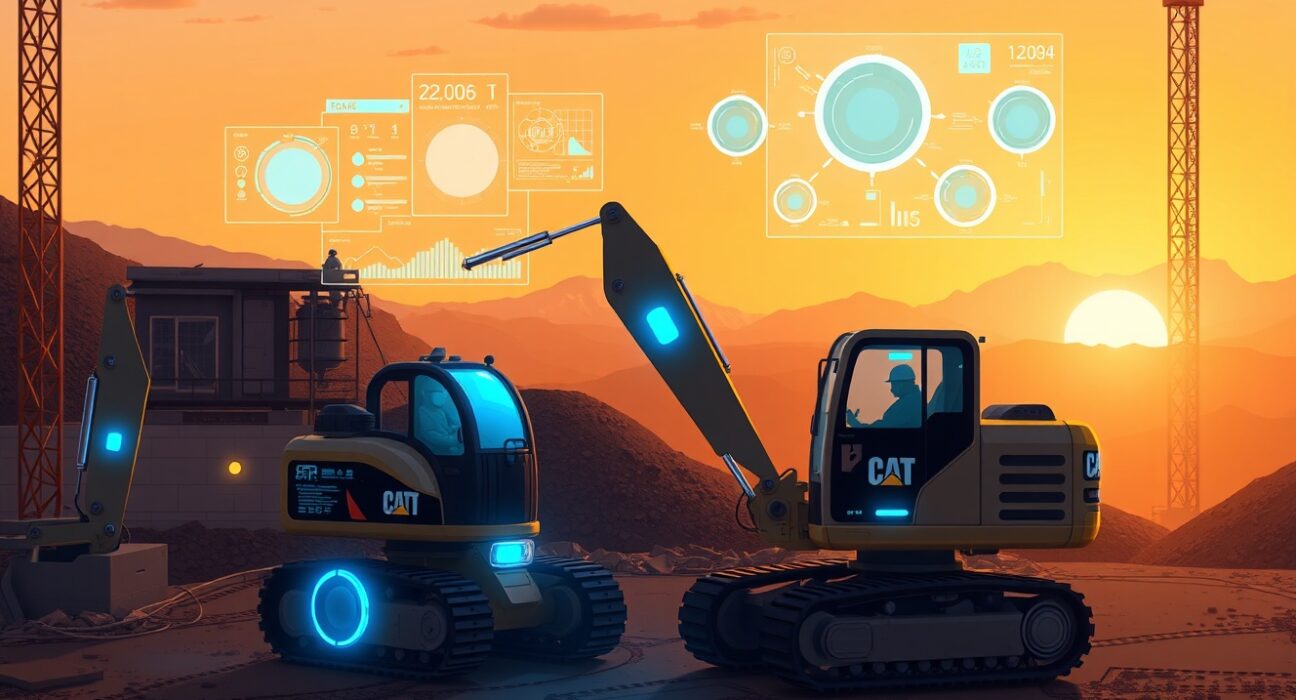
Caterpillar announced a significant expansion of its partnership with Nvidia to embed advanced artificial intelligence directly into construction and mining equipment, transforming traditional machines with real-time, edge AI capabilities designed to support operators, improve safety and efficiency, and enable autonomous functions, highlighted by the debut of the Cat AI Assistant running on Nvidia’s Jetson Thor platform that can interact naturally with users, provide operational guidance, and collect rich jobsite data for digital twin simulations and improved decision-making across jobsites and factory operations.
Sources:
https://techcrunch.com/2026/01/07/caterpillar-taps-nvidia-to-bring-ai-to-its-construction-equipment/ https://www.prnewswire.com/news-releases/caterpillar-teams-with-nvidia-to-revolutionize-heavy-industry-with-physical-ai-and-robotics-302655427.html https://www.datacenterdynamics.com/en/news/caterpillar-and-nvidia-to-integrate-ai-into-manufacturing-and-operating-systems/
Key Takeaways
• Caterpillar is integrating Nvidia’s physical AI platforms into its heavy machinery to offer on-board AI assistance, analytics, and automation.
• The Cat AI Assistant uses edge computing to help operators with real-time guidance, safety tips, maintenance support, and natural language interaction.
• Data gathered from AI-enhanced machines feeds digital twin simulations and factory optimization tools, signaling broader industrial transformation beyond just the jobsite.
In-Depth
At the Consumer Electronics Show on January 7, 2026, Caterpillar showcased a bold move into industrial artificial intelligence by deepening its collaboration with Nvidia. For a company long associated with raw mechanical power and rugged reliability, this shift toward software-driven capability represents a major evolution. Heavy equipment outfitted with Nvidia’s Jetson Thor physical AI platform can now process data locally at the edge and interact with machine operators through the newly introduced Cat AI Assistant. Instead of relying on distant cloud servers, these AI systems work directly on the jobsite to interpret real-world conditions, offer tailored operating advice, and surface safety and maintenance insights in real time. This integration is not merely about voice commands or friendly interfaces, but about embedding intelligence into platforms that historically relied on human expertise alone.
From a conservative perspective, the practical implication is clear: this partnership leverages American technological leadership in semiconductor design to extend the productive life and utility of U.S.-built infrastructure equipment. The Cat AI move does not replace humans but augments their capabilities—making operators safer and more productive while generating valuable operational data. That data feeds digital twin simulations and factory automation tools that can optimize scheduling, resource allocation, and manufacturing flows, enhancing economic efficiency without surrendering core industrial control to overseas cloud systems or unaccountable tech monopolies.
This approach underscores how responsible adoption of AI can boost the competitiveness of traditional industries. By keeping processing at the edge and integrating data with trusted Caterpillar platforms, the emphasis remains on enhancing work, not displacing it. As these systems scale across construction, mining, and factory environments, they offer a pathway to smarter infrastructure development and more resilient supply chains—rooted in durable American engineering and powered by cutting-edge AI innovation.