

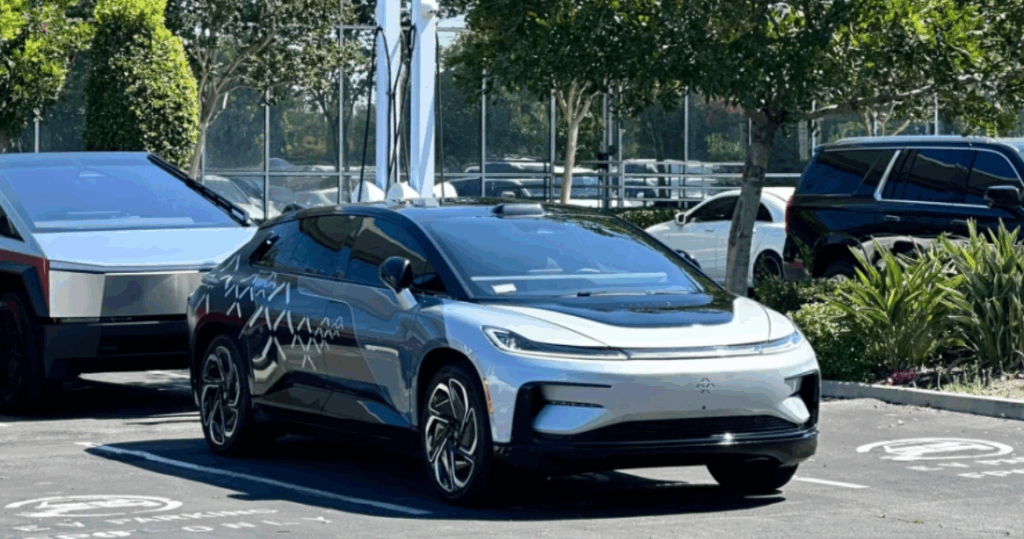
Early Sunday morning, a Faraday Future FF 91 electric prototype caught fire at the startup‘s Los Angeles headquarters, triggering an explosion that blew out portions of a wall and led Los Angeles’ Department of Building and Safety to red-tag the affected building as unsafe to occupy. No injuries were reported, and Faraday says its main operations were unaffected, claiming preliminary findings show the battery pack was likely not to blame, instead pointing to a wiring short or a loose 12V connection. The fire happened just as the company’s lease on the property was expiring — a lease dispute with the landlord had already been settled earlier this year — compounding concerns about the EV company’s financial and operational footing.
Key Takeaways
– The fire-explosion incident involved a beta prototype FF 91 used for display, not a production vehicle, with Faraday stating its battery pack remained largely undamaged and unlikely the cause.
– The building where the fire occurred has been red-tagged and declared unsafe, requiring structural work before reoccupation, which may disrupt operations and logistics.
– The timing is especially precarious: Faraday’s lease for the property was set to expire, and recent legal and financial pressures make the incident a dangerous blow to credibility and stability.
In-Depth
The explosion and fire at Faraday Future’s Los Angeles headquarters is more than an isolated accident — it underlines how fragile the company’s position has become, both in terms of physical infrastructure and investor confidence. According to public reports, the blaze was first detected at 4:37 a.m. on September 28. Firefighters took about 40 minutes to contain the flames, but not before the blast had pushed out part of a wall and caused serious structural damage in an adjacent two-story section of the complex. The Los Angeles Department of Building and Safety has since “red-tagged” the building, declaring it unsafe until repairs or renovations are made.
Faraday’s immediate reaction was to emphasize that no staff were hurt and that the main operations of the company are “unaffected.” In a public statement, the company said the vehicle involved was an early engineering prototype (a beta unit), and that its interior materials, they admitted, do not meet the fire safety standards required of production vehicles. That disclosure has raised questions about why display or prototype units used on site weren’t held to higher safety precautions. Faraday claims it found no evidence implicating the battery pack, which if true might help limit reputational damage given how sensitive the public and regulators are to EV battery fire risks. Instead, they suggest the cause could lie in wiring in the showroom or a loose 12V electrical connection.
Still, this incident exposes several vulnerabilities. First, the damage to the facility could interrupt R&D, assembly, parts storage, or simply day-to-day operations that depend on that space. The red tag means some of the workspace is off limits until repairs are signed off, which might force temporary relocations. Second, the timing is brutal: Faraday sold the headquarters back in 2019 to raise capital, now leasing it. The landlord had previously sued to evict over missed payments, although that was settled in April 2024, with the lease set to expire at the end of September 2025. That means the fire occurs just as the company’s physical claim on the facility is under flux. Third, in financial and credibility terms, the fire offers fuel to critics who’ve long questioned whether Faraday can deliver viable production vehicles or manage operational risk competently.
Technically, the fact that the battery pack and structural subframe reportedly escaped major damage is a small silver lining. It suggests that the thermal containment systems and materials outside the cabin did their job to some degree. But it also highlights the potential danger of letting less strictly controlled prototype components—materials or wiring not meeting final safety standards—remain active in public spaces. For an EV company teetering between innovation and insolvency, each mishap tightens the margins of error.
In the coming days, the investigation’s findings will matter greatly. If wiring or 12V system flaws are confirmed, they point to preventable lapses in internal safety oversight. If deeper design problems are found, or ambiguity remains, the pressure from investors, regulators, and the marketplace will only intensify. In short, the explosion at headquarters is more than a dramatic news event — it’s a warning shot about what happens when a startup with stretched resources sustains damage in both its physical and reputational foundations.