

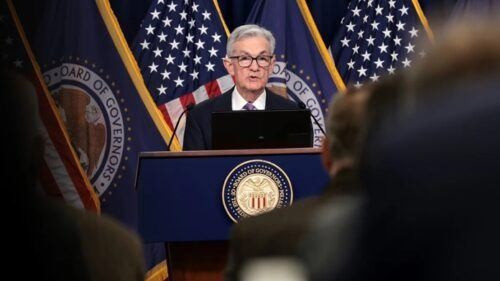
Federal Reserve Chair Jerome Powell said the surge in artificial-intelligence investment and spending should not be described as a bubble like the 1990s dot-com boom, noting that today’s companies “actually have earnings” and business models tied to concrete infrastructure. Sources cite his remarks at the Oct. 30, 2025, post-policy-meeting press conference, where he emphasized the difference in this cycle: investments are largely by established firms with revenue streams rather than speculative start-ups. At the same time, other analysts and media outlets caution that while the fundamentals may be stronger, the scale of AI capex and potential misalignments between spending and returns still raise bubble risks. The debate reflects a divide between optimism that AI will boost productivity and concerns that unchecked exuberance could sow instability.
Sources: Yahoo News, MarketWatch
Key Takeaways
– Chair Powell is clear that today’s AI investment wave is qualitatively different from the dot-com bubble of the late 1990s because many firms are already profitable, making “real businesses,” he says.
– Despite Powell’s reassurance, some market commentators and journalists argue the parallels remain strong: large-scale valuations, massive spending commitments, and uncertain monetization suggest bubble-like dynamics might still be present.
– The broader implication for economic policy: the Fed appears willing to recognize the productivity potential of AI without immediately treating it as a systemic financial risk, but that leaves open questions around labor markets, infrastructure capacity and the timing of returns.
In-Depth
In recent remarks following the Federal Reserve’s policy meeting, Chair Jerome Powell addressed a question that has been gaining traction across both financial markets and economic commentary: Is the explosion of investment in artificial-intelligence technologies a speculative bubble? Powell firmly answered no — but with some nuance. He emphasized that today’s AI ecosystem differs materially from the bubble that inflated during the dot-com era. Back then, many companies went public with little more than an idea and little to no earnings; today, the dominant firms underpinning the AI wave already generate substantial revenue, free cash flow, and have business models tied to cloud infrastructure, advanced chips, data centers and enterprise software. His argument: when companies have tangible earnings, risk is reduced compared with pure speculation.
Wall Street and media analytics haven’t entirely accepted this optimistic framing. Some report that although firms are profitable, the scale of spending and valuations remains staggering — the build-out of AI infrastructure, data-centers, chip fabs and the cloud networks supporting generative-AI applications involve multibillion-dollar commitments. That raises questions about whether investment growth is getting ahead of monetization and whether a reversal or slowdown could ripple through equity markets or the broader economy.
From a policy perspective, Powell’s stance signals that the Fed is willing to view the AI wave as a potential productivity engine rather than a latent financial hazard — at least for now. By distinguishing this cycle from the dot-com burst, he implicitly suggests the Fed may not treat the current AI investment boom as a trigger to pre-emptively tighten policy solely on account of asset-price excess. At the same time, the Fed remains alert to the possibility that elevated capex could translate into inflation, or that a collapse of expectations could impact employment or growth.
For conservative-leaning observers, Powell’s framing offers a cautiously positive narrative: the United States may be at an inflection point where technological investment can drive real economic expansion and productivity gains rather than simply speculative hi-tech mania. Yet that optimism should be tempered by realism. Infrastructure build-outs need power, data-flow, labor, and ecosystems to function. If any one of those bottlenecks slows, returns could be delayed — meaning the goose may not lay its golden egg overnight. The contrast between firms already earning and newer entrants chasing lofty valuations matters, but doesn’t eliminate the risk of disappointment or overreach.
In short, Powell’s declaration that the AI spending wave is “different this time” may carry weight — but it’s not a guarantee that risk is zero. Markets, investors and policymakers should heed both the potential and the pitfalls.