

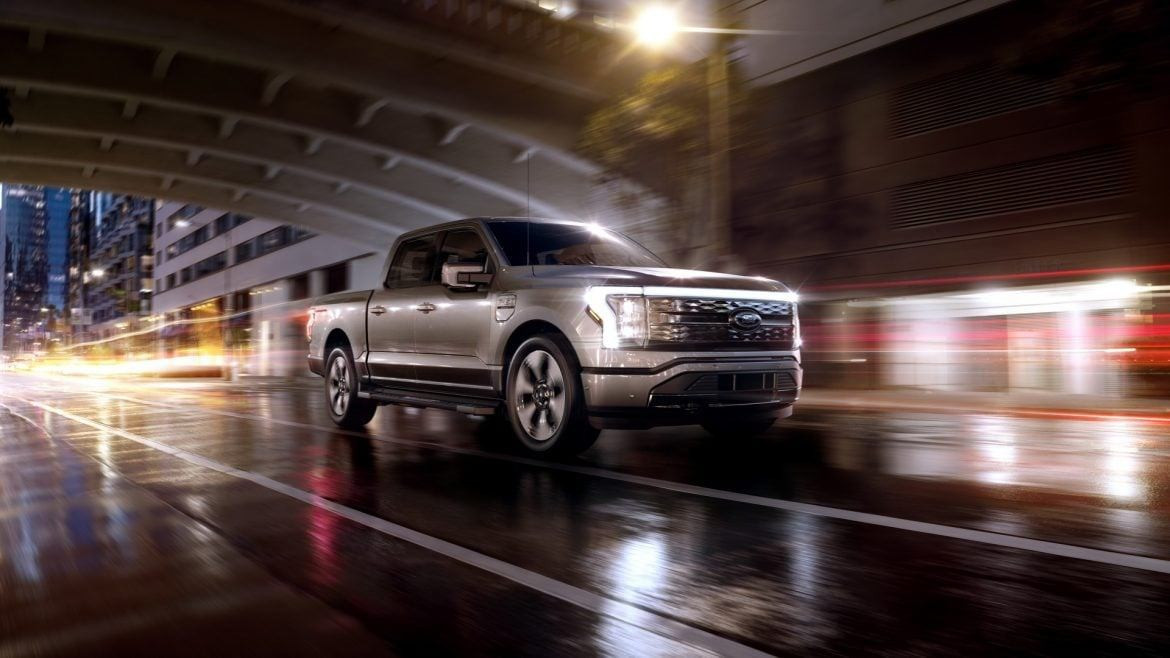
Executives at Ford Motor Company are reportedly considering discontinuing the all-electric version of its flagship pickup, the Ford F‑150 Lightning, amid slow sales, mounting losses and a recent production fire at a key aluminium supplier. According to reports, Ford paused production of the Lightning while prioritising gas and hybrid versions of the F-150 due to an aluminium-supplier fire and shifting market conditions. The decision underscores a broader EV strategy reset as Ford confronts low demand for large electric trucks and moves to restructure its lineup.
Sources: Car & Driver, Car Expert
Key Takeaways
– Ford is actively discussing whether to axe the F-150 Lightning entirely, rather than merely pause production, due to weak demand and profitability concerns.
– A fire at aluminium-supplier Novelis caused supply disruptions, prompting Ford to halt the electric truck’s production and shift focus to more profitable gas/hybrid F-150 models.
– The reported move reflects a broader trend in the auto industry away from high-cost large electric trucks toward lower-cost EVs, hybrids and internal-combustion vehicles as electrification ambitions face real-world headwinds.
In-Depth
Ford’s contemplation of pulling the plug on the F-150 Lightning sends a clear signal: the electric-truck era for major full-size pickups may be entering a reality check. When the Lightning debuted in 2021, it was portrayed as a watershed moment — the electrified version of America’s best-selling pickup, a symbol of EV legitimacy in a conventional truck world. But now, according to multiple reports, Ford executives are engaged in active discussions about discontinuing the model altogether. TechCrunch reports that the talks come after a late-October decision to idle production of the Lightning while prioritising the conventional gas and hybrid versions of the F-150. The production halt followed the fire at Novelis’ aluminium plant, which constrained aluminium body-panel supply and forced Ford to allocate materials to its more profitable ICE/hybrid lineup.
Car & Driver adds that the model is off to a sluggish start in terms of volume relative to expectations: despite being one of the first full-size EV pickups on the U.S. market, the Lightning has sold only a few thousand units per quarter and represents a tiny fraction of Ford’s overall F-Series volume. That poor uptake, compounded by the removal of the federal EV tax credit and rising costs, has made the business case difficult to justify. CarExpert further elaborates that the Lightning’s pricing has been substantially higher than originally promised and demand remains thin, hence the speculation that Ford may never resume Lightning production in its current form.
From a broader strategic perspective, Ford’s move appears less like an isolated model cut and more like a pivot. The automaker is reportedly shifting resources — including labour from its Rouge Electric Vehicle Center in Dearborn, Michigan — toward gas and hybrid F-150 production and a forthcoming smaller, more affordable electric pickup scheduled for 2027. By reallocating capital and capacity, Ford is signalling caution about committing heavy resources to high-cost EV trucks that may not scale profitably in the near term.
For conservative-leaning watchers of the auto sector, the development underscores the importance of realistic market economics over hype. The electrification narrative has often emphasised inevitability, but Ford’s recalibration suggests legacy OEMs are not immune to cost pressures, consumer hesitation and supply-chain disruptions. The question now is how many more large electric pickups will face similar re-evaluations — and how that reshapes the future landscape of trucks, hybrids and EVs in the United States.