

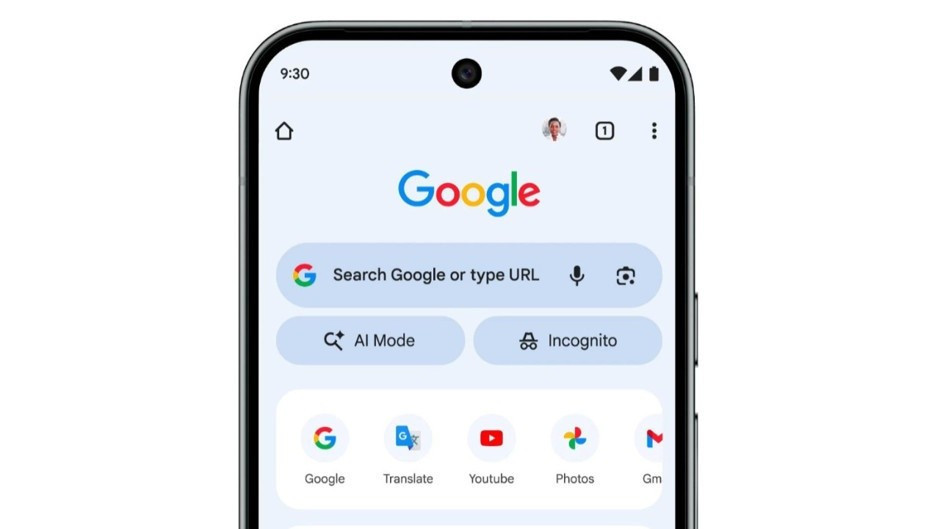
Google announced that its mobile version of Chrome is getting a dedicated “AI Mode” button positioned under the search bar on the New Tab page for iOS and Android users in the U.S., with a rollout to about 160 additional countries and support for languages such as Hindi, Indonesian, Japanese, Korean and Portuguese.
Sources: Google, Android GadgetHacks
Key Takeaways
– Google is making its AI Mode more accessible on mobile by adding a prominent shortcut button in the browser’s New Tab view, reducing friction for users seeking advanced search capabilities.
– The feature is part of a broader push by Chrome and Google to embed conversational-AI tools directly into everyday browsing rather than as separate apps or experimental add-ons.
– By launching the update in the U.S. first and then expanding globally, Google appears to be pre-empting competition from standalone AI tools and reinforcing its dominance in search and browser usage.
In-Depth
In a move that reflects its ambition to merge the convenience of search with the power of artificial intelligence, Google has rolled out a major update to Chrome for iOS and Android: a dedicated “AI Mode” shortcut button just beneath the search bar when opening a new tab. According to official communication from Google, the feature is live now in the U.S. and will soon arrive in about 160 more countries with support for a wider range of languages including Hindi, Indonesian, Japanese, Korean, and Portuguese. (Blog.Google)
What’s at stake? For years, Google’s primary interface for information retrieval has been the ordinary search box—with users typing keywords, clicking results, and navigating multiple pages. The new AI Mode shortcut reduces that friction: one tap, and users can ask complex, follow-up questions, explore topics deeper, and receive context-aware responses. It’s less about bringing users to a separate product, and more about embedding AI into the default browsing workflow. (TechCrunch)
That design choice is significant. By placing AI Mode front and center in Chrome’s mobile UI, Google is clearly signaling that this is no longer a niche experiment; it is becoming a standard part of how people browse, especially on mobile devices where convenience and speed matter most. According to GadgetHacks, Chrome commands a dominant share of the mobile browser market—so layering in AI at that scale could shift how millions of users approach search and discovery.
The timing aligns with Google’s broader push in AI: earlier this month, Google expanded the capabilities of AI Mode to include “agentic” tasks like booking event tickets or beauty-and-wellness appointments. (TechCrunch) With those features still evolving, the new shortcut ensures that users don’t have to go digging through menus or remember separate URLs—they can access Google’s most advanced AI experiences with minimal taps.
From a conservative-leaning perspective, this move underscores how big tech increasingly centralizes control over information access. By placing AI Mode prominently within Chrome, Google deepens its role not just as a gateway to web content, but as an intermediary interpreting, filtering, and presenting information to users. For content creators, publishers, advertisers, and regulatory observers alike, this means the battleground shifts from “search engine ranking” to “how Google’s AI interprets the query and composes the answer.”
In practical terms, users will notice the new experience as soon as they open a new tab in Chrome on mobile: beneath the familiar search box they’ll see a bold, pill-shaped button labeled “AI Mode” (or equivalent) that signals a single-tap access to conversational AI. They can then type or speak questions, follow-up with deeper prompts, and interact in a dialogue rather than a static search result list. Google says this rollout is the next phase of its effort to make AI accessible “when you’re on the go.” (Blog.Google)
Of course, the change also raises questions. How will accuracy, bias, transparency and user control be managed in the context of more automated responses? Will users realize when answers are generated rather than simply retrieved? And what does this mean for websites and publishers whose traffic may shift as Google’s AI serves up synthesized answers? For creators—podcasters, writers, media outlets—the challenge will be to integrate this evolving search paradigm into their distribution strategies.