

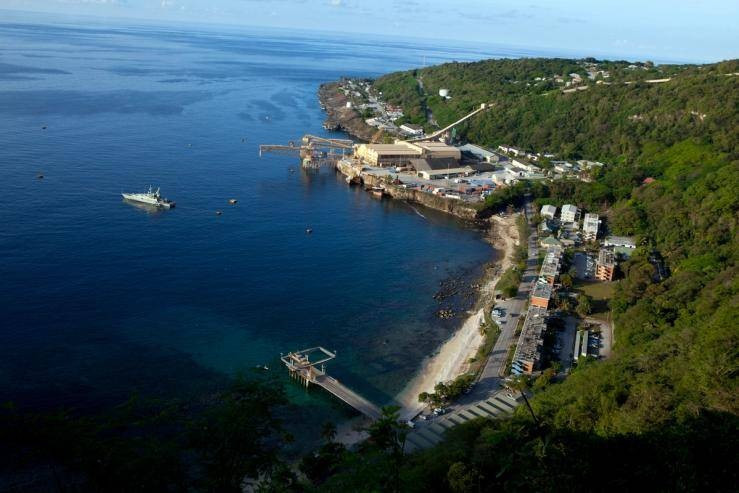
Google plans to establish a large artificial-intelligence data-center on Australia’s remote Indian Ocean territory of Christmas Island after striking a cloud-services agreement with the Australian Department of Defence earlier in 2025. According to multiple reports, the project would leverage the island’s strategic location roughly 350 km off Indonesia to support AI-enabled command, control and surveillance operations in the Indo-Pacific—particularly against growing Chinese naval activity. The tech giant is in advanced negotiations to lease land near the island’s airport and secure a long-term energy deal with a local mining company, while also seeking environmental approval for a subsea cable linking Christmas Island to Darwin in northern Australia. Local leaders say the initiative could bring infrastructure upgrades and jobs to the roughly 1,600-resident island but warn that community consent and impact on tourism and energy reliability must be addressed.
Sources: Reuters, The Guardian
Key Takeaways
– The site of the data centre—Christmas Island—provides a forward positioning advantage for Australia and its allies in the Indo-Pacific region, especially in tracking submarine and naval activity.
– The deal continues a trend of major tech firms like Google leveraging public-private partnerships to build infrastructure that blends commercial cloud services with defence applications.
– While the project promises local economic benefits such as jobs and better connectivity, the small‐community island also faces risks like increased militarisation, environmental strain and dependence on external energy sources.
In-Depth
In recent months, the tech-world and defence-community received notice of a bold new infrastructure initiative by Google LLC: to establish a large artificial-intelligence data-centre on Christmas Island, a small Australian territory in the Indian Ocean roughly 350 km south of Indonesia. The project gains added significance given that earlier in 2025 Google entered a multi‐year cloud-services deal with the Australian Department of Defence, signalling deeper integration between commercial cloud infrastructure and national security uses. According to reporting, Google is negotiating to lease land near the island’s airport and to partner with a local mining company to meet the site’s long-term energy requirements.
From a strategic standpoint, the island’s location is key. Defence analysts note that it lies near vital maritime chokepoints such as the Sunda and Lombok Straits, making it a prime vantage for surveillance, communications and uncrewed system operations tied to Indo-Pacific security. A subsea fibre-optic cable, reportedly in the works to link the island to Darwin in northern Australia—home to rotating U.S. Marine units—further underscores the dual commercial-defence dimensions of the project. The cable would enhance network resilience, bypass vulnerable satellite links and support high-bandwidth, low-latency data flows that undergird AI-enabled command and control.
On the local front, the island’s community of about 1,600 residents is cautiously optimistic. Officials believe the centre could bring much-needed infrastructure upgrades, broader digital connectivity and employment opportunities—longstanding gaps for this remote outpost. At the same time, they stress that any development must not compromise the island’s environment, tourism appeal (notably the famed red-crab migration), or impose energy burdens on residents already reliant on diesel and limited renewables.
Yet the broader implications extend beyond this tiny territory. The project typifies how leading technology companies are venturing deeper into geo-strategic infrastructure—blurring the lines between commercial cloud services and government defence capabilities. In a climate of rising great-power competition, especially between Australia and China, this data-centre could serve as a forward node in intelligence, surveillance and uncrewed operation ecosystems. For Google, the commercial upside aligns with regional cloud expansion and growing demand for AI-capable data-hubs; for Australia and its allies, the site offers a strategic asset in a contested maritime domain.
Nevertheless, challenges remain. The precise cost, size and timeline of the centre are not yet public. Community engagement must ensure local benefits and manage concerns of militarisation and environmental impact. From an energy perspective, assuring the island has reliable power without burdening residents is critical. On the defence side, deploying such infrastructure in a remote zone carries risks including maintenance, security and potential escalation in regional tensions.
All told, the Christmas Island initiative reinforces a convergence of tech, cloud infrastructure and defence strategy in the Indo-Pacific region. It may mark a significant step forward in how national security is supported by commercial data-hubs—and how remote territories become critical nodes in global power dynamics.