

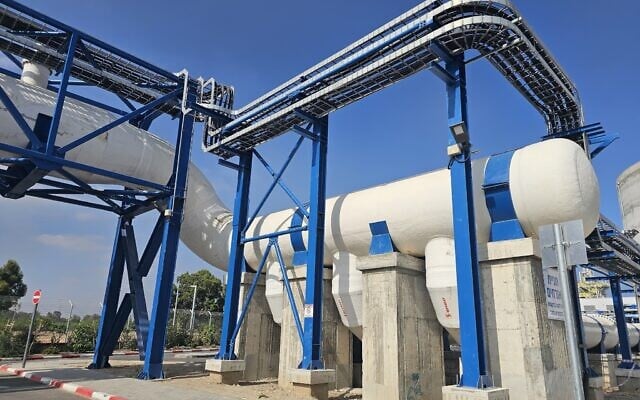
Israel’s Water Authority announced that the Soreq B desalination plant in the central region at Rishon Lezion has officially entered full operational status, capable of producing 200 million cubic meters of desalinated water annually, significantly bolstering the nation’s potable water supply; with six desalination facilities now contributing roughly 800 million cubic meters, desalination is projected to meet 70-80 percent of the country’s drinking water needs while additional “manufactured” water from recycled sewage and brackish sources bring total non-natural supply to around 1.5 billion cubic meters, with a seventh plant in Western Galilee expected online in 2027.
Sources
https://www.timesofisrael.com/desalination-plant-in-central-region-goes-into-full-operation/
https://www.gov.il/en/pages/project-desalination-sorek-b
https://en.wikipedia.org/wiki/Water_supply_and_sanitation_in_Israel
Key Takeaways
• The Soreq B desalination facility in central Israel now operates at full capacity, producing 200 million cubic meters of potable water annually.
• Israel’s network of desalination plants is providing the bulk of the nation’s drinking water, significantly reducing reliance on traditional sources like rainfall and freshwater reservoirs.
• Additional water sources — recycled sewage and brackish water — combined with desalination contribute to roughly 1.5 billion cubic meters of “manufactured” water, with expansion plans underway to further augment supply.
In-Depth
Israel’s advancement in water infrastructure reached a new milestone as the Soreq B desalination plant in the central region achieved full operational capacity, marking a major step in the country’s long-term strategy to secure reliable and abundant sources of potable water in a climate that historically suffers from aridity and limited natural freshwater resources. Located in Rishon Lezion and initially operating at reduced capacity for about a year, the Soreq B facility can now produce 200 million cubic meters of desalinated water per year, representing a meaningful contribution toward the overall national water supply and easing pressure on conventional water sources such as the Sea of Galilee and underground aquifers. This substantial output helps diversify Israel’s water portfolio amid changing weather patterns and growing demand from population and economic development.
Desalination in Israel is not an isolated effort but part of an integrated water policy that blends technology, infrastructure and resource management. With multiple desalination plants along the Mediterranean coast, the combined output now supplies the majority of the country’s drinking water. Six major plants are contributing around 800 million cubic meters annually, which alone meets an estimated 70 to 80 percent of potable water needs. These figures demonstrate how strategic investment in reverse osmosis desalination technology has shifted Israel from a water-scarce nation toward far greater self-sufficiency, especially when natural rainfall fluctuates from season to season.
But desalination does not operate in a vacuum; it works alongside other “manufactured” water sources that include recycled sewage and brackish water systems. Together, these systems produce an estimated 1.5 billion cubic meters of water, underscoring a broader approach that blends engineered solutions with resource recycling. While desalinated water addresses municipal and household needs, recycled and brackish sources help support agricultural and industrial uses, reducing dependence on finite natural reserves. Nearly all of this infrastructure falls under the national water management framework, with oversight and coordination from agencies that emphasize resilience and reliability.
Looking ahead, Israel plans to further expand its water production capabilities. A seventh desalination station, situated in the Western Galilee region, is slated to come online in 2027 and is expected to add another 100 million cubic meters of capacity. This development reflects ongoing efforts to anticipate future water demand growth and the need to adapt to climatic variability. Together, the current and planned desalination capacity, complemented by alternative water sources, positions Israel to meet not only its present potable water requirements but also to build a buffer against potential future shortages where natural resources alone may fall short.
Desalination has thus become a cornerstone of Israel’s national water strategy, turning a traditional vulnerability — limited natural freshwater — into a strength by harnessing advanced technologies and infrastructure to deliver consistent water supplies for its people and economy.