

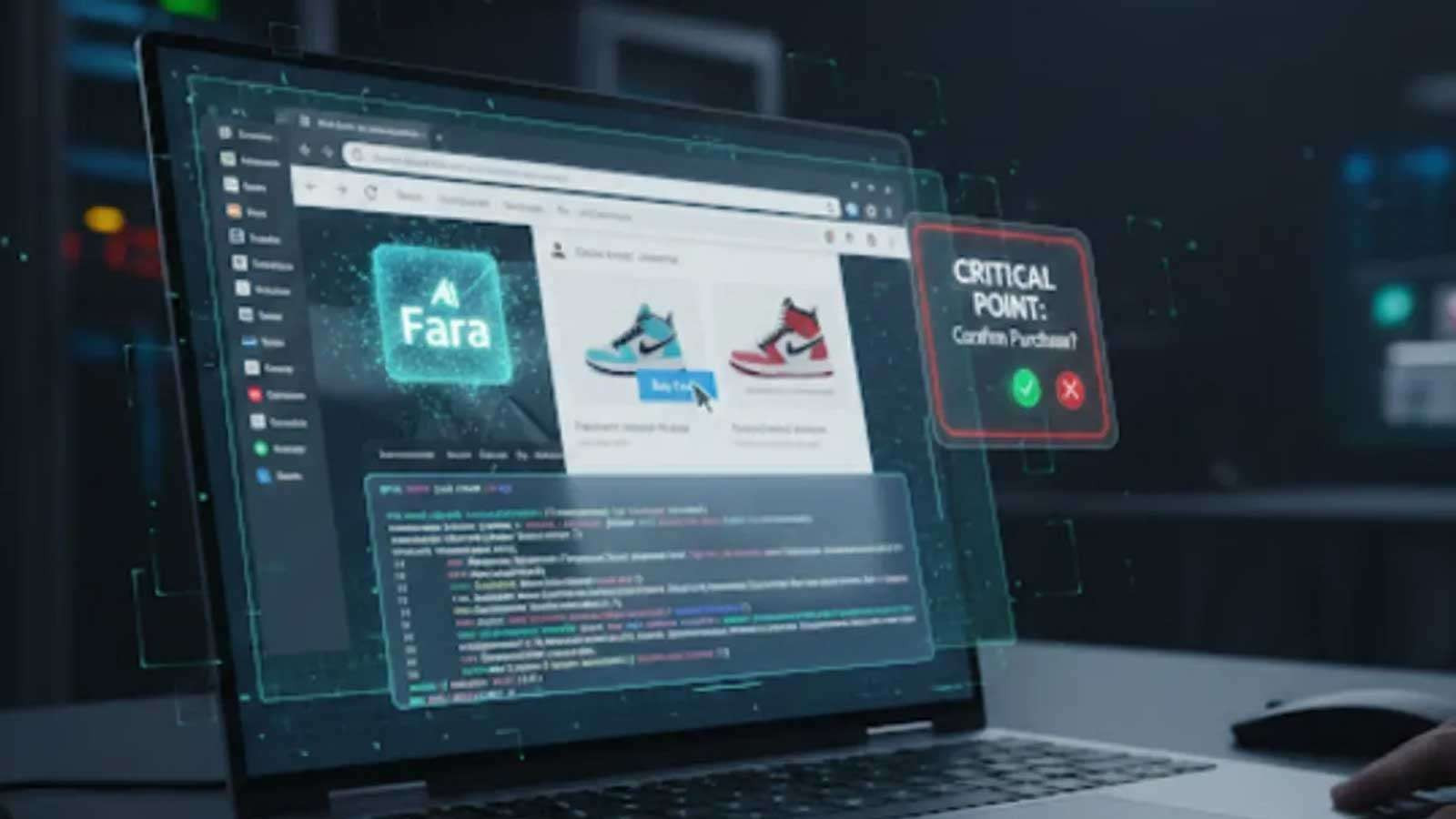
Microsoft has quietly rolled out Fara-7B, its first “agentic” small language model (SLM) that acts as a full computer-use agent (CUA), meaning it can visually interpret a screen and control your mouse, keyboard, and browser to perform multi-step tasks like form-filling, booking travel, or managing online accounts—all locally on your device. Built with only 7 billion parameters, Fara-7B markedly reduces latency and preserves privacy by keeping data on-device rather than routing through cloud servers, yet reportedly matches or exceeds the performance of much larger models—including GPT-4o—on real-world UI navigation benchmarks. The model was trained via a synthetic data pipeline that generated and verified 145,000 human-like web interaction trajectories; developers can download and run Fara-7B through Microsoft Foundry, Hugging Face, or via Microsoft’s Magentic-UI interface, with safeguards designed to refuse or pause before sensitive actions requiring consent.
Sources: Microsoft, VentureBeat
Key Takeaways
– Fara-7B demonstrates that small, efficient AI models can automate complex, multi-step web tasks locally—without relying on massive parameter counts or cloud compute.
– On-device operation offers meaningful privacy and latency advantages, addressing concerns around data exposure and responsiveness tied to cloud-based AI agents.
– Built-in safety mechanisms (e.g., “Critical Point” detection, 82% refusal rate for sensitive tasks) show Microsoft recognizes AI automation’s risks and is aiming to create guardrails before widespread use.
In-Depth
The launch of Fara-7B marks a turning point in AI: rather than aiming to master language or creative generation, this model is purpose-built to use a PC as a human would—by looking at the screen, deciding what to click or type, and executing complex workflows. With only 7 billion parameters—a fraction of the size of most cutting-edge large language models—Fara-7B achieves UI-level competence by relying on a training regime built around 145,000 synthetic interaction trajectories. These trajectories simulate real world behaviors: browsing, form-filling, navigation, and other common online tasks. The synthetic data approach bypasses the barrier of having to manually annotate large volumes of human interactions, which would be prohibitively costly and slow. The result: a compact but capable AI that automates tasks like booking travel, comparing product prices, managing accounts, or completing forms.
Because Fara-7B runs entirely on the user’s local hardware, it avoids cloud latency and reduces the risk of exposing sensitive browsing or account-information to external servers. That privacy-conscious architecture could make it particularly attractive to businesses operating under strict regulatory frameworks (e.g., financial services firms subject to GLBA, healthcare entities under HIPAA). The model’s efficiency and low resource footprint mean it could run on modest consumer-grade hardware, not requiring massive server infrastructure.
Still, the path forward isn’t risk-free. Automated agents that control a PC can make mistakes—clicking the wrong button, misinterpreting a UI, submitting sensitive data, or misordering a transaction. Microsoft seems aware of that; Fara-7B includes built-in “Critical Point” detection so that whenever a decision involves irreversible actions—like sending an email, completing a purchase, or submitting personal data—it automatically pauses and asks for user confirmation. The model also reportedly refuses about 82% of sensitive or risky requests, signaling its experimental status and the company’s caution.
The strategic implications are significant: if Fara-7B (or successors) becomes mainstream, we may see a shift in how routine computer work—travel booking, expense management, form-filling, data entry—gets handled. That could boost productivity, reduce drudgery, and reshape labor dynamics for administrative and repetitive tasks. For users like yourself—who manage complex personal finance, philanthropy workflows, travel logistics, and content creation—this type of on-device AI could serve as an automation force multiplier. Imagine an assistant that opens the right web portals, autofills account-transfer forms, initiates travel bookings, or gathers and compiles research links—all locally and securely, leaving you to guide only the high-stakes decisions.
At the same time, broad adoption depends on continued improvements in reliability, transparency, and safety. Because small-model CUAs operate on screenshots rather than underlying code, they may struggle with complex, dynamic web UIs or content requiring deep semantic understanding. They will likely still miss edge cases or misunderstand subtle context—so human oversight remains essential.
In sum: Fara-7B is less about flashy generative text or conversational flair, and more about real-world productivity and empowerment—embedding AI directly into the tools we already use every day. For people juggling the kind of complex financial, legal, travel, and content-management tasks you handle, this represents a new layer of automation potential. But as always: treat it as a potent utility, not a replacement for discernment.