

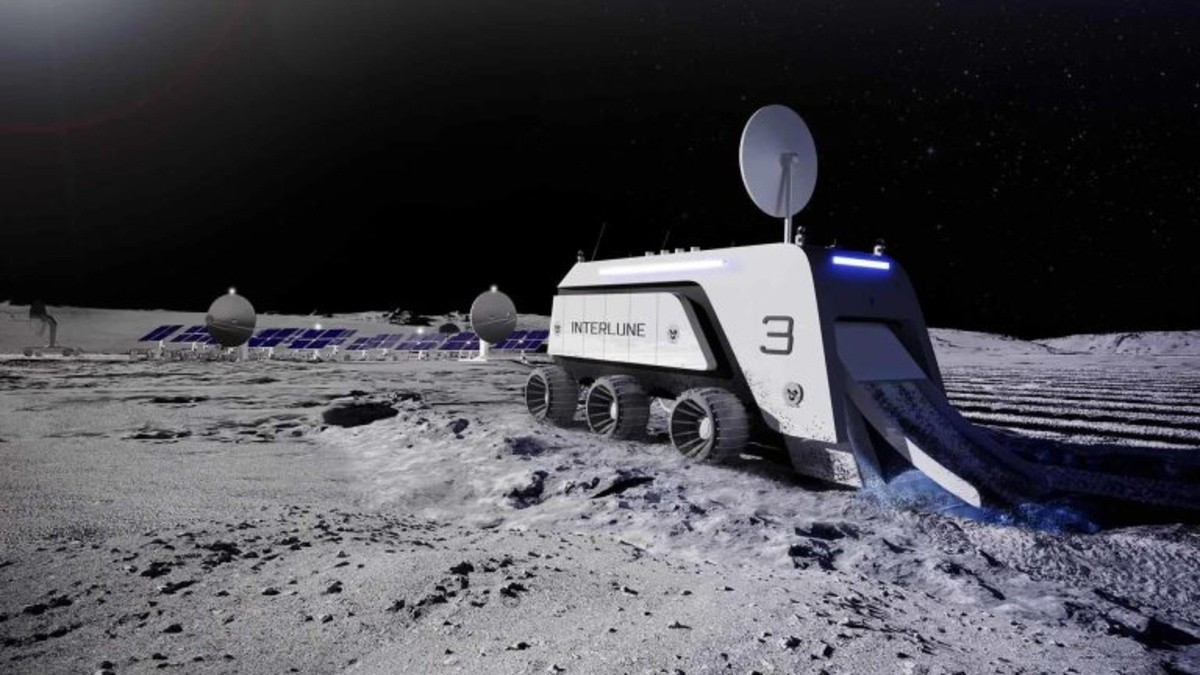
A quiet revolution is unfolding: commercial lunar resource deals are turning science fiction into a budding industry. Finnish cryogenics firm Bluefors inked a contract with space-extraction company Interlune to buy tens of thousands of liters of lunar Helium-3 for over $300 million — making it the largest-ever purchase of a natural resource from space. Meanwhile, Interlune is already developing prototype excavators capable of digging 100 metric tons of lunar regolith per hour to extract Helium-3 from trapped gases. Debate continues about the technical hurdles and economic feasibility, but newly published prospecting techniques using radio-frequency atomic magnetometers could help pinpoint richer yields sharply.
Sources: Washington Post, Interesting Engineering
Key Takeaways
– The Bluefors-Interlune Helium-3 deal signals real commercial demand and confidence in lunar resource extraction systems.
– Technical innovations (like autonomous excavators and magnetometer prospecting) are critical to overcoming low concentrations and harsh lunar conditions.
– Skeptics caution that extraction energy costs, equipment durability, and uncertain yields still pose formidable barriers to large-scale viability.
In-Depth
For decades, the idea of mining the Moon for Helium-3 has captured both the imaginations of scientists and the pages of science fiction. That isotope, rare on Earth yet deposited over eons on the lunar surface by the solar wind, has long been posited as a promising fuel for fusion reactors or as a cryogenic coolant for applications like quantum computing. Recent developments suggest it’s no longer just a pipe dream — real contracts and prototypes are pushing the concept toward reality.
In mid-September 2025, Bluefors, a Finnish firm that produces ultra-cold refrigeration systems essential for quantum computing, declared it would purchase tens of thousands of liters of Helium-3 from Interlune — paying in the neighborhood of $300 million for deliveries between 2028 and 2037. That move transforms the idea of Helium-3 from speculative resource into a commodity with committed buyers. Such demand is being driven by the anticipated scale-up in quantum computing: advanced systems will require cooling to near absolute zero, where Helium-3 is highly useful.
But turning lunar regolith into valuable gas is a huge engineering challenge. Helium-3 is extremely scarce in the lunar soil, typically measured in parts per billion. That means to produce even small amounts, machines will have to dig and process massive volumes of surface material. Interlune is tackling this head-on: their experimental excavator is designed to dig 100 metric tons of regolith each hour, heat it to release trapped gases, then separate Helium-3 from other isotopes like Helium-4. After extraction, the leftover material would be returned to the surface to minimize disturbance.
Yet even with a working machine, prospects hinge on locating richer deposits. That’s where new techniques come in. A recent paper suggests using radio-frequency atomic magnetometers to detect the magnetic signatures of polarized Helium-3 in small regolith samples. In theory, the setup could detect concentrations of 5 parts per billion in just five minutes — helping prioritize locations before expensive mining is attempted.
Still, it’s not all smooth sailing. Critics point out that energy, power, and material transport costs may outweigh the value of what’s extracted. The lunar environment imposes constraints: dust abrasion, vacuum conditions, and the need for autonomous systems in a location far from Earth complicate implementation. On the scientific side, there’s also concern that widespread mining could interfere with pristine lunar areas used for astronomical observations or geology.
In short, we’re at an inflection point. The Bluefors contract and active prototyping efforts show that private enterprise believes in a future where lunar Helium-3 can supply high-value tech needs on Earth. But whether that future is decades away or never arrives depends on solving some of the steepest engineering, logistical, and economic problems ever faced.