

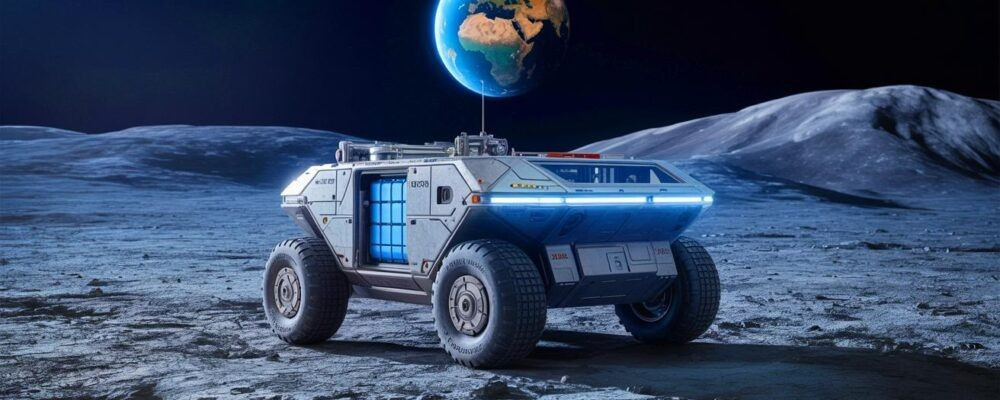
As NASA’s Artemis program advances, General Motors—in collaboration with Lunar Outpost—has unveiled a lunar rover concept boasting a rechargeable battery capable of lasting a decade and a lifetime range of roughly 19,000 miles, along with advanced maneuvering features like “crab walking” and zero-point turning for tackling lunar terrain. The vehicle is one of three contenders vying for NASA’s Lunar Terrain Vehicle (LTV) contract, intended to support sustained crewed operations on the Moon beyond the Apollo era. New Atlas describes how GM’s battery tech is central to this design, with “super-precise laser welding” and defect-scanning measures adapted from its EV work to ensure reliability in the harsh lunar environment. GM’s own announcements highlight that this LTV prototype aims to merge automotive-grade durability with space qualifications, operating autonomously or under astronaut control. Meanwhile, field testing of Lunar Outpost’s Eagle rover is already underway in Colorado ahead of NASA’s selection.
Sources: General Motors, NewAtlas
Key Takeaways
– GM’s lunar rover concept is designed with a rechargeable battery rated for 10 years and a projected lifetime range of ~19,000 miles—dramatically surpassing the Apollo-era rovers.
– Advanced fabrication techniques (laser welding, defect scanning) originally developed for Earth EVs are being adapted to bolster durability and reliability in the Moon’s harsh environment.
– The rover is competing among three finalists under NASA’s LTV program, and prototypes (like Lunar Outpost’s Eagle) are undergoing terrestrial testing to validate performance in realistic terrain.
In-Depth
NASA’s Artemis program, intended to return humans to the Moon and establish a sustainable presence there, demands a step change in lunar mobility. The Apollo missions used disposable rovers reliant on nonrechargeable batteries, limiting them to a total 57 miles of travel—barely scratching the surface of possibilities. In contrast, GM and Lunar Outpost are proposing a Lunar Terrain Vehicle (LTV) whose powertrain is built for longevity, reliability, and versatility. According to New Atlas, GM’s version promises a 10-year battery life and a lifetime travel capacity of about 19,000 miles, a vast leap forward in usable traverse capabilities. That’s especially ambitious given the rigors of the lunar environment—extreme temperature swings, vacuum, abrasive dust, and micrometeoroid exposure.
To meet those demands, GM is adapting techniques from its electric vehicle work: super-precise laser welding and flash thermography scanning to detect weld defects ensure that battery packs are robust and consistent under stress. These methods serve as quality control safeguards, reducing the risk of catastrophic failure in remote, unreachable settings. GM’s own corporate communications emphasize that the LTV must combine automotive durability with space-qualified resilience, able to operate both under astronaut control and autonomously.
Competition is stiff. NASA has shortlisted three companies (including Lunar Outpost, Intuitive Machines, and Venturi Astrolab) to build this next-generation rover. In Colorado, Lunar Outpost is already testing its Eagle prototype over rugged terrain that simulates lunar regolith, craters, and elevation changes. The tests use real sensors (LiDAR, cameras) and autonomous navigation to validate how well the rover can “crab walk,” pivot, or dodge obstacles. Observers note that the wheels themselves are engineered for longevity—designed to survive in a low-maintenance state for years on the Moon without servicing.
If successful, this LTV will be more than a piece of machinery—it will be core infrastructure for deep lunar exploration. Astronauts could cover farther ground, carry heavier scientific payloads, and do so with less dependence on resupply or redundancy. But challenges remain: battery performance in extreme cold, micrometeorite damage, dust infiltration, and the unknowns of long-term operation in lunar day/night cycles. NASA will select a winner in the coming months, and the chosen system is likely to be deployed on Artemis V (currently slated for 2030 or later).
If GM’s ambitious battery architecture holds up under the Moon’s brutal conditions and the rover’s mobility systems work as promised, we could see a fundamental shift in how we explore the lunar surface—making Artemis not only a return mission, but a persistent presence.