

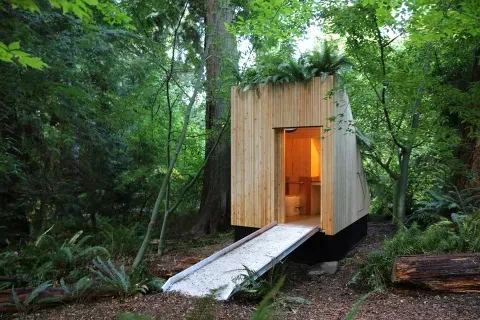
University of British Columbia researchers have unveiled the world’s first mushroom-powered waterless toilet, dubbed the MycoToilet, in the UBC Botanical Garden to pilot a novel waste-composting system leveraging mycelium to break down human waste without water, electricity, or harsh chemicals. According to UBC, the modular unit requires just four maintenance visits per year, is wheelchair-accessible, and employs a design intended to minimize odor and infrastructure cost. The project’s developers claim that the mycelium liners remove over 90 percent of odor-causing compounds while converting solid waste into nutrient-rich compost and processing liquids into fertilizer. The six-week pilot launched September 26 will test real-user experience, microbial performance, and viability for deployments in parks, remote communities, and developing regions.
Source links: TechXplore, NewAtlas
Key Takeaways
– The MycoToilet uses mycelium (fungal root networks) to process human waste into compost and fertilizer, eliminating the need for water, electricity, or chemical inputs.
– In lab trials, mycelial liners have removed more than 90 % of odor-producing compounds, addressing one of the main challenges of composting or decentralized toilets.
– The pilot run will evaluate system performance, user feedback, and scalability in settings without conventional plumbing, aiming to offer a self-contained sanitation option for parks, remote communities, and developing regions.
In-Depth
The MycoToilet represents a bold rethinking of how we handle human waste, especially in settings where plumbing is impractical or costly. Rather than treating waste as a disposal challenge, the project frames it as a resource: human waste becomes compost and fertilizer via biological transformation. At its core is a compartment lined with mycelium, the network of fungal threads that permeates soil and decomposing matter. As waste arrives, the mycelium and associated microbial communities enzymatically break it down into simpler compounds, accelerating decomposition in an aerobic environment. In contrast with conventional composting or chemical toilets, the approach aims to avoid foul odors and avoid reliance on external energy or chemical inputs.
From the design perspective, the UBC team took care to make the unit approachable and practical. The structure is modular, prefabricated from timber panels, with cedar cladding (charred for antimicrobial effect), a green roof, skylights, and ventilated compartments to maintain airflow. It is wheelchair-accessible and aesthetically blends into a natural garden environment, mitigating many of the negative psychological or experiential associations people may have with “composting toilets.” The maintenance schedule is fixed — four visits per year — sidestepping unpredictable upkeep burdens that often deter municipalities from adopting nontraditional sanitation systems. The unit separates solids and liquids: solids enter the mycelium chamber, while liquids are stored, processed, and eventually used as fertilizer.
Still, this is early days. The six-week pilot beginning September 26 will gauge real world behavior: whether the mycelium truly handles user load without odor or system failures, how microbial communities evolve over time, whether the compost output is safe and usable, and how users respond to installation, comfort, and perception. Optimizing the fungal and bacterial consortia is critical, since decomposition must remain aerobic to prevent smell and pathogen proliferation. The team is also grappling with the challenge of designing mycelium growth media and inserts that scale reliably and consistently.
If the pilot succeeds, the MycoToilet could be rolled out to parks, rural communities, refugee camps, or developing regions where centralized sewer infrastructure is unavailable or expensive. It could reduce reliance on chemical toilets (which introduce toxins and challenge disposal) and shrink the infrastructure footprint of sanitation systems. But there are hurdles: public acceptance, regulatory approval (especially for human waste reuse), long-term durability, pathogen risk, the consistency of compost quality, and cost versus conventional options. The project is inherently interdisciplinary, drawing on architecture, microbiology, ecology, and engineering, and it will require proving that the elegant concept holds up under sustained use. If it does, however, mushroom-powered toilets might become a compelling tool in sustainable sanitation strategy.