

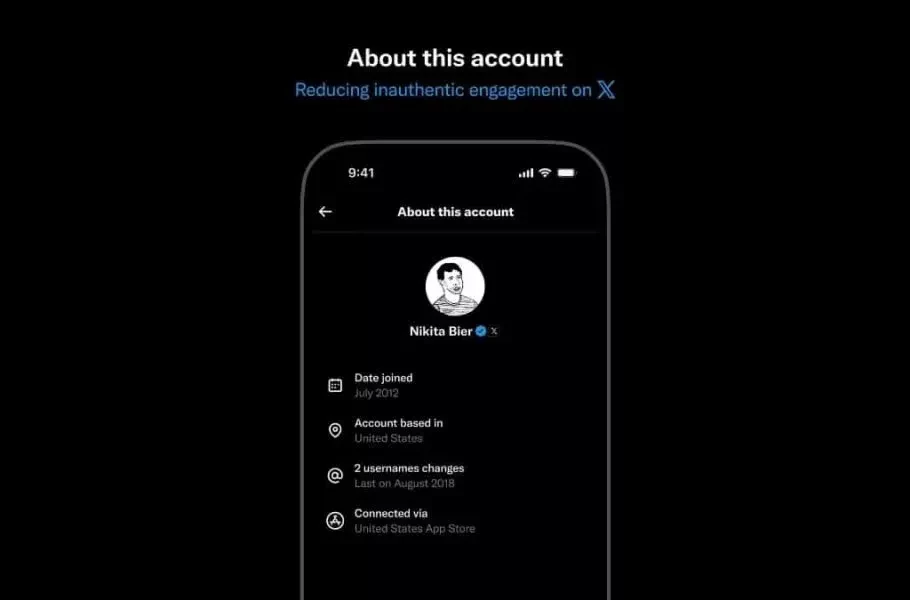
Over the weekend, social-media platform X introduced its new “About This Account” profile feature, which publicly displays details such as account join date, username change history, and crucially the country or region where the account is based. While the initiative is pitched as a boost to authenticity and trust in an era of bot farms and foreign influence operations, early users and reviewers have flagged serious inaccuracies — many accounts claiming U.S.-based identities are shown as operating from countries like Japan, Pakistan, or Thailand, and X itself has acknowledged that data for older accounts is “not 100 %.” (1) The rollout has thus become a flashpoint between pro-transparency branding and practical concerns about flawed data, user privacy, and political weaponisation of location metadata.
Sources: TechCrunch, The Verge
Key Takeaways
– The “About This Account” feature is intended to improve transparency and combat bots or misleading foreign-influenced accounts by displaying join date, username change count, and declared geographical base.
– Early results reveal many right-leaning “America First” style accounts claiming U.S. affiliation actually appear to be based abroad, calling into question either the profiles’ authenticity or the accuracy of X’s data.
– The rollout is marred by data quality issues (especially for older accounts), privacy-sensitivity concerns (especially in authoritarian regimes), and potential misuse of the location data for political targeting or doxxing.
In-Depth
The rollout of “About This Account” by X represents one of the more visible attempts by a social-platform to provide users with additional metadata about who they are interacting with. In theory, this helps users make more informed judgments: if an account purporting to be a local U.S. voice instead appears to be based halfway around the world, that is a relevant signal regarding context, authenticity and moderation risk. Indeed, as one of the earlier announcements made clear, the intention is to help users differentiate between accounts that are genuinely domestic and those that may serve foreign or otherwise coordinated agendas.
However, as the real-world implementation has revealed, the devil is in the details. According to reporting, many accounts widely assumed to be U.S.-based turned out in the metadata to be flagged as located in countries such as Pakistan, Thailand or New Zealand. While that might raise legitimate questions about whether those accounts were actually foreign-based, it also raises the issue of accuracy: X itself acknowledged that the location data for long-established (“older”) accounts may not be reliable. In many cases VPNs, travel histories, proxy servers or global staffing make it difficult to assign a meaningful “base country” to a profile without risk of error.
For conservatives and right-leaning users — in particular those supporting the “America First” messaging style — these revelations may feel especially disconcerting: if prominent MAGA-style accounts are shown as based abroad, critics will pounce not only on the content but on the perceived authenticity of the messenger. That dynamic risks turning what was pitched as a transparency feature into a political weapon. On the flip side, supporters of platform integrity will argue that exposing such metadata is precisely the kind of step long overdue in an ecosystem awash with bots, trolls and coordinated inauthentic behaviour.
The rollout also opens up serious privacy and safety questions. Users based in authoritarian countries may face real risk if their location is exposed; X indicated it would offer region-level disclosures instead of country in those cases, but rolling out any kind of location flag carries consequences. Some users have described the rollout as a kind of forced doxxing. Further, inaccurate or misleading metadata may erode trust rather than build it: if users see profiles flagged as based abroad that they know are domestic (or vice versa), the credibility of the system itself comes into question.
From a strategic standpoint, this release comes at a politically charged moment. Social networks are under increased scrutiny for their role in shaping narratives, influencing elections and enabling foreign interference. For X, now repositioned under the stewardship of its new owners and brand identity, showing some bite on bot detection or authenticity might be advantageous — especially with advertisers and regulators watching. But getting the data and disclosures wrong risks undermining the company’s credibility with the exact user base that relies on authentic conservative voices in the U.S.
In short: the idea of showing more about who’s behind an account is worthwhile, especially in a digital town-square environment where bots and foreign actors persist. But execution matters — and so far, the rollout of “About This Account” on X looks like a courageous step forward that is simultaneously stumbling over the practicalities of data accuracy, privacy and political optics. For conservative-leaning users who care about authenticity and U.S.-based voices, the implication is clear: they should check for themselves where their account appears to be flagged, understand the privacy settings, and watch closely how their messaging may be interpreted through the lens of “based abroad” metadata. Meanwhile, X will need to clean up its accuracy, communicate clearly about opt-out/region settings, and ensure the transparency it seeks does not become a liability.