

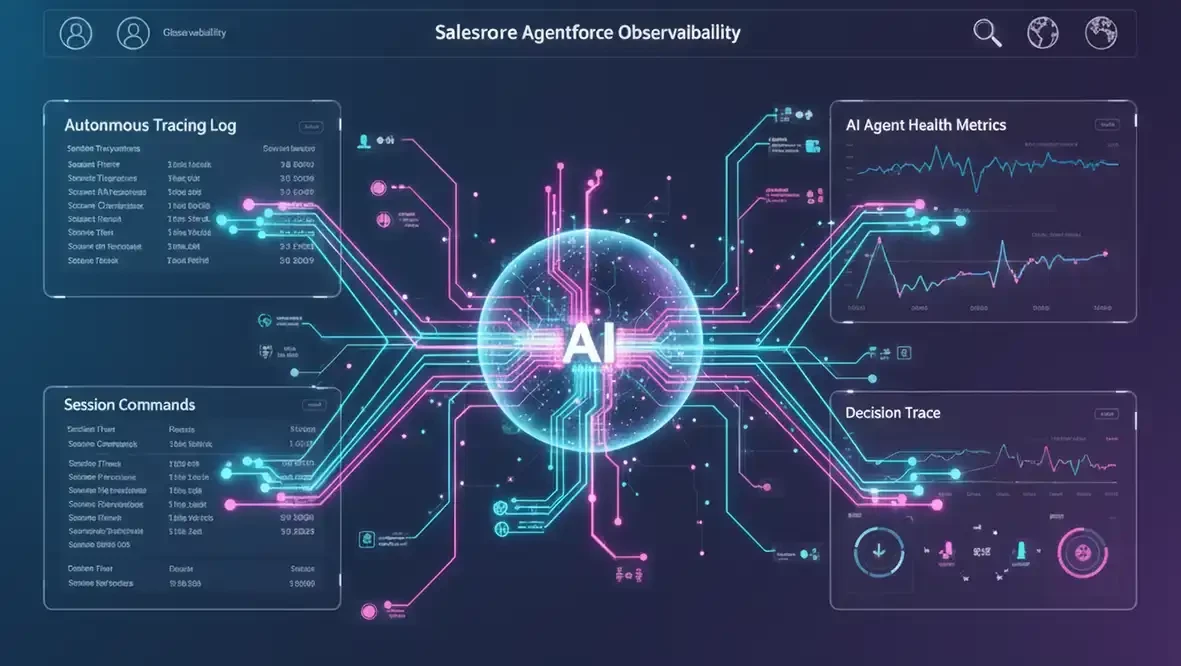
In a major push for enterprise AI transparency, Salesforce has launched Agentforce Observability, a suite of tools in its Agentforce 360 platform designed to expose every step of what its AI agents are doing — from user input to reasoning paths to final output — in near-real time. The system offers deep session-level tracing via a Session Tracing Data Model and management across all agents (even those built outside Salesforce) via MuleSoft Agent Fabric. With three core modules — Agent Analytics (tracking performance metrics and KPIs), Agent Optimization (tracing reasoning flows and spotting misconfigurations), and soon-to-launch Agent Health Monitoring (near-real-time alerts for latency or failures) — the suite aims to turn opaque AI into a fully governable “digital workforce.” Salesforce argues this level of visibility is essential if companies are serious about scaling AI beyond pilots and into core operations. VentureBeat, CIO, and APMdigest all cover the announcement and context.
Sources: CIO.com, APM Digest
Key Takeaways
– Agentforce Observability enables enterprises to trace every action and reasoning step of AI agents — eliminating the “black box” problem when using AI for customer service, sales, or decision workflows.
– The platform consolidates AI agent monitoring into a single, unified dashboard — covering agents built on Salesforce and external systems — enabling governance, transparency, and continuous improvement at scale.
– For companies deploying AI at volume, this level of oversight is becoming mission-critical; without it, many firms may hesitate to replace human staff, especially in sensitive domains like finance, tax, or customer support.
In-Depth
When enterprises first dipped their toes into AI agents, the focus was on building — crafting workflows, creating prompts, plugging in data sources. But as more companies move beyond proof-of-concept and begin deploying real AI agents to handle customer service, sales outreach, internal support, and workflows at scale, a critical problem has emerged: these systems quickly become “black boxes.” Executives and compliance teams can watch output, but almost nobody can reliably say why the agent made a particular decision. That lack of transparency has stymied AI from genuinely replacing — or augmenting — human workers in many organizations.
Agentforce Observability, the newly unveiled suite from Salesforce, attempts to solve exactly that problem. Built into the broader Agentforce 360 Platform, the observability tools give enterprises a “mission control” for AI agents — logging every interaction, reasoning step, call to underlying language models, and guardrail check. That raw trace data is captured in a proprietary Session Tracing Data Model, while another module, MuleSoft Agent Fabric, allows companies to register, govern, and monitor not just Salesforce-native agents but external ones too — offering a unified view across their entire AI ecosystem.
This isn’t mere logging for compliance. The tools break into three functional layers:
Agent Analytics monitors agent usage and effectiveness in real-world interactions. It surfaces key metrics — like engagement, deflection rates, conversions, or reply rates — and highlights trends over time. This gives leaders a business-level view of agent impact, helping justify ROI or identify areas for improvement.
Agent Optimization dives deeper, giving teams the ability to inspect exactly how agents reasoned step-by-step when handling complex queries or workflows. Organizations can cluster similar sessions to spot patterns or friction points, and fine-tune guardrails or prompt/configuration issues. For companies in high-stakes sectors — like finance, legal, or healthcare — that kind of traceability is non-negotiable.
Agent Health Monitoring (slated for general availability in Spring 2026) brings traditional operational rigour: uptime, latency monitoring, alerting for errors — just like you’d do with server infrastructure. Because many enterprises plan to run hundreds or thousands of agents, stability and reliability become as important as correctness or performance.
The significance of this launch becomes more apparent when you look at real-world adopters. For example, the accounting-service provider (to small businesses) 1-800Accountant used Agentforce agents during tax-season surges to handle customer queries. The transparency granted by Observability gave them confidence to let agents handle complex workflows — not just simple FAQs. Similarly, other early adopters — from social-media platforms to staffing firms — reported that the ability to trace reasoning and outcomes before full rollout was a game-changer.
Why does this matter now? Because many enterprises are rapidly ramping up their AI investments. According to Salesforce, deployments on the platform have surged 282% recently. But that growth rate doesn’t distinguish between pilot projects and fully live production deployments. The problem is: you can’t scale what you can’t see. Without observability and governance, AI agents may remain confined to limited experimental use.
With Agentforce Observability, Salesforce is betting that visibility — transparency — will unlock scale. If companies can treat AI agents like they treat human employees — but with even greater traceability — then replacing or augmenting parts of the workforce becomes not just technologically feasible, but operationally sound.
That doesn’t mean the transition to a “digital workforce” is automatic. Observability only works if companies build the internal processes, guardrails, and accountability structures to act on visibility. Logging every decision is useful — only if someone reviews it, drives improvements, and responds to failures. But for organizations willing to take that step, Agentforce Observability could be the difference between AI as a risky experiment and AI as a trusted, business-critical tool.