

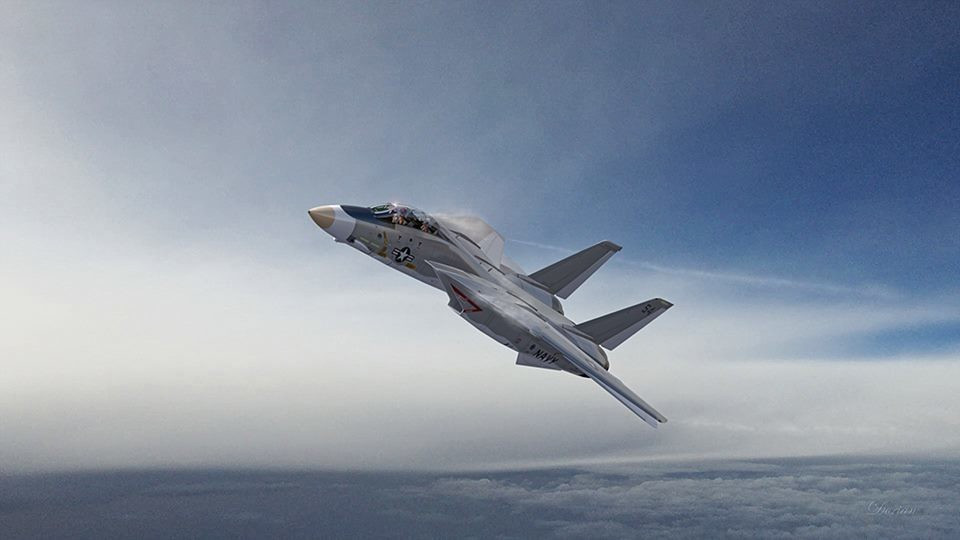
A recently surfaced profile of the chip known as the MP944 shows that what many credit as the first microprocessor — the Intel 4004 — may not hold that distinction after all. The MP944, developed for the U.S. Navy’s F-14 Tomcat’s Central Air Data Computer (CADC), entered service in June 1970 — more than a year before the Intel 4004 hit the market. According to reporting from Tom’s Hardware, the MP944 operated at around 375 kHz, running a six-chip MOS LSI set that processed flight data in real time, was highly reliable and built for military usage. The project remained classified until the late 1980s/1990s, meaning its role was largely omitted from mainstream accounts of early microprocessor history. Hackaday and other historical sources corroborate that the MP944 chipset was indeed designed for that F-14 control system and only publicly revealed decades later. Meanwhile, retrospective analyses highlight that conventional definitions of “microprocessor” (in particular, single-chip vs multi-chip) help explain why Intel 4004 has traditionally held the title of “first.”
Sources: Tom’s Hardware, Hackaday
Key Takeaways
– The MP944 chipset was operational in a military application (the F-14 Tomcat’s CADC) before the widely-cited Intel 4004, but remained classified and thus absent from mainstream microprocessor history until decades later.
– Standard definitions matter: the Intel 4004 is often credited as the first single-chip microprocessor available commercially, whereas the MP944 was a multi-chip system built for a specific military function, raising debates on what counts as “first.”
– History is shaped by commercial disclosure and public recognition: because the MP944 never entered the commercial marketplace and was secret, the narrative defaulted to Intel and the 4004 — demonstrating how market visibility influences what counts as “first” in tech history.
In-Depth
When you peel back the layers of computing history, you find that some of the accepted “firsts” have hidden footnotes. The story of the MP944, built for the U.S. Navy’s F-14 Tomcat’s Central Air Data Computer (CADC), is one of those subtle shifts in perspective. While the Intel 4004 is widely celebrated as the first microprocessor — introduced in 1971, affordable, programmable, commercially available — the MP944 set was already operational in a combat fighter jet’s flight-control system by June 1970, over a year earlier. That earlier deployment is confirmed in recent retrospective articles (for example from Tom’s Hardware) which point out that a six-chip MOS LSI system running at roughly 375 kHz executed flight-critical tasks (altitude, airspeed, Mach number, wing sweep control). The project was classified for nearly three decades and thus largely absent from public computing history until much later.
What does this mean for our understanding of microprocessor evolution? For starters, it forces a re-examination of how we define a microprocessor. The MP944 was a purpose-built, multi-chip set: it had a steering unit, multiplier, divider, RAM/ROM modules, and special logic units, all working in tandem inside that flight system. In contrast, the Intel 4004 was a single integrated circuit (IC) that combined ALU, registers, control logic, and bus interface — the hallmark of what many historians deem a “true” microprocessor. So while the MP944 may chronologically pre-date the 4004, the latter’s single-chip architecture and commercial availability cemented its cultural and industrial legacy. In other words, the MP944 challenged the timeline, but the 4004 claimed the narrative.
Another implication: the commercial and public footprint matters in tech recognition. The MP944 was never marketed — it stayed behind carrier decks and military contracts. Meanwhile Intel packaged the 4004, sold it to calculator manufacturers, and thus allowed computing enthusiasts, hobbyists, companies and eventually academia to build around it. That exposure made it a landmark. The MP944 may have been technically ahead in some respects — for example, running a 20-bit fixed-point system optimized for real-time aerospace computations — but its secrecy supplanted its role in general histories of computing.
From a conservative tech-historical perspective, this reinforces the principle that market influence and public accessibility play a crucial role in assigning “firsts.” Innovation doesn’t exist in the vacuum of engineering alone; it becomes memorable when it crosses from labs and military black boxes into the hands of developers, entrepreneurs and consumers. The Intel 4004 is remembered not just for being first, but for being accessible. The MP944 is remembered by few, though it arguably accomplished something extraordinary for its time.
In sum, the MP944 story doesn’t override the Intel 4004’s legacy — rather, it adds nuance. It shows that computing history contains parallel tracks: one in government/defense, one in commercial devices. The MP944 blazed a trail in the cockpit of a fighter jet, while the Intel 4004 laid the foundation for the personal-computer era. Acknowledging both doesn’t diminish either; it enriches our understanding of how microprocessors emerged, evolved and entered the marketplace.