

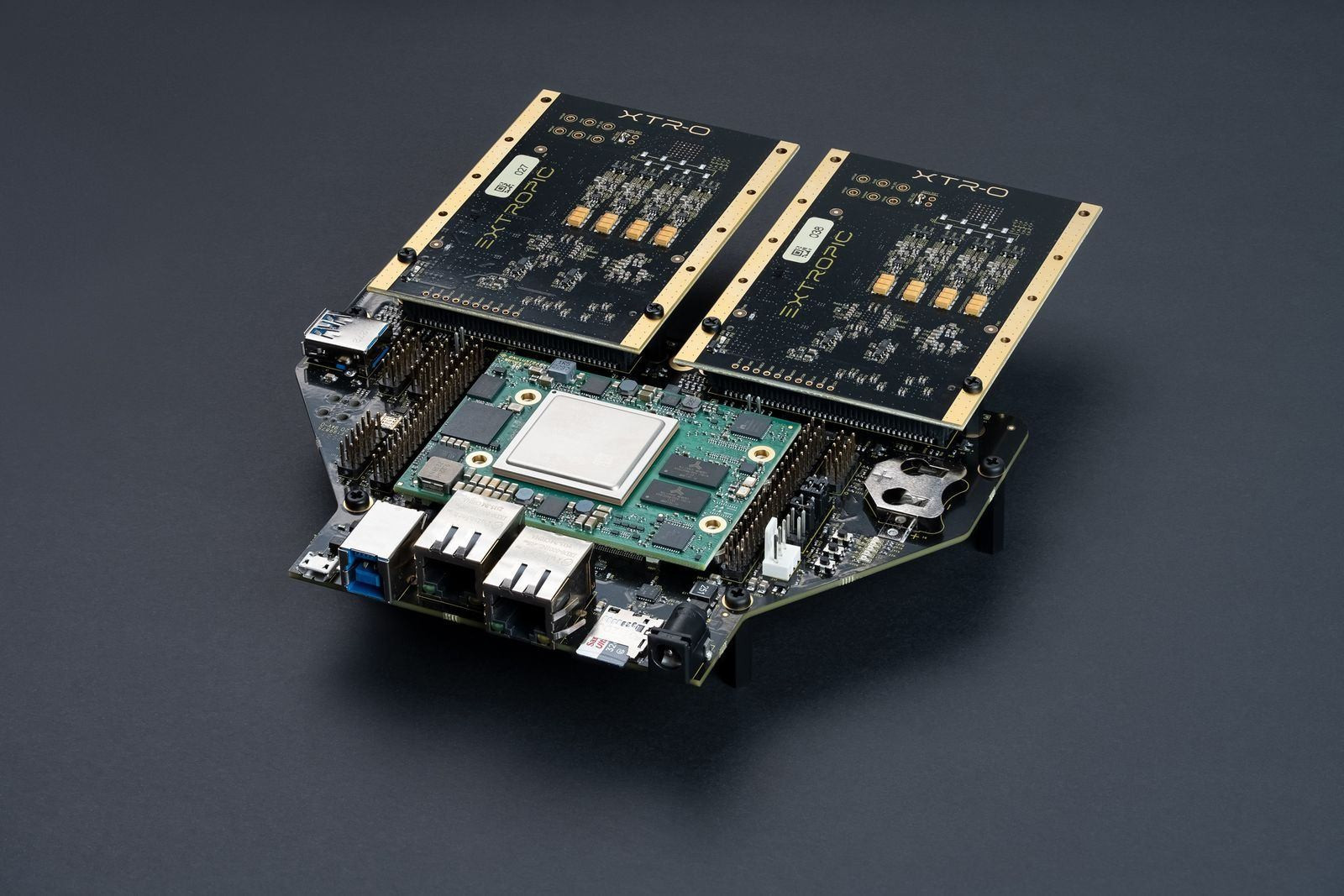
A bold U.S. startup, Extropic, is unveiling an entirely new class of computing hardware designed to shake up the entrenched dominance of conventional data-center chip suppliers. Their novel architecture, dubbed Thermodynamic Sampling Units (TSUs), uses probabilistic bits (“p-bits”) instead of the familiar binary “0s and 1s,” promising orders-of-magnitude improvements in energy efficiency for large-scale AI and scientific computation. The company has already produced its first working prototype, called the XTR-0, and anticipates scaling to a more capable chip with 250,000 p-bits next year. Meanwhile, industry commentators observe that as AI specialists pour billions into building massive GPU-based server farms, the energy costs and infrastructure demands may open the door for disruptive alternatives. The rise of Extropic’s physics-inspired approach may signal a tectonic shift in how data centers are built and how AI is run.
Sources: Wired, Times of AI
Key Takeaways
– Extropic’s TSU architecture uses probabilistic computing (p-bits) rather than traditional deterministic bits, offering a radically different route for AI hardware.
– The startup claims that in scaled form, the energy efficiency gains could be thousands of times better than current GPU/CPU-based systems, potentially alleviating one of the major cost and infrastructure bottlenecks in AI data centers.
– Disruption in the data-center hardware market could enable new players, reduce the dominance of major chip suppliers, and shift the economics of large-scale AI deployment—particularly on energy, cooling, infrastructure and location decisions.
In-Depth
The AI boom has fundamentally shifted how computing infrastructure is viewed—from simply faster chips to sprawling data centers costing billions of dollars, drawing down enormous amounts of electricity, and requiring vast cooling and logistical support. The conventional model—clusters of GPUs or CPUs in massive server farms—is reaching both physical and financial limits. Enter Extropic, a startup betting that instead of tweaking incremental improvements on familiar silicon chips, the future lies in a radical rethinking of computation itself.
At its core, Extropic’s approach abandons the classic binary bit and embraces a probabilistic bit, or p-bit, which can represent and manipulate uncertainty directly. Their hardware unit, called a Thermodynamic Sampling Unit (TSU), leverages the natural fluctuations of electrons (thermodynamic noise) to perform complex inference and optimization tasks. This is not merely a semantic shift: it means reengineering both hardware and algorithms to match a new computing paradigm. The company asserts that when scaled, a TSU can perform AI-type workloads—such as diffusion models for image generation or weather forecasting—with much lower power consumption than conventional chips.
The startup has produced an early prototype, the XTR-0, which pairs an FPGA with a small number of p-bits, and has distributed it to development partners in AI labs, climate modeling firms and even governmental agencies. The next generation chip, touted to contain 250,000 p-bits, is slated for the coming year. If viable, this would mark a major step toward replacing or at least supplementing GPU-centric data centers. While major chip players like Nvidia, AMD and Intel continue to dominate conventional compute, their model relies on ever-larger clusters, ever-higher power draw and increasingly challenging heat and cooling issues.
From a conservative viewpoint, the implications are significant. First, reducing energy consumption in data centers has both cost and geopolitical dimensions—lowering demand on the grid reduces exposure to energy price volatility, regulatory constraints and environmental scrutiny. For companies building massive cloud or AI infrastructure, a cheaper, cooler, lower-footprint alternative is very attractive. Second, a breakthrough like this could decouple the AI scale arms race from the sole path of stacking more GPUs—opening up room for specialized hardware, smaller players and diversified infrastructure models. Third, there is the potential for reduced capital investment needs: if each unit of computation uses far less energy and cooling, data-center siting, utility impact, and even secondary environmental permitting become less burdensome.
Of course, the path to mainstream adoption is steep. A new computing paradigm must overcome not just the technical challenge of performance and scaling, but also software ecosystem compatibility, manufacturing yield, reliability, and ecosystem trust. Enterprises and cloud providers are risk-averse; switching to entirely new hardware is a heavy lift. Moreover, while energy efficiency is tantalizing, the total cost of ownership includes integration, custom software rewrite, supply chain adjustment and risk of vendor lock-in. From a conservative perspective, one must assume that major incumbents (chip manufacturers, cloud providers) will respond by accelerating their own similar efforts or acquiring challengers before their dominance is threatened.
Nonetheless, the timing is opportunistic. As AI demand surges and energy/cooling infrastructure becomes a real constraint (both in cost and in regulatory/environmental exposure), an alternative architecture that promises radically lower energy use becomes not only desirable but perhaps necessary. For the broader economy—especially sectors sensitive to infrastructure costs, such as hyperscale cloud computing, defense, weather modeling, scientific research or even real-estate holdings of data-center assets—this kind of paradigm shift may change how we evaluate both location and cost models of compute infrastructure. In effect, we could be looking at the start of a transition from “more GPUs in more warehouses” to “smarter chips that require less environment support.” That shift aligns with conservative frameworks of resource efficiency, cost control and technological sovereignty (less reliance on massive foreign mining of rare earths, less exposure to cooling-water shortages, less energy grid stress).
In summary, Extropic and its TSU architecture represent a potentially transformative development in the hardware side of AI infrastructure. While still in early stages and not yet proven at scale, the promise of thousands-fold improvements in energy efficiency and a new computing model is enough to make infrastructure planners, real-estate analysts, and tech strategists sit up and pay attention. If the claims hold up, we could be witnessing the opening of a new chapter in the evolution of data centers—one that places a premium on physics-inspired computing and efficiency, rather than simply brute-force scale.