

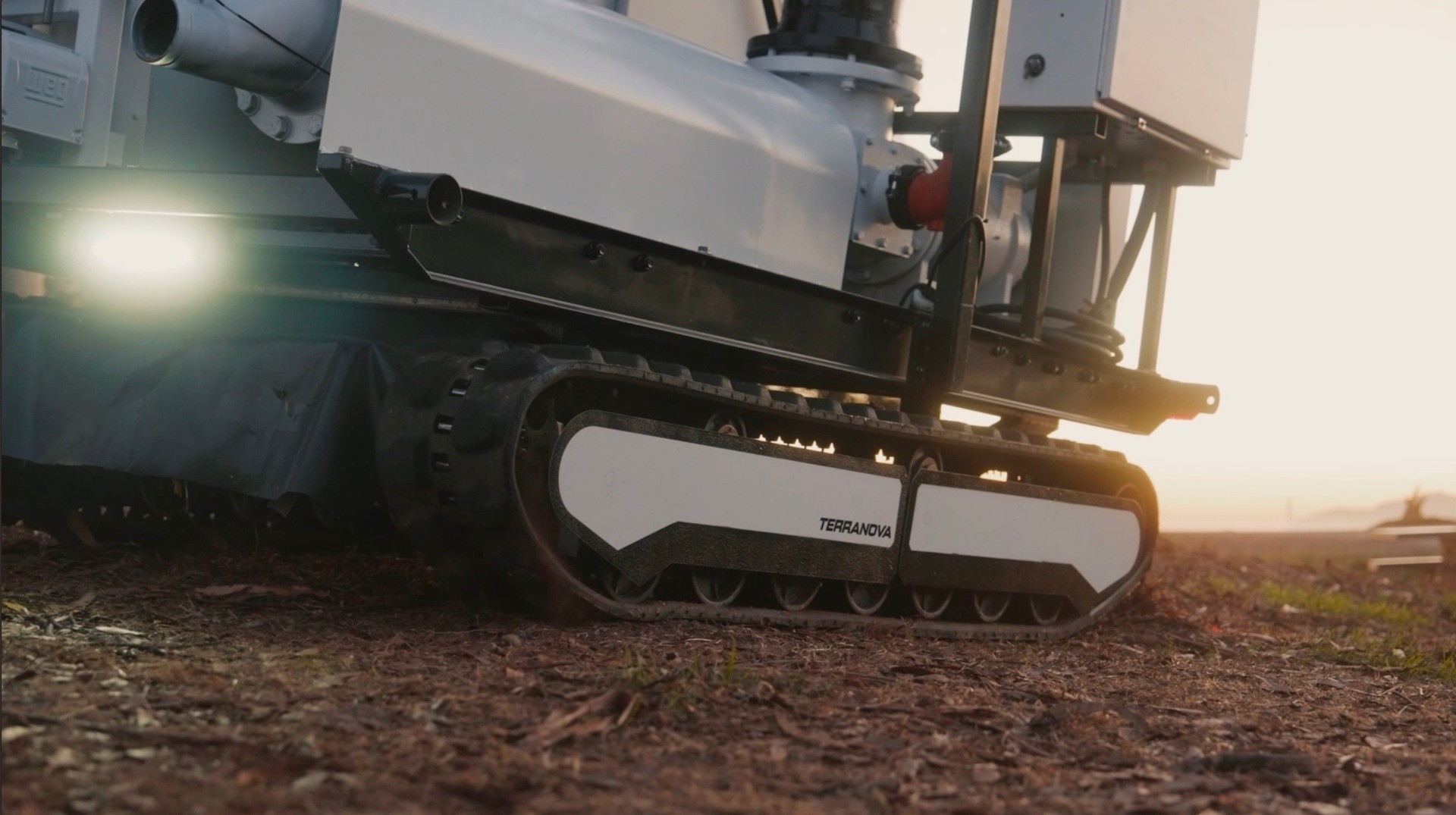
A tech startup led by Terranova and its co-founder Laurence Allen is offering a radical, cost-effective alternative to massive seawalls: instead of just holding back rising water, the company plans to raise sinking terrain. In San Rafael, a city north of San Francisco where some neighborhoods have already sunk by about three feet and continue subsiding at roughly half an inch per year, Terranova proposes using autonomous robots that inject a slurry of waste wood and proprietary material into the ground to lift 240 acres by approximately four feet for about $92 million—far less than the $500 million to $900 million price tag estimated for conventional seawalls. The company recently secured a $7 million seed round valuing it at $25.1 million and says the process could also be applied to land reclamation and wetlands restoration.Additional reporting highlights the broader risk of urban flooding—300 million people globally may face routine flooding by 2050—and positions Terranova’s land-lifting approach as a high-tech alternative to traditional coastal defence. A third source confirms details of the technology: tracked robotic units drill wells 40-60 feet deep, the slurry remains stable underground if kept moist, and the business model includes revenue-sharing with contractors plus carbon-credit sales enabled by using wood waste. (Source: Startup Ecosystem)
Sources: Start-Up Ecosystem, TechSpot
Key Takeaways
– This approach shifts from passive flood defence (seawalls, dikes) to active terrain elevation—raising land rather than only fighting water.
– The proposed cost for Terranova’s intervention in San Rafael (~$92 million) is an order of magnitude lower than conventional seawall estimates ($500–900 million), potentially making it more viable for smaller municipalities.
– While the technology is promising, it raises questions about long-term stability (especially in seismic zones), the durability of injected materials, and potential unintended consequences which require careful evaluation.
In-Depth
Coastal and near-coastal municipalities face a mounting crisis as sea-level rise and subsidence combine to erode protective buffers and raise the real threat of inundation. In the case of San Rafael, parts of the city are already several feet below sea level and sinking further. Conventional engineering responses—such as giant seawalls—are increasingly seen as prohibitively expensive and perhaps inadequate in the long term. Into this gap steps Terranova, a California startup that proposes a novel remedy: raise the land itself.
At its core the strategy is deceptively simple. Terranova uses waste wood, mixed with undisclosed additives, to create a slurry that is injected underground via robotic units. These tracked machines drill hundreds of wells, reaching depths of 40-60 feet, and pump in the mixture. Once the slurry settles, the land lifts. The startup claims that because the wood slurry remains moist underground it will not decompose, staying stable over time—and even generating carbon credits as an offset revenue stream. According to CEO Laurence Allen, lifting 240 acres of San Rafael by four feet can be achieved for about $92 million—far cheaper than the $500–900 million range estimated for a conventional seawall in the same region.
From a conservative vantage point, the appeal is clear: a lower-cost, less visibly intrusive solution that shifts the burden away from heavy civil engineering toward flexible, technology-driven terrain adjustment. For towns and smaller cities strapped for funds, such alternatives are attractive. Moreover, because land-raising retains natural drainage and avoids creating massive impermeable barriers, it may reduce long-term maintenance liabilities. The business model—revenue sharing with contractors, carbon credit monetization—is also appealing in an era where every cost is under scrutiny.
However, important caveats remain. The long-term behaviour of a wood-based slurry beneath urban land remains relatively untested, especially in areas subject to earthquakes or long-term geological shifting. Skeptics caution that injecting large volumes of material underground could change subsurface dynamics and potentially affect seismic response. While Allen argues that his method may perform better than seawalls in an earthquake, the evidence is still emerging. Local stakeholders will need to weigh the trade-offs: the lower upfront cost against the risk of unproven longevity and unanticipated structural behaviours. Regulators and insurers will also need to assess liability and durability.
Another conservative risk is mission creep. While Terranova aims first at municipalities like San Rafael, the same technology could be tried in wetlands and other ecologically sensitive zones. That raises ecological, regulatory, and cost-management questions. Will lifting wetlands alter natural hydrology? Will the wood slurry have ecological side-effects? And will maintenance be required decades down the line at unforeseen cost? These are questions any municipal leader must ask.
Ultimately, Terranova’s terrain-lifting concept may represent one of the most provocative civil engineering shifts of recent years. If it succeeds, it could reshape how we think about flood resilience—not as building ever-higher walls, but altering the earth itself to stay ahead of the water. For smaller cities with limited budgets and rising urgency, the prospect of such an approach is compelling. But like all bold innovations, the proof will lie in long-term performance, risk management and regulatory oversight. Municipal leadership that moves forward should do so with clear monitoring frameworks, strong contractual safeguards, and conservative contingency planning.