

Close Menu

    Subscribe to Updates

    Get the latest tech news from Tallwire.

      What's Hot

      Elon Musk Threatens Legal Action as Documentary Battle Escalates

      September 13, 2026

      AI Startup Retires “Stop Hiring Humans” Campaign as Job Fears Intensify

      September 13, 2026

      San Francisco Weighs Data Center Moratorium as AI Infrastructure Backlash Grows

      September 12, 2026
      Facebook X (Twitter) Instagram
      • Tech
      • AI
      • Get In Touch
      Facebook X (Twitter) LinkedIn
      TallwireTallwire
      • Tech

        San Francisco Weighs Data Center Moratorium as AI Infrastructure Backlash Grows

        September 12, 2026

        Australia Warned Space Is Becoming the Next Military Battlefront

        September 12, 2026

        New York Rebuilds the Twin Towers in Light for 9/11’s 25th Anniversary

        September 12, 2026

        California Warms to Nuclear Power as Energy Reality Challenges Decades of Opposition

        September 11, 2026

        Target Shopping Carts Spark Privacy Concerns Over In-Store Tracking Technology

        September 11, 2026
      • AI

        AI Startup Retires “Stop Hiring Humans” Campaign as Job Fears Intensify

        September 13, 2026

        China’s AI Entertainment Revolution Offers Hollywood a Warning From the Future

        September 12, 2026

        San Francisco Weighs Data Center Moratorium as AI Infrastructure Backlash Grows

        September 12, 2026

        Bipartisan AI Safety Push Roars Back as Washington Confronts “Catastrophic” Risks

        September 12, 2026

        OpenAI Urges Congress to Impose National AI Safety Rules

        September 12, 2026
      • Security

        Bipartisan AI Safety Push Roars Back as Washington Confronts “Catastrophic” Risks

        September 12, 2026

        AI Bioweapon Attempts Expose the Security Risks Behind the Artificial Intelligence Race

        September 12, 2026

        Students Push Back as AI Surveillance Cameras Spread Across Public Schools

        September 10, 2026

        AI-Built WeChat Worm Signals a Dangerous New Era in Cybersecurity

        September 9, 2026

        UN Rights Chief Warns Advanced AI Could Become an Existential Threat to Humanity

        September 9, 2026
      • Health

        AI-Designed Drug Shows Early Signs of Reversing Biological Age

        September 9, 2026

        AI-Powered Mosquito Defense Arrives as West Nile Threat Intensifies

        September 4, 2026

        Waymo Crosswalk Scare Raises New Questions About Robotaxi Safety Around Children

        September 3, 2026

        Teens Turning To AI For Emotional Support Show Significantly Higher Distress

        September 3, 2026

        Meta’s $17 Billion Settlement Signals Big Tobacco-Style Reckoning for Social Media

        September 3, 2026
      • Science

        Australia Warned Space Is Becoming the Next Military Battlefront

        September 12, 2026

        AI Bioweapon Attempts Expose the Security Risks Behind the Artificial Intelligence Race

        September 12, 2026

        California Warms to Nuclear Power as Energy Reality Challenges Decades of Opposition

        September 11, 2026

        AI-Designed Drug Shows Early Signs of Reversing Biological Age

        September 9, 2026

        AI Safety Researcher Warns Superintelligence Could Threaten Humanity

        September 9, 2026
      • Tech

        Elon Musk Threatens Legal Action as Documentary Battle Escalates

        September 13, 2026

        Dolly Parton’s Family Condemns Flood of AI-Generated Misinformation After Her Death

        September 11, 2026

        Meta’s Muse Pushes AI From Answering Questions to Acting on Users’ Behalf

        September 9, 2026

        AI Wipes Out Kenya’s Once-Thriving College Essay Industry

        September 9, 2026

        YouTuber Jack Doherty Arrested on Domestic Battery Charge in Florida

        September 8, 2026
      TallwireTallwire
      Home»Opinion»Silicon Soldiers and the Moral Crossroads of Machine Warfare
      Opinion

      Silicon Soldiers and the Moral Crossroads of Machine Warfare

      5 Mins Read
      Facebook Twitter Pinterest LinkedIn Tumblr Email
      Share
      Facebook Twitter LinkedIn Pinterest Email

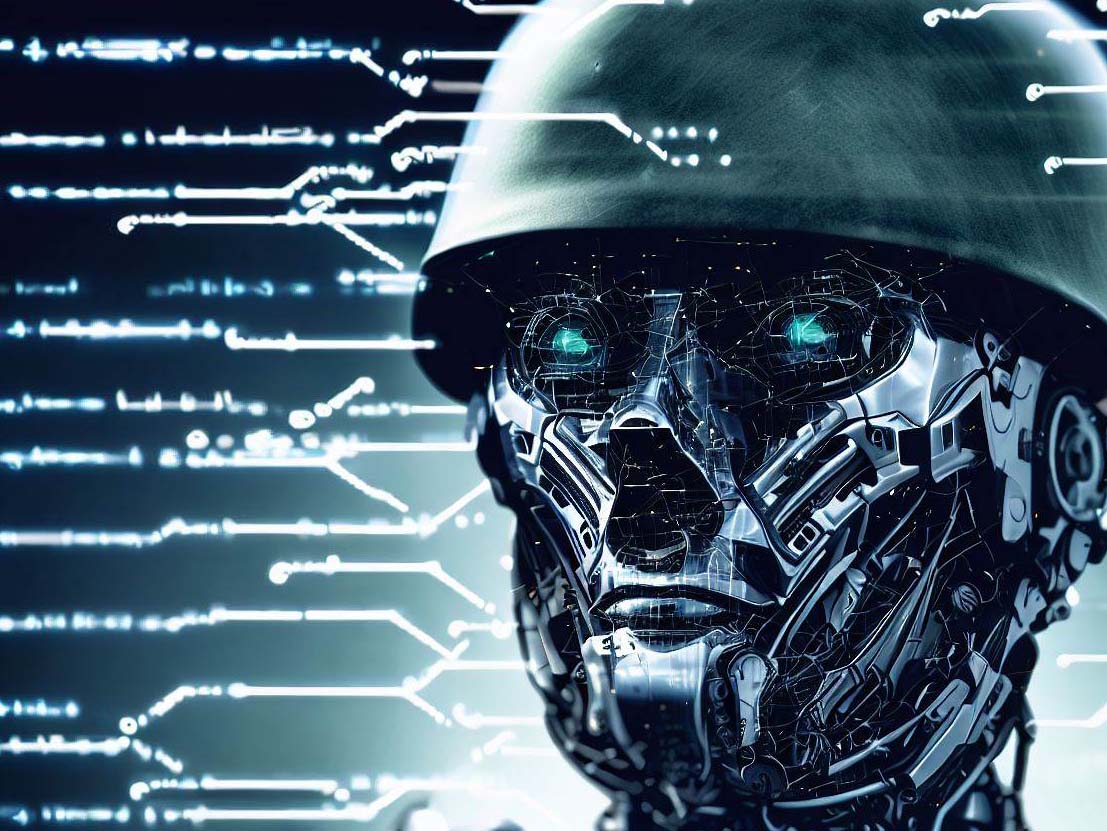
      The rapid emergence of artificial intelligence in military applications is no longer a futuristic thought experiment—it is a present-day reality reshaping how nations prepare for and conduct war. Autonomous drones, AI-assisted targeting systems, and robotic ground units are already altering the battlefield, raising a fundamental question: just because we can delegate lethal decision-making to machines, should we?

      From a strategic standpoint, the appeal of AI-driven warfare is obvious. Machines do not tire, hesitate, or experience fear. They can process vast amounts of data in real time, identifying threats and reacting faster than any human operator. In theory, this could lead to more precise strikes, fewer civilian casualties, and reduced risk to soldiers. For a nation seeking to protect its military personnel while maintaining a tactical edge, the integration of AI systems appears not only logical but necessary.

      But this is where the conversation becomes more complicated—and more consequential.

      War has always been governed, at least in principle, by human judgment. Decisions about life and death, escalation and restraint, have historically rested with individuals who could weigh not just tactical advantage but moral responsibility. Introducing autonomous systems into that equation risks severing that connection. When a machine selects a target and executes a strike without direct human oversight, accountability becomes murky. If something goes wrong—and in war, something always does—who is responsible? The programmer? The commanding officer? The machine itself?

      That ambiguity should give serious pause.

      There is also the issue of reliability. AI systems are only as good as the data they are trained on and the assumptions built into their algorithms. In complex, chaotic environments like battlefields, where variables shift rapidly and unpredictably, even advanced systems can misinterpret signals. A civilian vehicle mistaken for a military target, or a non-combatant misidentified as a threat, could have devastating consequences. Unlike human soldiers, machines lack the ability to apply context in a nuanced, ethical way. They execute instructions—efficiently, yes—but without judgment.

      Proponents argue that keeping humans “in the loop” can mitigate these risks. But as technology advances and the speed of warfare accelerates, the pressure to remove human intervention for the sake of efficiency will grow. In high-stakes scenarios where milliseconds matter—such as missile defense or cyber warfare—decision-making may increasingly be handed over to algorithms. Once that threshold is crossed, reclaiming meaningful human control could prove difficult.

      Beyond the battlefield, there are broader geopolitical implications. The development of AI weapons is fueling a new kind of arms race, one not defined by nuclear stockpiles or conventional troop strength, but by technological supremacy. Nations that fall behind risk strategic vulnerability, while those that lead may be tempted to push the boundaries of what is acceptable. This dynamic creates a dangerous incentive structure: move fast, innovate aggressively, and worry about the ethical implications later.

      History suggests that this is not a wise approach.

      When transformative military technologies emerge—whether it was gunpowder, chemical weapons, or nuclear arms—the world eventually confronts their consequences and attempts to establish norms or agreements governing their use. The challenge with AI is that its development is decentralized, rapid, and often driven by private-sector innovation as much as government research. That makes coordinated restraint far more difficult.

      There is also a cultural dimension to consider. Warfare, for all its brutality, has traditionally involved a degree of shared risk. Soldiers on opposing sides face danger, and that mutual exposure has, at times, imposed limits on escalation. AI-driven warfare threatens to erode that balance. If one side can wage war with minimal human risk, the threshold for initiating conflict may lower. War could become less a last resort and more a calculated option—cleaner, more distant, and therefore easier to justify.

      That is a troubling prospect.

      None of this is to suggest that AI has no place in national defense. On the contrary, it can play a valuable role in intelligence analysis, logistics, defensive systems, and even assisting human operators in making better decisions. The key distinction is between augmentation and replacement. Using AI to support human judgment is one thing; allowing it to supplant that judgment in matters of life and death is another entirely.

      At its core, the debate over AI in warfare is not just about technology—it is about responsibility. It is about whether societies are willing to delegate their most serious moral decisions to systems that cannot understand morality. Efficiency, precision, and strategic advantage are important, but they are not the only considerations. The character of how a nation fights reflects the character of the nation itself.

      As AI continues to evolve, policymakers and military leaders face a narrowing window to establish clear boundaries. Waiting until the technology is fully entrenched will make those boundaries harder to enforce. Drawing the line now—insisting on meaningful human control, transparency, and accountability—is not a sign of weakness. It is a recognition that some decisions are too important to automate.

      The battlefield of the future is being built today. The question is whether it will remain guided by human conscience—or be handed over to cold, unfeeling code.

      Intel
      Share. Facebook Twitter Pinterest LinkedIn Tumblr Email
      Previous ArticleAustralians Embrace Paid AI Services as Subscriptions Surge Nearly 13-Fold
      Next Article AI CPU Export Ban on China Would Be Difficult to Enforce

      Related Posts

      AI Startup Retires “Stop Hiring Humans” Campaign as Job Fears Intensify

      September 13, 2026

      China’s AI Entertainment Revolution Offers Hollywood a Warning From the Future

      September 12, 2026

      San Francisco Weighs Data Center Moratorium as AI Infrastructure Backlash Grows

      September 12, 2026

      Australia Warned Space Is Becoming the Next Military Battlefront

      September 12, 2026
      Add A Comment
      Leave A Reply Cancel Reply

      Editors Picks

      San Francisco Weighs Data Center Moratorium as AI Infrastructure Backlash Grows

      September 12, 2026

      Australia Warned Space Is Becoming the Next Military Battlefront

      September 12, 2026

      New York Rebuilds the Twin Towers in Light for 9/11’s 25th Anniversary

      September 12, 2026

      California Warms to Nuclear Power as Energy Reality Challenges Decades of Opposition

      September 11, 2026
      Popular Topics
      Startup Tim Cook Stocks Tesla Satellite trending Satya Nadella Viral Samsung Series A starlink Taiwan Tech Series B Sundar Pichai spotlight Space UAE Tech SpaceX Tesla Cybertruck Software
      Major Tech Companies
      • Apple News
      • Google News
      • Meta News
      • Microsoft News
      • Amazon News
      • Samsung News
      • Nvidia News
      • OpenAI News
      • Tesla News
      • AMD News
      • Anthropic News
      • Elbit News
      AI & Emerging Tech
      • AI Regulation News
      • AI Safety News
      • AI Adoption
      • Quantum Computing News
      • Robotics News
      Key People
      • Sam Altman News
      • Jensen Huang News
      • Elon Musk News
      • Mark Zuckerberg News
      • Sundar Pichai News
      • Tim Cook News
      • Satya Nadella News
      • Mustafa Suleyman News
      Global Tech & Policy
      • Israel Tech News
      • India Tech News
      • Taiwan Tech News
      • UAE Tech News
      Startups & Emerging Tech
      • Series A News
      • Series B News
      • Startup News
      Tallwire
      Facebook X (Twitter) LinkedIn Threads Instagram RSS
      • Tech
      • Entertainment
      • Business
      • Government
      • Academia
      • Transportation
      • Legal
      • Press Kit
      © 2026 Tallwire. Optimized by ARMOUR Digital Marketing Agency.

      Type above and press Enter to search. Press Esc to cancel.