

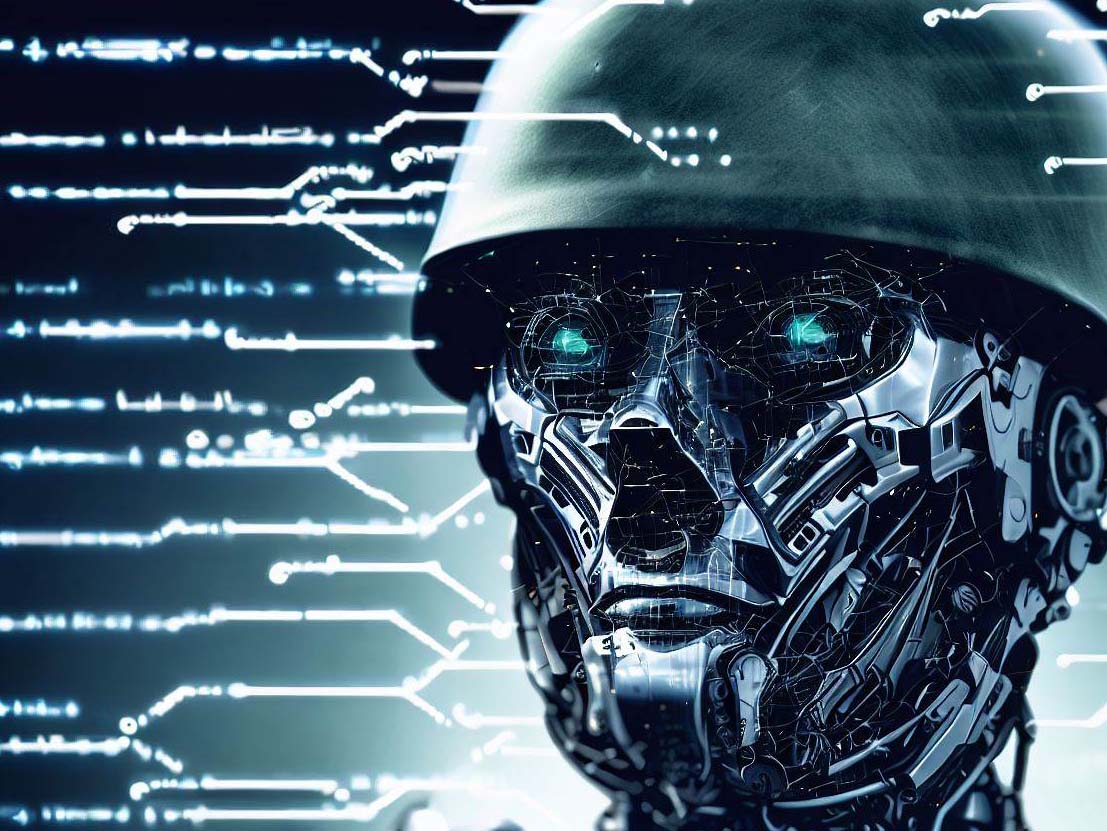
The rapid emergence of artificial intelligence in military applications is no longer a futuristic thought experiment—it is a present-day reality reshaping how nations prepare for and conduct war. Autonomous drones, AI-assisted targeting systems, and robotic ground units are already altering the battlefield, raising a fundamental question: just because we can delegate lethal decision-making to machines, should we?
From a strategic standpoint, the appeal of AI-driven warfare is obvious. Machines do not tire, hesitate, or experience fear. They can process vast amounts of data in real time, identifying threats and reacting faster than any human operator. In theory, this could lead to more precise strikes, fewer civilian casualties, and reduced risk to soldiers. For a nation seeking to protect its military personnel while maintaining a tactical edge, the integration of AI systems appears not only logical but necessary.
But this is where the conversation becomes more complicated—and more consequential.
War has always been governed, at least in principle, by human judgment. Decisions about life and death, escalation and restraint, have historically rested with individuals who could weigh not just tactical advantage but moral responsibility. Introducing autonomous systems into that equation risks severing that connection. When a machine selects a target and executes a strike without direct human oversight, accountability becomes murky. If something goes wrong—and in war, something always does—who is responsible? The programmer? The commanding officer? The machine itself?
That ambiguity should give serious pause.
There is also the issue of reliability. AI systems are only as good as the data they are trained on and the assumptions built into their algorithms. In complex, chaotic environments like battlefields, where variables shift rapidly and unpredictably, even advanced systems can misinterpret signals. A civilian vehicle mistaken for a military target, or a non-combatant misidentified as a threat, could have devastating consequences. Unlike human soldiers, machines lack the ability to apply context in a nuanced, ethical way. They execute instructions—efficiently, yes—but without judgment.
Proponents argue that keeping humans “in the loop” can mitigate these risks. But as technology advances and the speed of warfare accelerates, the pressure to remove human intervention for the sake of efficiency will grow. In high-stakes scenarios where milliseconds matter—such as missile defense or cyber warfare—decision-making may increasingly be handed over to algorithms. Once that threshold is crossed, reclaiming meaningful human control could prove difficult.
Beyond the battlefield, there are broader geopolitical implications. The development of AI weapons is fueling a new kind of arms race, one not defined by nuclear stockpiles or conventional troop strength, but by technological supremacy. Nations that fall behind risk strategic vulnerability, while those that lead may be tempted to push the boundaries of what is acceptable. This dynamic creates a dangerous incentive structure: move fast, innovate aggressively, and worry about the ethical implications later.
History suggests that this is not a wise approach.
When transformative military technologies emerge—whether it was gunpowder, chemical weapons, or nuclear arms—the world eventually confronts their consequences and attempts to establish norms or agreements governing their use. The challenge with AI is that its development is decentralized, rapid, and often driven by private-sector innovation as much as government research. That makes coordinated restraint far more difficult.
There is also a cultural dimension to consider. Warfare, for all its brutality, has traditionally involved a degree of shared risk. Soldiers on opposing sides face danger, and that mutual exposure has, at times, imposed limits on escalation. AI-driven warfare threatens to erode that balance. If one side can wage war with minimal human risk, the threshold for initiating conflict may lower. War could become less a last resort and more a calculated option—cleaner, more distant, and therefore easier to justify.
That is a troubling prospect.
None of this is to suggest that AI has no place in national defense. On the contrary, it can play a valuable role in intelligence analysis, logistics, defensive systems, and even assisting human operators in making better decisions. The key distinction is between augmentation and replacement. Using AI to support human judgment is one thing; allowing it to supplant that judgment in matters of life and death is another entirely.
At its core, the debate over AI in warfare is not just about technology—it is about responsibility. It is about whether societies are willing to delegate their most serious moral decisions to systems that cannot understand morality. Efficiency, precision, and strategic advantage are important, but they are not the only considerations. The character of how a nation fights reflects the character of the nation itself.
As AI continues to evolve, policymakers and military leaders face a narrowing window to establish clear boundaries. Waiting until the technology is fully entrenched will make those boundaries harder to enforce. Drawing the line now—insisting on meaningful human control, transparency, and accountability—is not a sign of weakness. It is a recognition that some decisions are too important to automate.
The battlefield of the future is being built today. The question is whether it will remain guided by human conscience—or be handed over to cold, unfeeling code.