

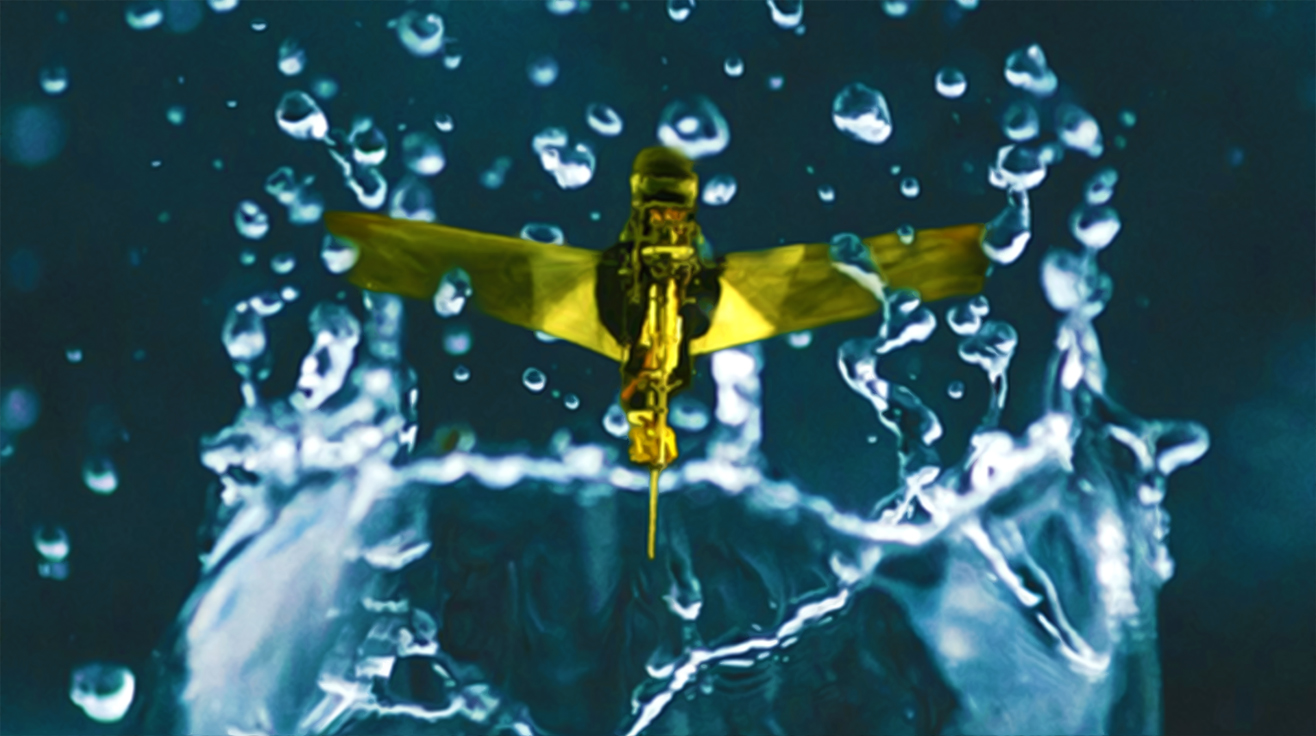
Researchers have unveiled a lightweight robotic vehicle capable of both sustained flight and underwater swimming by closely mimicking the mechanics of diving birds such as puffins, loons, and petrels. Developed through a collaboration between researchers in the United States and Switzerland, the flapping-wing robot weighs less than 300 grams and transitions directly from underwater propulsion to powered flight without requiring separate propellers or flotation devices. Engineers believe the technology could revolutionize oceanographic research, environmental monitoring, infrastructure inspection, and maritime security by allowing a single autonomous platform to gather data above and below the water’s surface. The achievement demonstrates that engineers continue drawing inspiration from nature rather than relying solely on increasingly complex artificial systems, highlighting how biological designs refined over millions of years remain among the most effective blueprints for solving difficult engineering problems.
Sources
- https://news.mit.edu/2026/new-flapping-robot-swims-and-flies-like-diving-bird-0709
- https://www.science.org/doi/10.1126/science.advXXXX (research paper referenced by MIT)
- https://actu.epfl.ch/news/new-flapping-robot-swims-and-flies-like-diving
Key Takeaways
- • Engineers successfully created a robot capable of seamlessly transitioning between underwater swimming and powered flight by replicating the mechanics of diving birds.
- • The technology could significantly reduce the cost and complexity of marine research, environmental monitoring, infrastructure inspection, and coastal surveillance.
- • The project demonstrates that biomimicry remains one of the most productive avenues in robotics, leveraging evolutionary solutions instead of forcing entirely artificial designs.
In-Depth
For decades, robotics researchers have struggled with a fundamental engineering problem: air and water demand completely different methods of propulsion. Aircraft wings are optimized for low-density air, while underwater vehicles typically depend on propellers, fins, or jet propulsion to move efficiently through water. Creating one machine capable of performing both tasks without sacrificing performance has remained an elusive goal.
The latest breakthrough changes that equation. By studying diving birds, researchers developed a flapping-wing robot that not only flies efficiently but also swims underwater before launching itself back into the air. Rather than attempting to reinvent physics, the engineers borrowed from one of nature’s most successful designs. Diving birds have spent millions of years evolving mechanisms that allow them to operate effectively in two dramatically different environments, making them ideal models for robotic innovation.
The implications extend well beyond academic curiosity. Autonomous systems that can fly to remote locations, dive beneath the surface to inspect infrastructure or collect scientific samples, and then immediately return to flight could transform numerous industries. Coastal security agencies could inspect ports and harbors without deploying separate aerial drones and underwater vehicles. Marine biologists could study wildlife with less disruption. Researchers monitoring glaciers, coral reefs, or offshore energy facilities could gather more comprehensive data while reducing operational costs.
The project also serves as a reminder that technological advancement does not always require bigger computers or more artificial intelligence. Sometimes the greatest innovations come from carefully observing the natural world. Engineers increasingly recognize that evolution has already solved many of the problems modern robotics seeks to overcome. By understanding those solutions rather than ignoring them, researchers can build machines that are simultaneously more capable, more efficient, and less mechanically complicated.
As governments and private industry invest billions in autonomous systems, practical technologies like this are likely to find applications far beyond the laboratory. Whether supporting scientific exploration, strengthening maritime security, or improving environmental stewardship, dual-environment robots could become an important new class of autonomous vehicles whose versatility mirrors the remarkable creatures that inspired their design.