

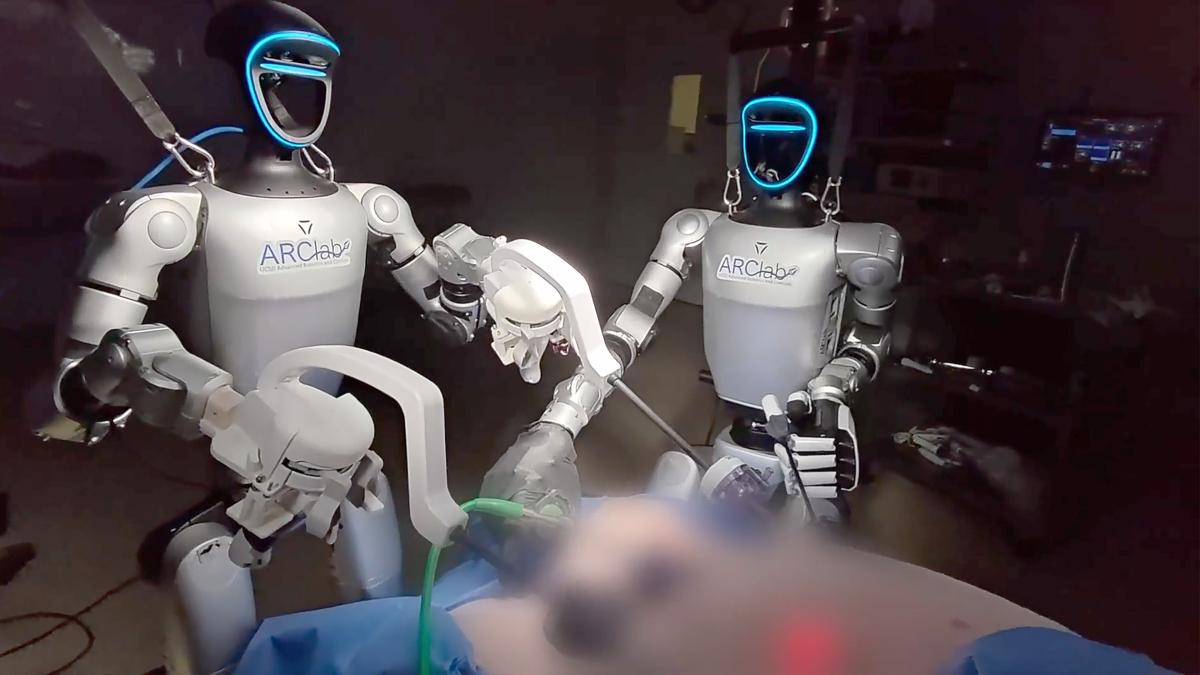
Humanoid robots have reached another significant milestone in the evolution of surgical medicine after researchers successfully used human-like robots to perform live laparoscopic gallbladder removal procedures on pigs, marking the first known instance of humanoid robots participating in live surgical operations. The project, led by researchers at the University of California San Diego, utilized modified Unitree G1 humanoid robots capable of manipulating standard surgical instruments in operating rooms designed for human surgeons rather than specialized robotic systems. Researchers conducted two successful procedures—one involving a robot working alongside a human surgeon and another with two humanoid robots collaborating under remote human control. While the technology is not yet autonomous and still requires frequent recalibration and human oversight, proponents argue the breakthrough could eventually expand access to quality surgical care in rural communities, military environments, disaster zones, and other locations where experienced surgeons are scarce. Supporters also point to the relatively low cost of the humanoid platforms compared with conventional surgical robots. As with virtually every major advance involving artificial intelligence and robotics, however, the achievement also raises important questions regarding patient safety, regulatory oversight, liability, cybersecurity, physician training, and the appropriate balance between technological innovation and human medical judgment.
Sources
- https://nypost.com/2026/07/11/health/human-like-robots-perform-live-surgery-for-the-first-time
- https://www.tomsguide.com/ai/humanoid-robots-just-helped-perform-live-surgeries-for-the-first-time-heres-why-its-a-medical-breakthrough
- https://arxiv.org/abs/2607.07972
Key Takeaways
- • Humanoid robots successfully completed live preclinical gallbladder removal procedures, demonstrating that general-purpose human-like robots can perform sophisticated surgical tasks under physician supervision.
- • Researchers believe lower-cost humanoid platforms could eventually help address physician shortages and expand surgical capabilities in remote, military, emergency, and underserved healthcare settings.
- • Although the technology represents a major engineering achievement, substantial technical, ethical, legal, and regulatory hurdles remain before humanoid robots are likely to perform routine human surgeries independently.
In-Depth
The successful use of humanoid robots in live surgical procedures represents another remarkable step in the rapid convergence of artificial intelligence, robotics, and modern medicine. Unlike conventional robotic surgical systems designed specifically for operating rooms, the robots used in this research were built with human-like anatomy, allowing them to function within environments already designed for physicians. That distinction could eventually lower implementation costs while making robotic assistance available to hospitals that otherwise could not justify purchasing multi-million-dollar specialty platforms.
The implications extend well beyond technological novelty. America, like much of the developed world, faces growing physician shortages, particularly among surgeons willing to practice in rural communities. Researchers argue that remotely operated humanoid robots could eventually place expert surgical capability virtually anywhere reliable communications exist, from isolated hospitals to disaster relief operations and even military deployments. If that promise becomes reality, patients who currently travel hundreds of miles for specialized procedures may someday receive care much closer to home.
Still, enthusiasm should be tempered with realism. The procedures required repeated recalibrations, human supervision remained indispensable, and the robots operated in controlled preclinical settings rather than on human patients. Before widespread adoption, regulators will have to establish rigorous standards governing reliability, cybersecurity, liability, and physician responsibility when robotic systems inevitably encounter unexpected complications.
Innovation has consistently improved medical care over generations, but successful healthcare ultimately depends on accountability and trust as much as technology. Humanoid surgical robots appear poised to become valuable tools rather than replacements for skilled physicians. If future development continues while preserving physician oversight and patient safety as the highest priorities, this breakthrough could become one of the defining advances in twenty-first century medicine.