

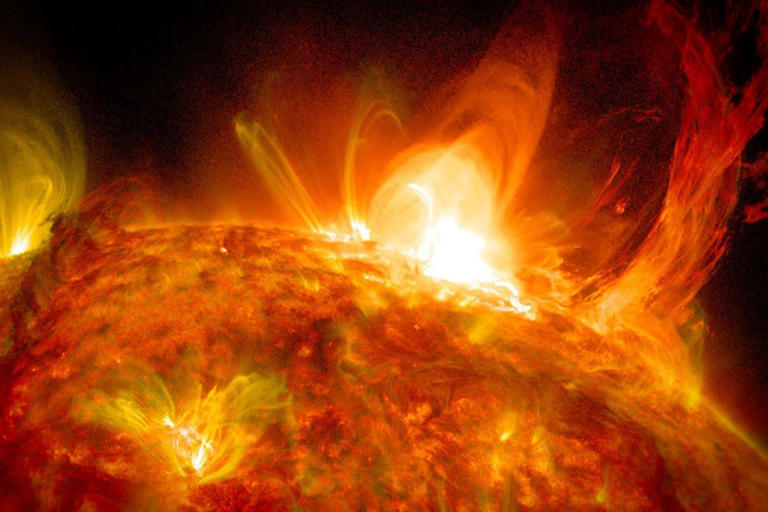
Scientists are advancing an ambitious proposal known as “StormWall,” a theoretical planetary defense system designed to reduce the destructive effects of rare but potentially civilization-disrupting solar superstorms. The concept calls for a constellation of large satellites positioned in geosynchronous orbit that would release ionizable materials such as barium, lithium, or sodium into space just before a major coronal mass ejection reaches Earth. The resulting plasma cloud would temporarily reinforce Earth’s magnetosphere, weakening the incoming storm and helping protect electrical grids, satellites, GPS systems, communications networks, and critical infrastructure. Although the proposal remains in the conceptual stage and would require tens of billions of dollars along with unprecedented international cooperation, researchers argue that the cost is modest compared to the potentially trillions of dollars in economic damage that a Carrington-class solar event could inflict on a technologically dependent civilization.
Sources
- https://www.wsj.com/science/space-astronomy/solar-storm-what-is-stormwall-e2ca1823
- https://www.space.com/astronomy/earth/scientists-propose-spraying-chemicals-into-earths-magnetic-field-to-protect-us-from-powerful-solar-storms
- https://www.forbes.com/sites/jamiecartereurope/2026/07/05/scientists-propose-stormwall-to-stop-a-24-trillion-solar-storm
Key Takeaways
- Scientists believe a space-based plasma shield may be technically achievable using existing or near-future launch capabilities, though enormous engineering and financial hurdles remain before deployment becomes realistic.
- Modern society’s dependence on electricity, satellite communications, GPS navigation, cloud computing, and AI infrastructure makes the economic consequences of an extreme solar storm far greater than during previous centuries.
- The proposal reflects a growing recognition that governments have historically underinvested in protecting critical infrastructure from low-frequency but exceptionally high-impact natural threats, leaving the developed world vulnerable to a catastrophic space-weather event.
In-Depth
For decades, governments have spent vast sums preparing for military threats, cyberattacks, and even climate-related disasters while devoting comparatively little attention to one of nature’s most devastating hazards: an extreme solar superstorm. The StormWall proposal represents an acknowledgment that modern civilization has become extraordinarily dependent on fragile electrical and satellite infrastructure that simply did not exist during historical events such as the 1859 Carrington Event. Today, a comparable solar eruption could disable power transmission, interrupt GPS navigation, cripple financial networks, disrupt military communications, damage satellites, and create prolonged supply-chain failures affecting millions of people.
The proposed solution is undeniably bold. Rather than merely hardening infrastructure on Earth, researchers envision actively reinforcing Earth’s magnetic defenses by releasing specially selected materials into space to create a temporary plasma barrier capable of reducing the energy transferred from an incoming coronal mass ejection. While critics may dismiss the concept as science fiction, many transformative technologies—from reusable rockets to private spaceflight—were once viewed similarly before engineering caught up with imagination.
Whether StormWall is ultimately built or not, the proposal underscores an uncomfortable reality: the world’s technological prosperity increasingly rests upon infrastructure vulnerable to forces entirely beyond human control. Conservatives have long argued that government should prioritize core responsibilities over speculative spending, and protecting the nation’s electrical grid and critical infrastructure from a predictable natural threat falls squarely within that mission. Even if StormWall remains years away, the discussion should encourage policymakers to strengthen grid resilience, improve space-weather forecasting, and ensure the country is better prepared before—not after—the next major solar storm arrives.