

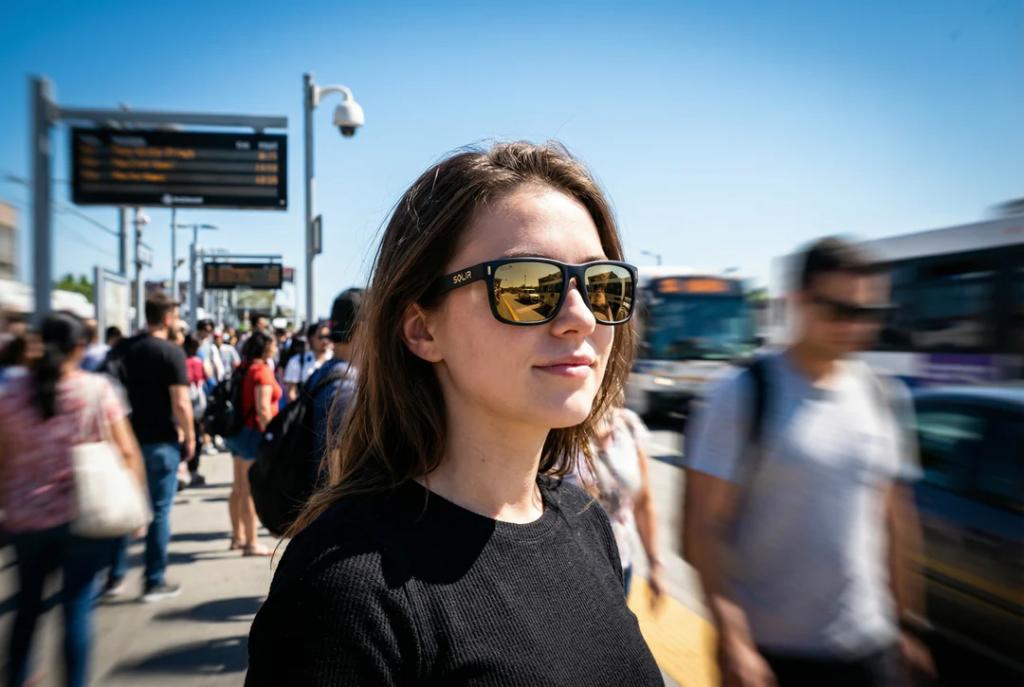
As AI-powered surveillance systems become more sophisticated and increasingly common in public spaces, airports, retail stores, and commercial venues, a growing number of designers are developing “adversarial” fashion intended to interfere with facial-recognition software and biometric tracking. New products range from specialized sunglasses that claim to block infrared and retinal scanning to clothing featuring algorithm-confusing patterns designed to reduce the accuracy of computer vision systems. While researchers caution that no garment can reliably defeat modern surveillance technology under all conditions, proponents argue that these products serve both as practical privacy tools and as visible statements against the rapid expansion of digital monitoring. The movement reflects broader public concerns over the balance between technological convenience, personal privacy, and the growing capabilities of governments and private corporations to collect biometric data.
Sources
- https://nypost.com/2026/07/21/lifestyle/designers-are-producing-adversarial-styles-to-scramble-surveillance-cameras
- https://www.theguardian.com/fashion/2026/jul/17/adversarial-clothing-are-garments-designed-to-confuse-facial-recognition-systems-about-to-go-mainstream
- https://arxiv.org/abs/1904.08653
Key Takeaways
- AI-powered surveillance is driving a new market for clothing and eyewear designed to interfere with facial-recognition and biometric identification systems.
- Although adversarial fashion may disrupt some computer vision systems under certain conditions, experts caution that it is not a guaranteed defense against increasingly sophisticated surveillance technologies.
- The growing popularity of anti-surveillance fashion highlights an expanding public debate over privacy, government monitoring, corporate data collection, and the future limits of biometric identification.
In-Depth
The emergence of adversarial fashion underscores a growing reality of the AI era: technological innovation rarely advances without generating an equally determined effort to preserve personal liberty. As governments, retailers, transportation hubs, and private companies deploy increasingly capable facial-recognition systems, a segment of designers is responding by creating apparel intended to complicate automated identification. Whether through infrared-blocking lenses, disruptive geometric patterns, or optical illusions that confuse computer vision algorithms, these products represent a modern form of privacy advocacy.
From a conservative perspective, the trend reflects a legitimate concern about the unchecked accumulation of surveillance capabilities. Americans have long viewed excessive government monitoring with skepticism, and many are equally wary of private corporations collecting vast amounts of biometric information without meaningful transparency or consent. The combination of AI, ubiquitous cameras, and wearable devices capable of recording virtually everything raises important questions about who owns personal data and how it may ultimately be used.
At the same time, claims surrounding these products deserve careful scrutiny. Academic research has demonstrated that adversarial techniques can reduce the effectiveness of some machine-learning models under controlled conditions, but real-world performance varies considerably as AI systems continue to improve. Designers themselves increasingly acknowledge that these garments should be viewed less as invisibility cloaks than as part of a broader conversation about digital privacy. Regardless of whether anti-surveillance fashion becomes technically decisive, its growing popularity signals that many citizens are no longer willing to accept expanding biometric surveillance as simply another cost of technological progress.