

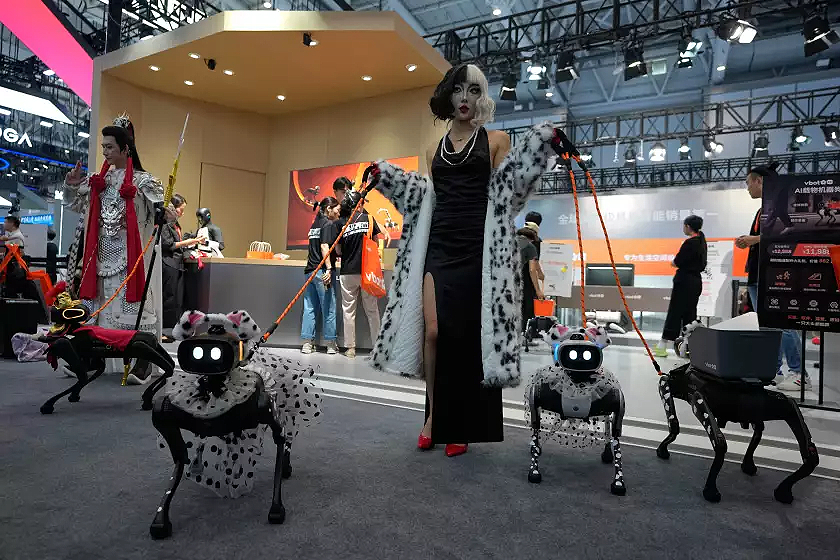
China used the 2026 World Robot Conference in Beijing to showcase its accelerating leadership in humanoid and quadruped robot technologies, presenting thousands of robotic systems ranging from industrial automation platforms to household assistants and robot dogs. While the exhibition emphasized commercial applications and China’s manufacturing strength, it also unfolded against a backdrop of growing U.S. national security concerns over Chinese-made connected robots. The event underscored China’s ambition to dominate a strategic industry while reinforcing the increasingly competitive technological rivalry between Washington and Beijing, where advances in artificial intelligence, robotics, manufacturing, and cybersecurity are becoming inseparable from broader geopolitical competition.
Key Takeaways
- • China continues to expand its dominance in humanoid robotics through large-scale manufacturing, aggressive commercialization, and substantial state-backed investment, placing it well ahead of most global competitors in production volume.
- • The United States increasingly views advanced Chinese robotics as a potential national security concern, with policymakers citing cybersecurity vulnerabilities, supply chain dependence, and the possibility of remote exploitation of connected robotic systems.
- • Although China’s demonstrations showcased increasingly capable humanoid and quadruped robots, industry experts note that widespread commercial adoption will ultimately depend on whether these systems consistently deliver measurable productivity gains rather than impressive demonstrations alone.
In-Depth
China’s latest robotics exhibition served as both a technology showcase and a strategic message to the rest of the world. Hundreds of domestic companies showcased humanoid robots capable of performing warehouse work, assisting in manufacturing, handling household tasks, and participating in public demonstrations that illustrated the rapid pace of Chinese development. The event reflected Beijing’s long-term commitment to robotics as a cornerstone of future industrial competitiveness and economic growth.
The timing of the conference was significant. It followed recent U.S. actions restricting imports of advanced foreign-made humanoid and quadruped robots based on national security concerns. American officials have warned that increasingly sophisticated connected machines could introduce cybersecurity vulnerabilities or deepen dependence on Chinese technology in critical industries. Those concerns have become part of a broader strategy aimed at protecting domestic supply chains while limiting strategic reliance on Chinese technology.
Despite the attention generated by dancing, boxing, and athletic robot demonstrations, the industry’s next challenge is proving sustained commercial value. Manufacturers are increasingly shifting their focus from spectacle to practical applications in logistics, manufacturing, and service industries where automation can reduce labor costs and improve efficiency. Whether China’s current lead translates into long-term global market dominance will depend less on impressive demonstrations than on the ability of these machines to perform reliably, economically, and at industrial scale.