

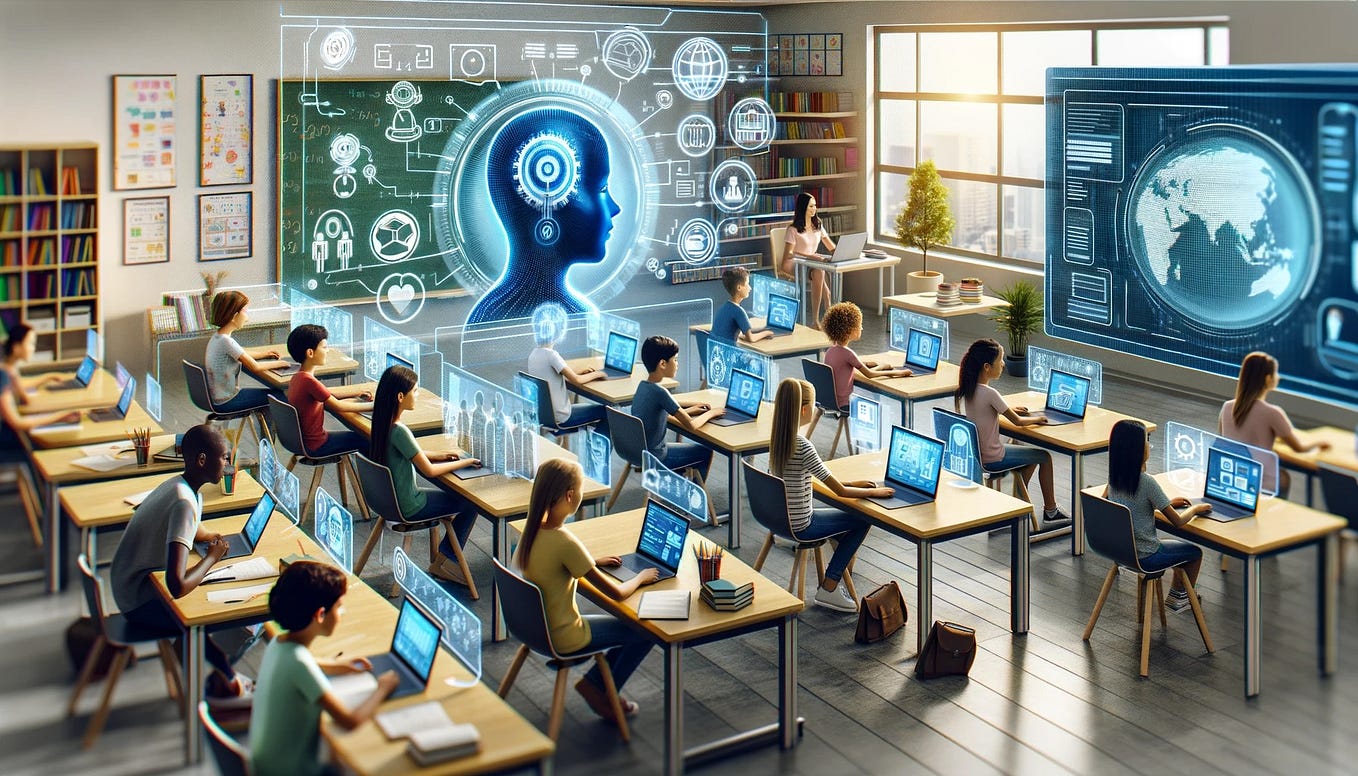
Artificial intelligence presents American higher education with a challenge that is much larger than cheating. Universities can attempt to wall students off from generative AI, or they can recognize the more consequential reality: these tools are rapidly becoming part of the intellectual and economic environment in which graduates will be expected to compete. The proper response is therefore neither unconditional enthusiasm nor prohibition. It is education.
The central argument for integrating AI into higher education rests on a straightforward principle. A university should prepare students for the world they will actually enter rather than preserve an academic environment that no longer exists. Generative AI can research, summarize, analyze, organize, draft, calculate, translate, and assist with programming at speeds that would have seemed extraordinary only a few years ago. Employers are consequently placing increasing value on workers capable of using these systems effectively.
Pretending otherwise does students no favors.
Yet universities have a legitimate reason to worry. Education cannot become a process in which students ask machines to perform the intellectual work they were supposed to learn to perform themselves. A student who submits an AI-generated essay without understanding its argument has learned very little. A future accountant who relies upon AI without understanding accounting, an engineer who cannot independently evaluate a calculation, or a journalist who cannot recognize a fabricated source has not become more capable. He has become dependent.
That distinction should become the foundation of university AI policy.
There is an enormous difference between substitution and augmentation. AI becomes destructive educationally when it substitutes for the development of knowledge, judgment, writing ability, mathematical competence, or critical thinking. It becomes extraordinarily useful when a person who possesses those abilities employs AI to extend them.
This is not an entirely new problem. Calculators did not eliminate the need to understand mathematics. Search engines did not eliminate the value of knowledge. Spreadsheets did not eliminate accounting. Computer-aided design did not eliminate engineering. Each technology changed which skills mattered most while making certain routine activities dramatically easier.
AI is likely to produce the same transformation on a much larger scale.
That means universities should resist two equally misguided temptations. The first is treating AI as inherently corrupting and attempting to prohibit it wherever possible. The second is treating technological adoption as synonymous with progress and allowing students to outsource fundamental intellectual development.
Neither approach constitutes education.
The better objective is AI literacy accompanied by rigorous standards. Students should understand how generative systems operate, where they are useful, where they fail, how they can hallucinate information, how biases can emerge, how sources must be verified, and why human accountability cannot be transferred to an algorithm. They should learn how to formulate sophisticated instructions, interrogate outputs, identify errors, refine results and decide when AI should not be used at all.
Those capabilities increasingly resemble basic professional literacy.
Indeed, the proliferation of AI may ultimately increase rather than diminish the importance of genuine education. When virtually anyone can generate a competent-looking report, presentation, analysis or essay within seconds, the scarce commodity becomes judgment. The valuable employee will not necessarily be the person capable of producing the first draft. It will be the person capable of determining whether that draft is correct, insightful, incomplete or dangerously wrong.
That requires knowledge.
Universities therefore have an opportunity to restore something higher education has sometimes undervalued: mastery. Students cannot intelligently supervise artificial intelligence in fields they do not understand. The less human beings know, the more easily they can be deceived by confident machine-generated errors. AI literacy without subject-matter expertise risks creating graduates who are technologically sophisticated but intellectually vulnerable.
Academic integrity must consequently remain nonnegotiable. Universities should continue requiring students to demonstrate independent competence. There are obvious circumstances in which AI should be prohibited: examinations designed to measure individual knowledge, foundational writing exercises, mathematical work intended to demonstrate comprehension, and other assignments whose purpose is developing rather than merely producing.
But prohibition should be purposeful rather than reflexive.
In advanced coursework, students might instead be required to use AI and then defend the results. A professor could require students to identify hallucinations, improve an AI-generated argument, compare machine analysis against primary sources, document their prompts, explain their revisions, or orally defend conclusions reached with AI assistance. Such assignments would make cheating considerably less attractive because understanding would remain indispensable.
This approach also reflects a broader conservative principle: technology should remain the servant of human beings rather than become their master.
AI should increase human agency, productivity and opportunity. It should not encourage intellectual passivity. Universities should produce graduates capable of commanding these systems rather than graduates conditioned to obey whatever appears on a screen.
There is also a national interest involved. Artificial intelligence is becoming intertwined with economic productivity, scientific research, manufacturing, medicine, finance, defense and virtually every major competitive industry. A country whose educational institutions hesitate to teach emerging technologies because they complicate existing academic practices risks surrendering advantages to nations that do not share that hesitation. The original argument correctly connects AI proficiency with America’s broader economic competitiveness.
The answer, however, cannot simply be “more AI.” It must be better education for an AI age.
Universities should preserve the timeless purposes of education—knowledge, reason, intellectual discipline, ethical judgment and the pursuit of truth—while recognizing that the instruments available for pursuing those objectives have changed.
The printing press changed education. The calculator changed it. Personal computers changed it. The internet transformed it again. Artificial intelligence represents another such transition, although potentially a far more profound one.
Higher education will not protect students by pretending the transition can be stopped.
Its responsibility is harder than that.
Universities must teach students when to use AI, how to use it, when to distrust it, when to reject it and, most importantly, how to think without it. The graduate who can do both—reason independently and command powerful technological tools—will possess a considerable advantage over the graduate who can do only one.
The question facing higher education, then, is not whether artificial intelligence belongs on campus. It is already there. The real question is whether universities will shape its use according to enduring standards of scholarship, responsibility and human judgment, or spend the coming years fighting a technology their graduates will encounter the moment they leave.
Education has never been served by preparing young people for a world that has already disappeared. The prudent course is to preserve what is permanent while mastering what is new.