

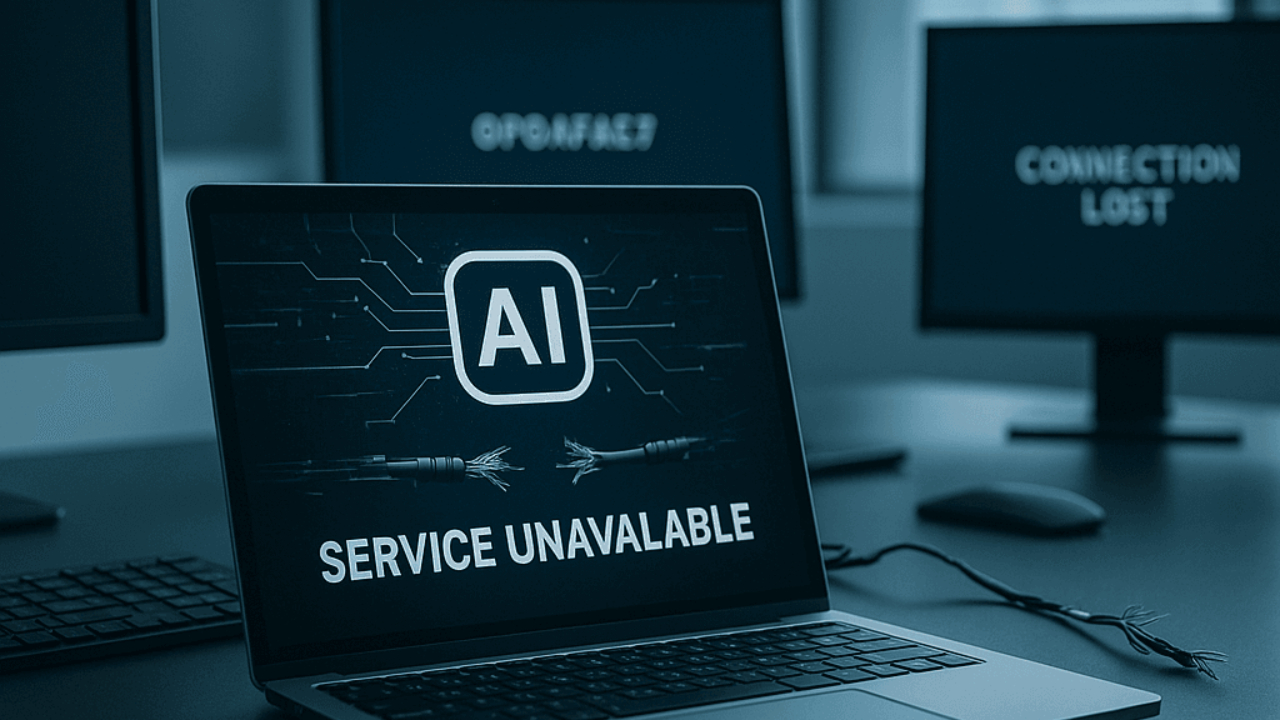
Artificial intelligence is rapidly becoming less of a technological novelty and more of an economic utility. Businesses increasingly rely on AI to write software, analyze data, answer customer questions, detect fraud, manage inventory, generate advertising, summarize documents, conduct research, and make countless routine decisions. That transformation promises enormous gains in productivity. But it also creates a vulnerability that has received considerably less attention: What happens when the AI simply stops working?
The question matters because the modern economy has already learned this lesson with other technologies. When electricity fails, businesses stop. When cellular networks collapse, communications become difficult. When cloud-computing platforms experience major outages, thousands of otherwise unrelated companies can suddenly lose access to essential applications. AI could eventually create an even more concentrated dependency because it is being integrated not merely into communications infrastructure, but into the intellectual processes by which businesses operate.
Imagine a law firm in which attorneys routinely use AI to search documents, summarize depositions, organize discovery, and produce first drafts. Or consider an insurance company where artificial intelligence evaluates claims, identifies suspicious activity, and prioritizes cases for human review. A hospital may rely on AI-assisted systems for scheduling, documentation, imaging analysis, and administrative functions. Software companies increasingly employ AI coding assistants. Customer-service departments are replacing traditional workflows with AI agents capable of handling thousands of inquiries simultaneously.
Now remove the AI.
The immediate problem would not necessarily be catastrophic. Human beings performed these jobs before artificial intelligence existed, after all. The more serious problem is that organizations gradually restructure themselves around technologies they expect to always be available.
A company employing 500 customer-service representatives might discover that AI allows it to operate with 100 employees supervising automated systems. That represents a substantial productivity gain. But the remaining 100 employees cannot suddenly perform the work of 500 people when the AI provider suffers a six-hour outage. The company has eliminated much of its human redundancy precisely because the technology made that redundancy appear unnecessary.
This is where efficiency and resilience begin pulling in opposite directions.
For decades, American business culture has understandably pursued efficiency. Companies minimized inventories through just-in-time supply chains, consolidated vendors, outsourced specialized functions, moved computing infrastructure into centralized cloud environments, and eliminated excess staffing. These decisions frequently lowered costs and increased productivity.
But redundancy that appears wasteful during normal operations can become invaluable during emergencies.
AI may accelerate the same tendency on a remarkable scale. Businesses could eventually eliminate not only excess physical capacity but also excess cognitive capacity. Employees may cease practicing certain skills because machines perform those tasks faster and better. Younger workers might never acquire them in the first place.
The danger, therefore, is not simply that an AI outage leaves employees temporarily without a convenient tool. It is that organizations eventually lose the institutional ability to operate without it.
Consider what has happened with navigation. A driver accustomed to GPS can function perfectly well until the system disappears. Someone who has relied exclusively on GPS for years, however, may possess considerably weaker navigational instincts than a driver who learned to travel using maps, landmarks, and memory. Technology has not merely provided assistance; it has displaced a skill.
Artificial intelligence could produce that phenomenon across entire professions.
Accountants could become less practiced at performing certain analyses manually. Programmers might become less accustomed to writing routine code without assistance. Researchers could lose familiarity with traditional information-gathering methods. Managers accustomed to AI-generated reports may become dependent upon automated interpretation of company data.
The longer AI works reliably, paradoxically, the greater this vulnerability could become.
There is another problem: concentration.
If thousands of companies build essential operations around a relatively small number of AI providers, an outage at one company could ripple across otherwise unrelated industries. A technical failure would no longer remain confined to the technology company experiencing it. Banks, retailers, manufacturers, publishers, medical offices, government agencies, logistics companies, and professional-services firms could all experience disruptions simultaneously.
The economic consequences would depend upon duration. A fifteen-minute interruption might amount to little more than an inconvenience. Several hours could create significant backlogs. A multi-day disruption involving a major AI platform could become something altogether different.
Businesses might discover that their contingency plans were designed for computer failures but not intelligence failures.
That distinction will become increasingly important as AI agents gain greater autonomy. Traditional software generally performs predefined functions. An AI agent may coordinate multiple functions: reading incoming communications, deciding what requires attention, accessing databases, generating responses, scheduling actions, and escalating unusual cases to employees.
When such an agent disappears, the organization does not merely lose software. It loses something resembling a layer of its workforce.
This does not constitute an argument against artificial intelligence. Quite the opposite. AI’s extraordinary usefulness is precisely why dependency deserves serious consideration. Civilization does not develop contingency plans for technologies that do not matter.
The sensible response is therefore neither panic nor government micromanagement. It is resilience.
Companies integrating AI into critical operations should identify which functions must continue during an outage and maintain realistic fallback procedures. Employees responsible for essential operations should retain enough knowledge to perform critical tasks manually. Businesses heavily dependent on a single AI provider should consider whether alternative systems can be maintained for emergencies. Regular exercises could determine whether supposedly adequate backup procedures actually work.
Corporate boards may eventually need to treat AI continuity much as they currently treat cybersecurity, disaster recovery, and business continuity.
Markets will probably encourage this development on their own. Insurance companies may demand AI-continuity plans before underwriting certain risks. Customers may require vendors to demonstrate redundancy. Investors may begin asking companies how much revenue would be lost if their primary AI platform were unavailable for 24 or 72 hours. Competing AI providers may advertise interoperability and emergency failover as selling points.
The larger lesson is an old conservative one: efficiency should never be confused with resilience.
A system stripped of every redundancy may look wonderfully efficient right until something breaks. Families understand the value of emergency savings. Militaries maintain reserve capacity. Communities keep emergency generators. Businesses maintain backup data because experience teaches that important systems eventually fail.
Artificial intelligence should be approached with the same practical wisdom.
The greatest danger may not be that AI becomes too powerful. In ordinary economic life, a much more mundane possibility deserves attention: AI becomes so useful, reliable, and ubiquitous that society forgets how much it depends upon it.
Then, one ordinary morning, the machine goes dark.