

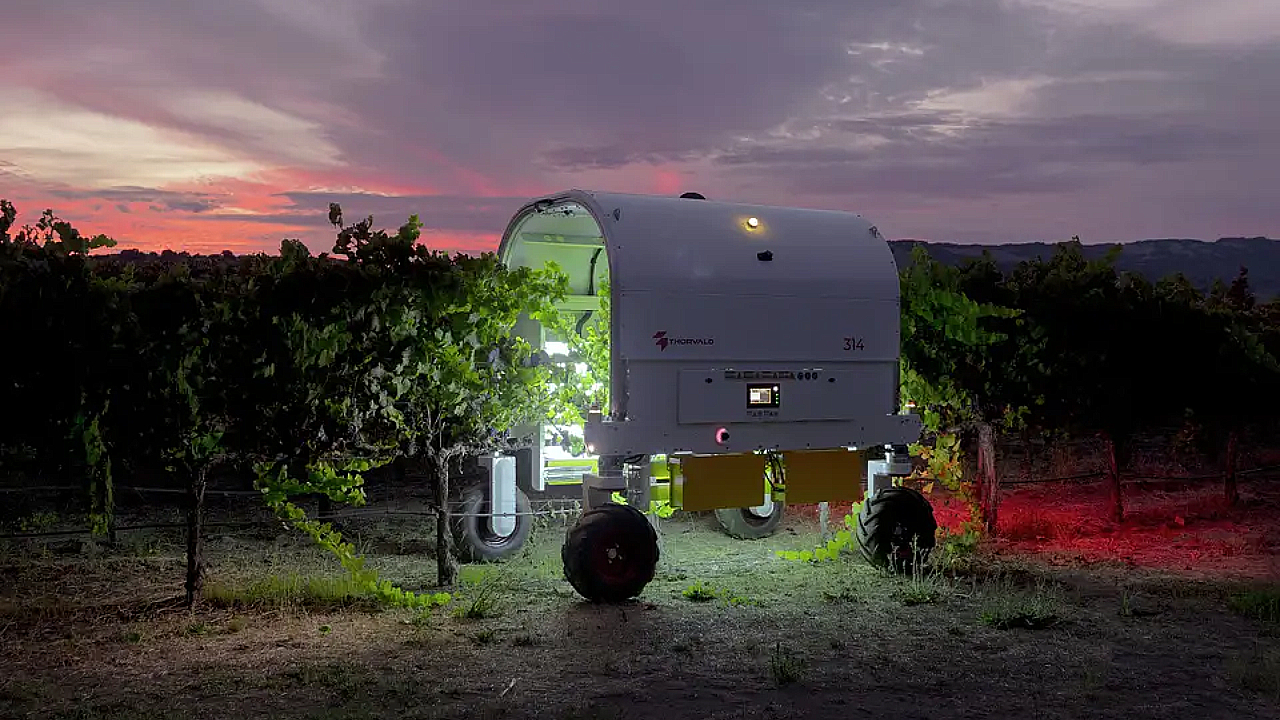
California wine growers are testing Thorvald, a lightweight autonomous electric robot that patrols vineyards after dark and uses concentrated UV-C light to combat powdery mildew, one of the industry’s most persistent fungal threats. The 900-pound machine offers an alternative to repeated tractor-applied sulfur and fungicide treatments, potentially reducing chemical use, soil compaction, emissions and labor requirements. More than 100 Thorvald robots have been deployed across 27 California vineyards, with about 2,600 acres expected to receive treatment this year. Yet despite promising field results and years of supporting research into nighttime UV treatment, California regulations dating to 1977 continue to restrict fully autonomous agricultural machinery, requiring human oversight and potentially slowing adoption of a technology specifically designed to reduce agricultural inputs and improve efficiency.
Key Takeaways
- Thorvald attacks powdery mildew with nighttime UV-C light, exploiting a biological vulnerability in the fungus and potentially allowing vineyards to sharply reduce conventional sulfur and fungicide applications.
- The technology is moving beyond experimentation: more than 100 robots have reportedly been deployed across 27 California vineyards, while an upgraded vineyard-oriented model is expected to cost approximately $125,000.
- California’s decades-old rules governing driverless farm machinery remain a significant obstacle to full autonomy, creating tension between the state’s environmental goals and regulations that restrict newer technologies capable of reducing chemicals, emissions and heavy-equipment use.
In-Depth
California vineyards are testing Thorvald, a 900-pound electric robot that travels vine rows at night and uses concentrated UV-C light to attack powdery mildew, a fungal disease that can damage grapes and degrade wine quality. The technology offers growers an alternative to repeated sulfur and fungicide applications, while reducing tractor weight, noise, soil compaction and dependence on drivers. More than 100 robots are reportedly operating across 27 California vineyards, with roughly 2,600 acres scheduled for treatment this year.
The science behind the system is clever. Powdery mildew possesses mechanisms that repair ultraviolet damage when exposed to blue light. Nighttime UV-C treatment exploits the fungus when that repair mechanism is less effective, allowing low ultraviolet doses to disrupt the pathogen without damaging vines. Earlier university research demonstrated the approach, while current commercial trials are testing whether it can work reliably at vineyard scale.
The larger obstacle may be government rather than engineering. California rules dating to 1977 generally prevent agricultural machinery from operating autonomously without an operator, even though modern robots bear little resemblance to old tractors that prompted the regulation. Thorvald therefore still requires remote human oversight.
That creates an awkward contradiction. California policymakers encourage reduced chemical use, lower emissions and technological innovation, yet an old regulatory framework can restrict equipment designed to advance those goals. At approximately $125,000 per upgraded unit, economics already impose a substantial market test. Growers should be free to determine whether the technology earns its keep, provided modern safety standards protect workers and neighboring property.