

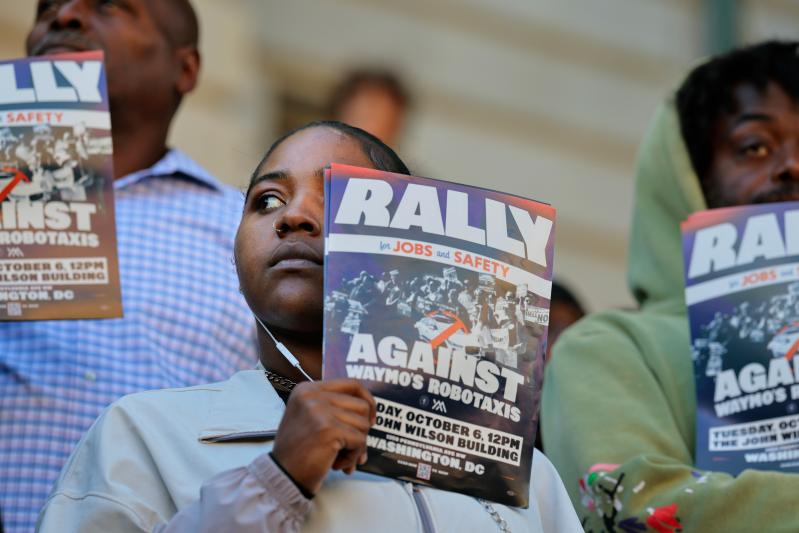
A proposal to introduce commercial driverless taxis in Washington, D.C., has ignited protests from labor unions, rideshare drivers, and community leaders concerned that autonomous vehicles could eliminate thousands of transportation jobs. The Autonomous Vehicle Deployment Authorization Amendment Act of 2026, introduced by Councilmember Charles Allen, would establish a regulatory framework allowing companies such as Waymo to begin commercial operations as early as 2028, initially limiting deployment to 200 vehicles. Demonstrators gathered outside the John Wilson Building on October 6, warning that replacing human drivers with artificial intelligence threatens working families and neighborhood economies. Supporters counter that autonomous transportation could improve road safety, increase consumer choice, and create new employment opportunities. The controversy underscores a growing national challenge: balancing technological innovation and free-market competition against the economic disruption automation can impose on established workers.
Key Takeaways
• Workers Fear Displacement: Labor unions and rideshare drivers warn that autonomous taxis could eliminate driving jobs and reduce income for families already struggling with rising living costs.
• Safety and Competition Drive Support: Advocates cite autonomous vehicle safety data, increased transportation options, and potential consumer benefits, although lower fares are not guaranteed.
• Regulation Could Shape the Industry: Proposed restrictions include an initial 200-vehicle cap, extensive testing requirements, permit fees, and financial provisions intended to assist displaced workers.
In-Depth
Washington, D.C., has become the latest battleground in America’s accelerating transition toward artificial intelligence and automation. A proposal allowing commercial robotaxis has prompted organized opposition from labor unions and rideshare drivers who fear technology could replace their livelihoods.
The legislation, introduced by Councilmember Charles Allen, would authorize commercial autonomous vehicle operations under District Department of Transportation oversight. Its initial framework limits deployment to 200 vehicles and requires substantial testing before companies can begin transporting paying passengers.
Opponents argue that replacing human drivers threatens household incomes, particularly among workers who depend on rideshare earnings to supplement other employment. Union representatives insist that affected workers deserve meaningful participation in decisions that could reshape their industry.
Supporters emphasize the potential benefits of innovation. Autonomous vehicles could reduce crashes, expand transportation access for disabled passengers, and introduce additional competition into a market dominated by established rideshare companies. Waymo has also pledged to create local maintenance, fleet management, and technical employment opportunities.
Nevertheless, legitimate questions remain about consumer pricing, vehicle safety, liability, and whether newly created positions could offset displaced driving jobs.
The broader controversy raises a fundamental economic question: Should government restrict emerging technology to preserve existing employment, or establish reasonable safety standards while allowing consumers and businesses to determine its commercial viability?
American economic history demonstrates that technological advancement frequently eliminates certain occupations while creating others. Yet those transitions can impose substantial hardships on individual workers and communities.
Washington’s challenge is therefore to develop transparent, enforceable safety regulations without unnecessarily protecting established industries from competition, while recognizing that technological progress does not automatically guarantee prosperity for everyone affected.
Sources
• https://www.fox5dc.com/news/local-unions-rally-against-proposed-dc-robotaxi-bill
• https://www.axios.com/local/washington-dc/2026/09/25/waymo-robotaxi-dc-bill-opposition-rally
• https://reason.com/2026/10/08/d-c-wants-to-protect-ride-share-jobs-riders-could-pay-the-price/
• https://www.axios.com/local/washington-dc/2026/07/13/waymo-robotaxis-dc-jobs-council-vote/