

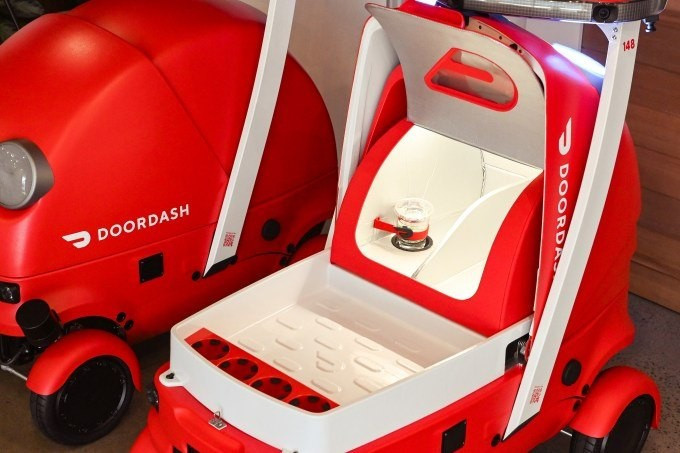
DoorDash this week introduced Dot, its first in-house autonomous delivery robot capable of navigating roads, bike lanes, sidewalks, and driveways at speeds up to 20 mph while carrying up to 30 lbs—enough for six pizza boxes. The company says Dot is already undergoing trials in the Phoenix area with plans to scale regionally by year’s end, positioning the bot as a complement (not a replacement) to human Dashers. Meanwhile, DoorDash also continues to expand its partnership with Coco Robotics to deploy sidewalk bots in markets like Los Angeles and Chicago, part of its broader “Autonomous Delivery Platform” strategy integrating robots, drones, and human delivery. As the company ventures deeper into robotics, it faces hurdles such as safety, regulation, public acceptance, and the engineering complexities of mixed-mode navigation across roads and sidewalks.
Key Takeaways
– DoorDash is shifting from being purely a delivery marketplace to owning more of its logistics stack by building Dot and launching its Autonomous Delivery Platform.
– The company is pursuing a hybrid, multi-modal model—robots, drones, and humans—that assigns the best delivery mode per order.
– Major challenges remain: safety in mixed environments, regulatory buy-in, vandalism and public trust, and real-world robustness.
In-Depth
DoorDash is taking a bold turn in its evolution by building its own autonomous delivery vehicle, Dot, and rolling it out in the Phoenix area as a proof-of-concept for what it hopes becomes a scalable system. Dot is designed to bridge gaps that existing delivery options struggle with: it can travel on roads, bike lanes, sidewalks, and driveways, thus reducing reliance on cars for short, suburban “last-mile” trips. This flexibility is a strategic bet—DoorDash wants to control not just the platform that connects merchants and customers but also the hardware that actually moves goods.
In its public rollout, Dot is limited to early-access tests in Tempe and Mesa, with full rollout across the Phoenix metro to come by end of 2025. The robot weighs about 350 pounds, stands under five feet tall, moves at up to 20 mph, and is engineered to carry ~30 lbs, the company says. Its design is intentionally friendly and expressive—with LED “eyes,” a red shell, and a swing-open “mouth” cargo compartment—to soften its reception among people and restaurant staff. More critically, Dot is managed through DoorDash’s new Autonomous Delivery Platform, which acts as a dispatcher, routing orders to the optimal delivery mode: human Dashers, Coco or Dot robots, or drones. That platform allows DoorDash to leverage data and operational control across modes rather than outsourcing its autonomous ambitions.
That said, the road ahead is full of risks. The mixed terrain that Dot must negotiate—roads, sidewalks, driveways, curbs, pedestrians, bicycles, vehicles, even pets—presents complex real-world challenges. Safety is paramount; DoorDash insists Dot will defer to pedestrians and cyclists, and if it encounters a situation it can’t resolve, it will pull over and wait rather than rely on human teleoperation. And vandalism is a practical concern, especially since small robots are vulnerable to tipping or interference. Regulatory hurdles loom at the city level, as local municipalities must permit robots on roads or sidewalks. Moreover, public acceptance may lag technological readiness: people may still prefer human delivery or mistrust autonomous bots in personal spaces.
In parallel, DoorDash is expanding its sidewalk robot strategy via partnership with Coco Robotics. That system has already processed more than 100,000 deliveries, and is live in Los Angeles and Chicago across ~600 merchants. Coco bots are more limited (sidewalk-bound) but proven in their domain; by contrast, Dot attempts to expand the operating envelope. The combination helps DoorDash explore which mode works best under different geographies and densities.
Strategically, this move signals DoorDash’s intent to deepen margins. If Dot and the Autonomous Delivery Platform succeed, DoorDash could reduce reliance on third-party robotics or hardware providers and capture more value per delivery. But the financial investment is large, and failure is not out of the question—robot delivery experiments have faltered in the past. Still, if DoorDash can knit the tech, operations, and local regulation into a reliable system, it may reshape consumer expectations about how quickly, cheaply, and quietly local goods arrive.