

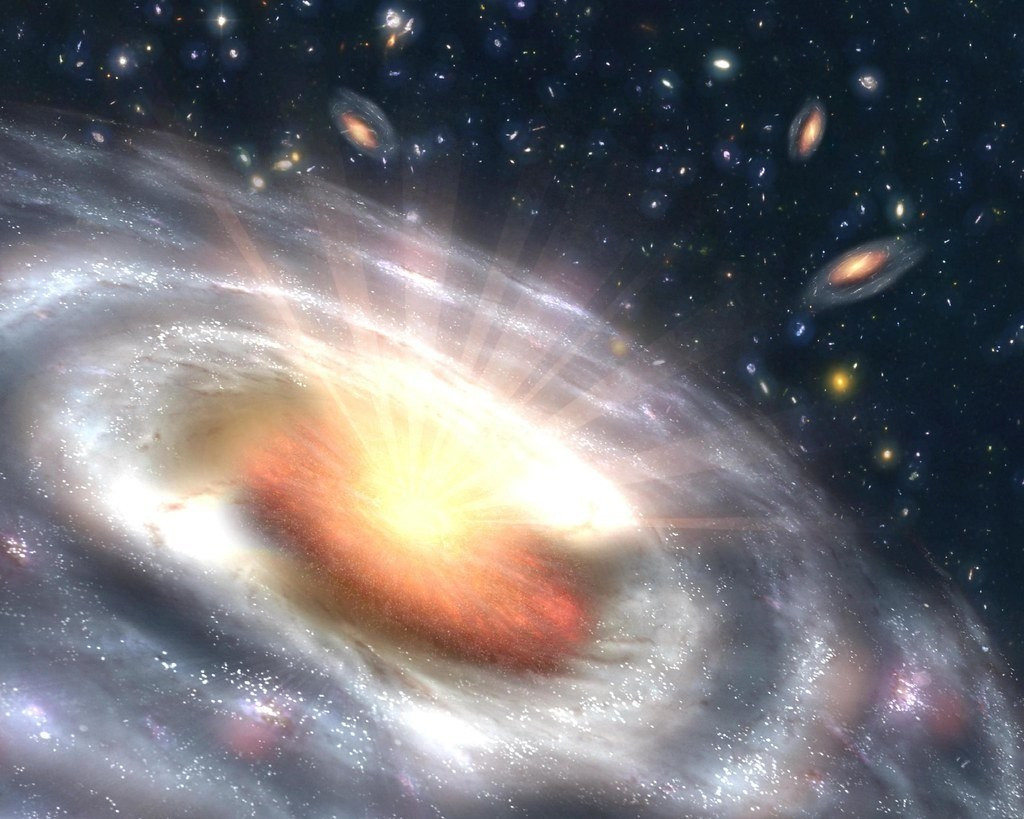
Astronomers may have finally caught evidence of a long-hypothesized “wind” blowing out from Sagittarius A*, the supermassive black hole at the center of our galaxy, in the form of a cone-shaped clearing in surrounding cold gas. According to a new paper based on deep ALMA observations, the cold molecular gas closest to Sgr A* shows a distinctive conical cavity rather than being uniformly distributed, consistent with a hot plasma wind that has carved a path outward. This discovery helps resolve a decades-old mystery about why the anticipated outflows from our galaxy’s core had not been clearly seen before. The new results are detailed in the research paper “The Discovery of a Large Active Wind from the Milky Way’s Central Black Hole.”
Sources: Science.org, The Verge
Key Takeaways
– The cold molecular gas distribution around Sagittarius A* reveals a cone-shaped gap extending at least ~1 parsec with ~45° opening angle, interpreted as the imprint of a hot outflow clearing the cold gas.
– This discovery provides the strongest direct evidence yet of a galactic nucleus wind from our own galaxy, closing a long-standing observational gap in our understanding of Sgr A*’s feedback.
– Understanding this wind is crucial for models of how supermassive black holes influence their host galaxies, particularly in regulating star formation and gas flows near the galactic center.
In-Depth
For years, astronomers have theorized that supermassive black holes should not only swallow matter but also expel energy and material outward in winds or jets, affecting the surrounding galactic environment. In many distant active galaxies, we see spectacular jet structures or winds. But in our own Milky Way, Sgr A* has appeared relatively quiet and passive — so much so that one mystery lingered: where is the wind? Why had we not detected the expected outflows directly?
The new research, led by Mark D. Gorski and Elena Murchikova among others, uses very deep observations from the Atacama Large Millimeter/submillimeter Array (ALMA) to map the cold molecular gas around the Galactic Center with exquisite resolution. What they found is striking: instead of gas filling the region around Sgr A*, there is a cone-shaped cavity devoid of cold dense gas. The shape and orientation strongly suggest that a hot plasma wind has pushed aside the cold gas along a preferred axis, carving out the cone. The cavity stretches at least about one parsec from the black hole, with an opening angle of roughly 45 degrees. The morphology and inferred energetics align with theoretical expectations for a nuclear wind clearing its surroundings.
This is compelling because it directly connects the observational signature with modeled black hole feedback processes. Previous indirect hints — such as X-ray emission, outflowing hot gas, or disrupted molecular clouds — hinted at activity, but lacked the clear geometry tied to a wind. The new study helps reconcile the apparent lack of a wind in the Milky Way with theory: the wind was hidden in the cold gas morphology until high enough resolution and sensitivity could resolve its imprint.
Why does this matter? Because such winds play a major role in galaxy evolution theories. They can suppress star formation in the central regions by sweeping out gas, regulate how efficiently the black hole accretes matter, and shape the interplay between a galaxy’s nucleus and its larger structure. In the Milky Way, now we have a laboratory close at hand to study these feedback effects in detail. Going forward, astronomers will probe how this wind is driven (magnetic fields? radiation pressure? disk instabilities?) and how it interacts with the multiphase gas (hot, warm, cold) in our central region. The discovery fosters a more coherent picture: even in a seemingly quiet galaxy, black hole-driven winds are real and influential.