

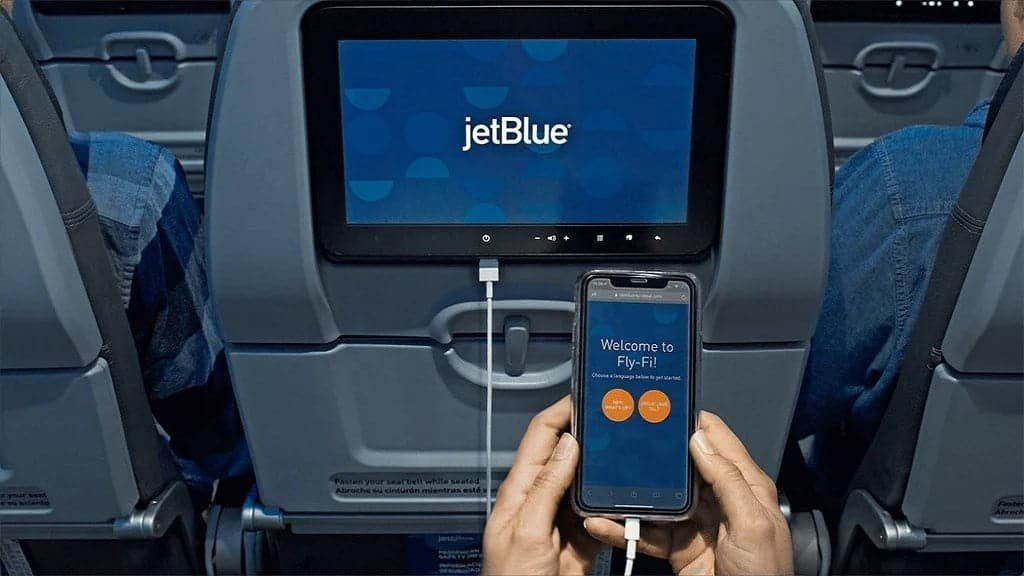
JetBlue Airways has struck a first-of-its-kind deal with Amazon‘s Project Kuiper to enhance its popular Fly-Fi service, bringing free, low-latency, high-speed internet to select aircraft—up to 1 Gbps downloads—beginning in 2027. Unlike traditional geostationary (GEO) satellite systems, Kuiper uses a low Earth orbit (LEO) network—which includes over 100 satellites launched so far, with plans for a constellation of more than 3,200—to deliver faster, more reliable connectivity. JetBlue will continue offering its current Viasat-powered free Wi-Fi while also integrating Kuiper to create a hybrid network for stronger coverage and redundancy. This move positions JetBlue as the first airline to adopt Amazon’s satellite internet solution amid growing in-flight connectivity competition with providers like SpaceX‘s Starlink.
Sources: Reuters, Wall Street Journal, TechCrunch
Key Takeaways
– Game-Changing Connectivity: Leveraging Kuiper’s LEO satellites means JetBlue can offer passengers significantly higher speeds (up to 1 Gbps) and lower latency than traditional GEO-based Wi-Fi.
– Hybrid Network Strategy: JetBlue plans to operate both Kuiper and Viasat GEO services, balancing coverage and reliability to ensure seamless in-flight connectivity.
– First-Mover Advantage: As the first airline to partner with Project Kuiper, JetBlue gains a technology edge—helping it stay competitive amid Starlink’s rapid expansion.
n-Depth
JetBlue is doubling down on its long-standing commitment to free, reliable in-flight Wi-Fi by striking a pioneering deal with Amazon’s Project Kuiper. Beginning in 2027, select JetBlue aircraft will feature Kuiper-powered Fly-Fi capable of delivering download speeds up to 1 Gbps—an order of magnitude faster than the typical 250 Mbps cap of competing systems like Starlink.
This move taps into the advantages of low Earth orbit (LEO) connectivity, offering both lower latency and better performance over regions that GEO systems struggle to cover. With over 100 Kuiper satellites already in orbit—and a full constellation of 3,200 planned—the service is gearing up for broader launch even amid earlier delays.
JetBlue, which has been offering free Wi-Fi fleet-wide since 2013, isn’t replacing its existing Viasat system. Instead, it’s adopting a hybrid model: Kuiper will augment Viasat’s GEO-based Fly-Fi network to boost reliability and capacity during high-traffic flights or in hard-to-reach areas.
This agreement positions JetBlue at the forefront of satellite-powered, complimentary in-flight connectivity. As the first airline to roll out Kuiper service, it gains a head start and likely competitive advantage—especially as rival systems like SpaceX’s Starlink expand through deals with United and Hawaiian Airlines.
For passengers, this means smoother streaming, video calls, and browsing experiences that feel more like ground-based internet. And it underlines Amazon’s growing ambitions in telecommunications, further diversifying its reach beyond retail and cloud computing.