

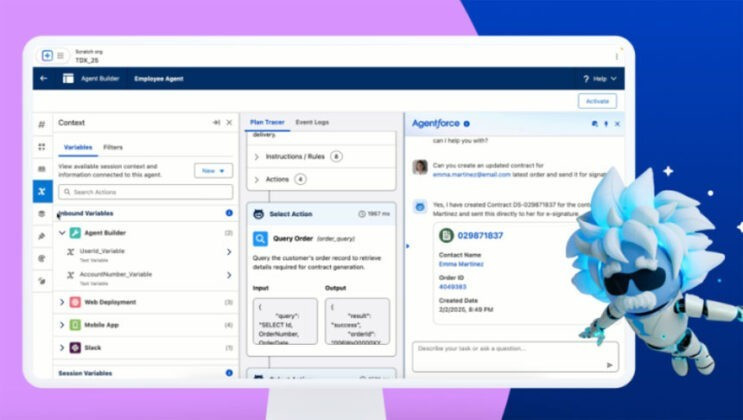
Salesforce has introduced Agentforce Vibes, a new “vibe-coding” offering intended to let developers describe what they want in plain language, with AI agents (like Vibe Codey) handling the actual code generation and integration within the Salesforce ecosystem. The system is designed for enterprise use, with built-in governance and security, leveraging a company’s prior codebase and policies. To sweeten the deal, Salesforce is offering a base level of usage (50 AI requests per org per day via GPT-5, with overflow handled by a Salesforce-hosted Qwen 3.0 model) for its current customers, with paid tiers expected later. The move solidifies Salesforce’s strategy to embed agentic AI into business workflows, following its Agentforce suite, and positions it to compete in the emerging vibe-coding space against startups and other platform vendors.
Sources: Salesforce, Tech Monitor
Key Takeaways
– Salesforce’s Agentforce Vibes aims to bring vibe coding into enterprise settings by coupling natural-language prompts with AI agents that generate production-grade code under corporate guardrails.
– The offering builds on Salesforce’s existing AI/agent roadmap (Agentforce, AgentExchange) and reuses existing code and policies to lower adoption friction.
– While vibe coding promises faster development and democratization of app creation, critics warn of security, maintainability, and debugging risks in enterprise environments.
In-Depth
Salesforce’s roll-out of Agentforce Vibes represents a turning point in how large organizations might adopt “vibe coding” — the idea that you can tell an AI what you want in everyday language, let it generate the logic, wiring, and deployment, and focus human effort on higher-level validation and oversight.
The heart of Vibes is Vibe Codey, an AI agent tightly integrated with a company’s existing Salesforce setup. Because it understands the company’s prior code, security models, naming conventions, and architecture constraints, Vibe Codey can generate new features more safely than a generic AI might. Salesforce claims this embedding effect gives enterprise customers “the best of both worlds” — the agility of AI-driven development, with the governance and control enterprises expect. In practice, early users get 50 free AI-agent requests per Salesforce org daily through GPT-5, with overflow shifting to a Salesforce-hosted Qwen 3.0 model; future paid tiers will expand limits and capabilities.
This launch is far from Salesforce’s first foray into AI agents. Its Agentforce platform — announced in 2024 — already offered autonomous agents that execute tasks across sales, service, and marketing workflows. Meanwhile AgentExchange, introduced earlier this year, serves as a marketplace for third-party agents that plug in to Salesforce’s AI ecosystem. In that light, Vibes is a logical extension: enabling enterprise teams not just to use agents but to instruct them in code creation. The announcement also comes during a broader surge in enterprise interest in vibe coding. Tools like Replit have teamed up with Microsoft to bring natural-language app building to Azure customers; analysts forecast that by 2028, up to 40 percent of new enterprise code may originate from AI-assisted methods. But the road ahead is rocky.
On the upside, vibe coding promises to shift software creation into a more iterative, conversational space. Business users, product designers, or internal operations staff—rather than only engineers—could prototype functional tools quickly, without the full handoff to developers. That speeds innovation and reduces delay. But critics point out that AI-generated code is prone to flaws: security vulnerabilities, logic bugs, unclear architecture, and difficult debugging. In large deployments, those risks compound. Some caution that what seems like a shortcut early on can become long, costly technical debt later. There’s also the cultural challenge: developers may resist ceding control, and organizations must evolve roles from coders to testers, validators, and orchestrators of AI agents.
Salesforce is trying to strike balance: it embeds compliance and governance, reuses existing code, and limits access in early phases. If it can avoid the pitfalls others face, Agentforce Vibes could accelerate the adoption of AI-native software workflows in enterprises. But success will hinge on whether organizations can maintain trust, manage risk, and evolve their tooling and practices to this new paradigm.